
















































EdgeX Token Drops 70% in One Hour as Team Looks Into Price Anomaly
The EdgeX token (EDGE) fell 70% in about an hour. Not normal. Not even close. A move that sharp makes traders reload the chart, check the exchange feed, and ask the ugly question first: was this a dump, a system failure, or just an order book with almost no real depth behind it?
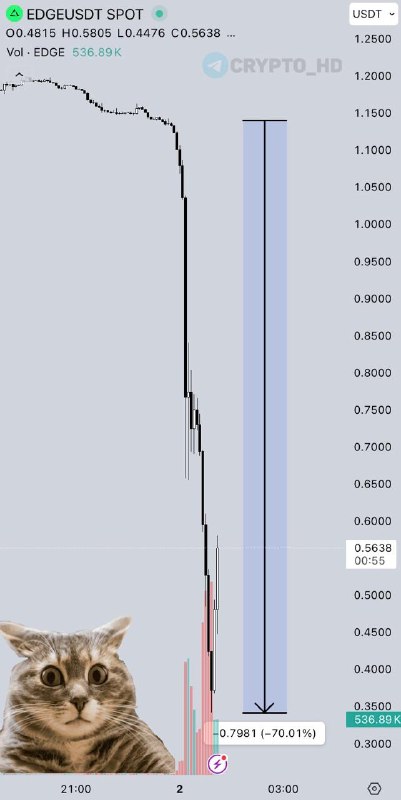
The EdgeX team said it is “расследует причину аномального ценового движения EDGE” (investigating the cause of the anomalous price movement of EDGE). I’ll be honest: until the team explains the mechanics, the market will fill in the blanks. A large holder may have sold into weak bids. A smart contract issue may be involved. Liquidity may simply have vanished at the worst possible moment. Most guides say crashes need a single clean cause. That’s only half right. In smaller tokens, the cause is often a stack of bad conditions hitting at once.
The EDGE crash is only one token, but traders rarely isolate a 70% drop in 60 minutes as “just one chart.” Why does this matter? Because one broken low-cap market can make people reprice the whole risky end of crypto. In DeFi and thin altcoin names, depth can look fine until the first serious sell order hits. We saw something similar in February 2023, when the SEC moved against staking services. Bitcoin (BTC) rose 4%, while many smaller altcoins posted double-digit losses as money moved toward names traders trusted more.
The timing matters too. Investors are already cautious with risk assets while the Federal Reserve keeps rates high and inflation remains a concern. My take: an unexplained EDGE collapse gives them permission to avoid the fragile stuff for a while. Bitcoin still swings hard, but in crypto terms it often becomes the place people hide when they do not want to leave the market entirely. During the March 2023 banking crisis, BTC climbed more than 30% and moved above $28,000, while many smaller tokens struggled.
What this means
The EDGE crash shows how weak liquidity can be outside the biggest crypto assets. Tokens outside the top 20 by market cap can still unwind fast, even in a market that likes to act more mature than it is. Yes, this slightly contradicts the usual “crypto is institutional now” story. Bear with me. Institutional attention around Bitcoin and Ethereum (ETH) does not magically fix a thin EDGE order book. I would expect some traders to move more capital toward BTC and ETH, at least until the EdgeX team gives a clearer answer. If this was manipulation, a technical failure, or a liquidity problem, holders will want the difference spelled out.
Watch the EdgeX investigation first. Then watch whether other low-cap altcoins with thin order books start selling off too. Is this overkill? For a token that just lost 70% in about an hour, no. Bitcoin’s $60,000 support level is also worth tracking, since a break below that could turn one ugly token crash into a broader risk-off move. Counter to the usual advice, the key signal may not be EDGE itself after the first shock. It may be whether traders use the crash as a reason to cut exposure across weaker altcoins. Any new SEC or CFTC action would add more pressure and could push more capital into BTC and ETH, which many traders still treat as the safer end of a risky market.