















































Arthur Hayes Multicoin Capital Bet Turns HYPE Versus SOL
The “Arthur Hayes Multicoin Capital bet” is a public wager between Arthur Hayes and Kyle Samani over whether HYPE or SOL delivers the better return from June 2, 2024, to January 1, 2027. Hayes, the BitMEX co-founder, picked HYPE as the strongest-return candidate among today’s Top-10 crypto assets through the end of 2026. Kyle Samani, co-founder of Multicoin Capital, took SOL. I’ll be honest: this is exactly the kind of crypto argument that usually floats away into timeline noise. This one has dates, tickers, and a scoreboard.
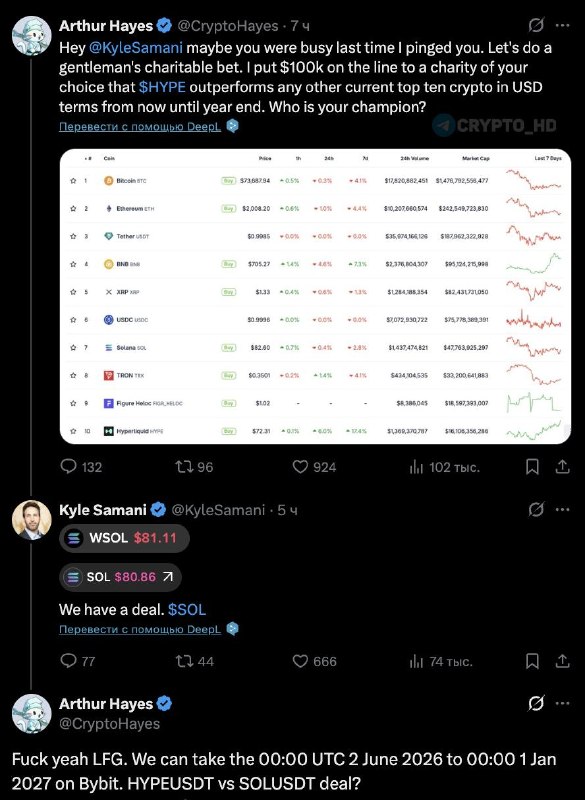
According to the source post, Hayes challenged Samani after saying HYPE would have the best return among the current Top-10 cryptocurrencies by the end of 2026. Samani accepted and picked SOL. They agreed to compare HYPE with SOL on Bybit from June 2, 2024, to January 1, 2027. The loser donates $100,000 to charity. The same post, in the same blunt mood, also said: “WEB3 is dead.” Subtle? No. Effective? Probably.
The $100,000 donation is the easy headline. The more interesting part is that Hayes and Samani are backing two very different crypto bets. HYPE is the newer trade, tied closely to exchange activity and liquidity. SOL is the older high-beta Layer 1 bet that lived through the 2021 boom, the 2022 crash, and the 2024 risk rebound. Most guides would frame this as simply new coin versus old coin. That’s only half right. Bybit matters because this is not a vibes contest. It comes down to execution and price between two fixed dates. Liquidity, too. Watch the ratio.
From a macro-flow view, HYPE and SOL are both risk-on crypto assets. These are not short-term Treasury bills. When U.S. policy loosens, or when traders think real rates are headed lower, money often moves first into Bitcoin (BTC) and Ethereum (ETH). After that, higher-beta tokens usually get their turn. In the 2020 liquidity cycle, BTC went from under $10,000 in early 2020 to more than $60,000 in 2021. SOL became one of that cycle’s big beta trades. Why does this matter? Because if 2026 rewards familiar beta, SOL has history on its side. If traders care more about fees, venue activity, and exchange-style usage, HYPE has the cleaner pitch. My take: both cases are real, but they are not the same trade.
Regulation also hangs over the bet, though not in the same way for both tokens. Bitcoin (BTC) got U.S. spot ETF approval on January 10, 2024, and Ethereum (ETH) spot ETFs followed in 2024. That gave both assets a more institutional wrapper than most altcoins have. SOL sits closer to that conversation than many smaller tokens because traders keep treating it as a possible next large-cap candidate for regulated products. HYPE probably gets judged on something rougher: venue usage, derivatives depth, and whether people keep trading there when markets get ugly. Same crypto market. Different pressure points.
Hayes picking HYPE is the more aggressive call. He is betting that the next leader may not be an old smart-contract brand. It may not be the ticker that already feels institution-friendly either. Counter to the usual advice, being newer can help if the market wants reflexivity more than comfort. In his view, the winner could be the token closest to where active traders are taking risk. Samani’s SOL pick leans on scale, liquidity, and a community that has already survived a full cycle. SOL does not need to be new to win. It only needs to beat HYPE on Bybit from June 2, 2024, to January 1, 2027.
The source material does not give entry prices, percentage targets, or private comments beyond the wager terms. That matters more than it sounds. Without a stated starting level in the original post, traders should not treat this as a price target from Hayes or Samani. I would not overread it. It is a relative-performance call. HYPE can rise and still lose if SOL rises more. SOL can fall and still win if HYPE falls harder. Is the $100,000 number the point? Not really. The trade is the HYPE/SOL ratio.
The line “WEB3 is dead” gives the bet a harder edge. It makes the wager feel less like a standard token debate and more like an argument about what replaced the old Web3 pitch. In 2021, Web3 was sold through apps and communities. Open ownership was part of the pitch, too. By 2026, traders may care more about revenue, liquidity, execution, and token performance. Yes, that slightly contradicts the cleaner “macro beta” framing above. Bear with me. HYPE versus SOL is also a culture bet: whether the market rewards old network belief or the place where traders are actually clicking buttons. Skip the mythology. Check which ticker wins by January 1, 2027.
What this means
This bet turns the 2026 crypto leadership debate into something measurable. For HYPE, the number to watch is not one price level. It is HYPE’s return against SOL on Bybit from June 2, 2024, through January 1, 2027. For SOL, the question is whether an established Top-10-style risk asset can still beat a newer, more reflexive market favorite when traders are chasing returns. The HYPE/SOL ratio says more than either standalone chart. Simple as that.
The comparison period starts on June 2, 2024, and ends with the final check on January 1, 2027. Between those dates, Bitcoin (BTC) and Ethereum (ETH) still matter because macro flows usually hit the majors before spilling into higher-beta altcoins. Traders will watch Federal Open Market Committee (FOMC) decisions and CME positioning data. Spot ETF flows belong in that same monitor, but they are not the whole story. If BTC stalls while SOL and HYPE keep climbing, altcoin beta is probably leading. If BTC dominance rises instead, both sides of the $100,000 bet may be facing a tougher market than the headline suggests. We should be careful here: the wager is loud, but the measurement is narrow.