
















































Investors move from AI to crypto: a possible rotation signal
Money is starting to come out of the hottest AI trades and drift back into crypto. Memory and semiconductor stocks have cooled off, while Bitcoin has bounced enough to get traders watching again. My take: this is not confirmation yet, but it is no longer background noise.
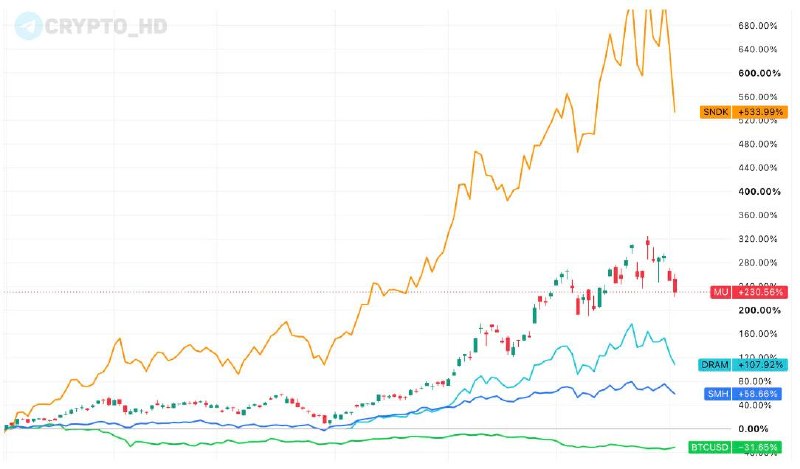
Investors are taking profits in AI stocks that had begun to look stretched. Memory and semiconductor names are losing steam, and some of that cash seems to be finding its way into crypto. Bitcoin fell below $58,000 on July 1, then climbed back to about $62,000. That does not prove a full rotation is underway. Still, a roughly $4,000 bounce in Bitcoin while AI-linked trades are wobbling is enough that I would not ignore it.
The AI trade has had a huge run. Maybe too huge. Sandisk was up about 530% year to date, and Micron was up around 230%, so profit-taking is not some mystery. The DRAM memory ETF more than doubled in the first half of the year, then dropped roughly 25% from its June high. SMH, the semiconductor ETF, gained 60% before pulling back about 12%. Most guides frame this as simple sector rotation. That is only half right. When a crowded trade starts to wobble, money does not calmly relocate; it hunts, hesitates, and sometimes piles into the next volatile thing.
This looks like a macro flow worth watching. A macro flow is capital moving between sectors or asset classes, usually because investors have changed their view of risk, growth, or value. Short version: money is changing its mind.
When high growth tech starts to look tired, investors often go looking for the next place with upside. The money that chased the AI boom may now be hunting for a fresher trade, and Bitcoin’s move from below $58,000 on July 1 to about $62,000 happened fast. Why does this matter? Because speed tells you buyers were already waiting, not slowly discovering the chart after the fact. I’ll be honest: I would be careful about making too much of it. This is not some sweeping market judgment. It looks more like a messy move from one speculative trade into another. Still, if the flow continues, it could support BTC and the larger crypto names.
It is too early to call this a lasting rotation. A few strong Bitcoin candles do not make a trend. But the setup is changing: less buzz around AI infrastructure, more interest in digital assets. There is also a small safe-haven angle here. A safe-haven asset is an investment people expect to hold up, or even rise, when markets get rough. Yes, that sounds odd in a Bitcoin paragraph. Bear with me.
Bitcoin is volatile, obviously. Anyone who has watched a weekend crypto selloff knows that. Still, some investors treat it as a hedge against traditional market stress or as another store of value. Counter to the usual advice, the important point is not whether Bitcoin is truly safe. It is whether enough investors start comparing it favorably with AI stocks after Sandisk’s 530% year-to-date rise, Micron’s 230% move, and SMH’s 12% pullback. That does not make Bitcoin safe. It just means the market may be taking another look.
What this means
The market may be moving away from crowded AI trades and back toward digital assets. For now, Bitcoin is the clearest winner. Simple as that.
Bitcoin recovered quickly after its July 1 dip below $58,000, moving back to about $62,000. That bounce matters because it happened while parts of the AI trade were cooling. If this rotation keeps going, it could also help Ethereum and some larger altcoins that have been lagging. Is this overkill to track? No, not when the same week gives you a Bitcoin rebound, a DRAM memory ETF drawdown from its June high, and a semiconductor ETF pullback. Traders should watch BTC and ETH inflows. They should also watch trading volume on major exchanges. Price alone can fool you. Volume makes the signal harder to dismiss.
To see whether this move has legs, watch the DRAM memory ETF and SMH. If those keep falling while Bitcoin keeps grinding higher, the rotation case gets stronger. The $65,000 level matters too. A clean move above that area would make the bullish argument harder to brush off. My bias here is cautious, not bearish. Economic data and central bank comments still matter, though. If risk appetite weakens across the board, crypto can get hit along with everything else.
FAQ
Q: What is causing investors to shift from AI to crypto?
A: Investors are taking profits in AI stocks after a huge run and looking for other places to put risk capital. Crypto, especially Bitcoin, is getting some of that attention.
Q: How has Bitcoin reacted to this shift?
A: Bitcoin bounced from below $58,000 on July 1 to about $62,000. That suggests buyers stepped in quickly, though it does not prove all the money came from AI profits.
Q: What indicators can confirm this rotation?
A: Watch BTC and ETH inflows, trading volume on major exchanges, and continued weakness in AI and semiconductor ETFs such as the DRAM memory ETF and SMH.
Q: Is this shift sustainable in the long term?
A: It is too early to say. The case gets stronger if Bitcoin keeps rising while AI and semiconductor stocks keep losing momentum.
Q: Why does Bitcoin’s $65,000 level matter?
A: A clear break above $65,000 would suggest buyers are still in control and could pull more traders back into the crypto market.