
















































Arthur Hayes sells ZEC: privacy story takes a hit, market flinches
Arthur Hayes sold all of his Zcash (ZEC), pointing to a cryptographic risk in the Orchard transaction pool that he says cannot be measured cleanly. My take: that is less a panic move than a very public refusal to price uncertainty politely.
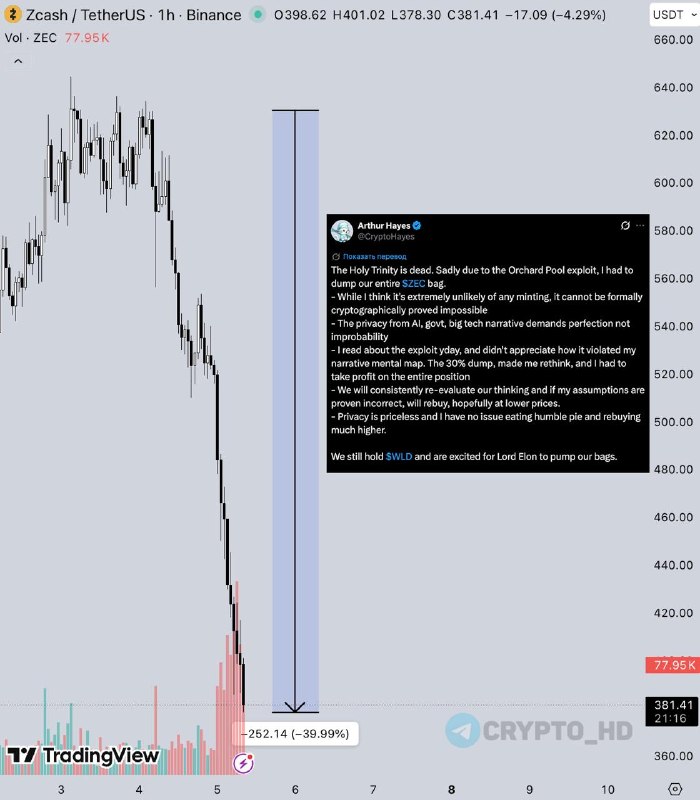
The timing was ugly. ZEC fell about 30%, and Hayes’s exit turned what could have stayed a narrow engineering issue into a market story almost overnight. Shielded Labs researchers had found a serious bug in the Orchard pool. In theory, someone could have used it to mint an “unlimited” amount of ZEC. The bug was patched quickly, and researchers described the chance of exploitation as low. Hayes did not buy that framing. In public comments, he said the “holy trinity is dead” because nobody can rule out even a tiny chance of unauthorized ZEC creation with 100% certainty. Most guides would say a fast patch and low exploit odds should calm the market. That’s only half right. Privacy coins sell trust in the math. If the pitch is privacy against AI systems, governments, and Big Tech, “probably fine” is a brutal line to defend. After the 30% drop, Hayes sold the whole position and kept the profit.
So what is the actual question here? Not whether ZEC is dead. It is how much uncertainty investors will accept when the product is supposed to offer cryptographic certainty.
Market data showed ZEC losing roughly 30% as confidence cracked. Sit with that. Investors did not wait for proof that someone exploited the bug. The possibility was enough. For a privacy coin, that matters more than it would for many other tokens because cryptographic integrity is not a feature on the side; it is the product. This is not just a ZEC problem. If Monero (XMR), Dash (DASH), or another privacy token gets hit with a similar technical scare, the market could punish it quickly. We have seen versions of this before. During heavier regulatory pressure, privacy coins often sell off as traders cut risk. CoinDesk reported a milder version in Q3 2023, when updated Financial Action Task Force guidance on virtual assets was followed by a 15% to 20% slide across several privacy focused altcoins over about two weeks.
The move also says something about where crypto capital goes when traders get nervous. It gets weird fast.
Hayes is willing to buy ZEC back later, even at a higher price, if he decides his assumptions were wrong. Still, selling now suggests he would rather hold assets with cleaner security stories, or at least different risks. I’ll be honest: the Dogecoin (DOGE) contrast is almost too perfect. He is out of ZEC over a cryptographic concern, but he is still holding DOGE while joking about “Lord Elon” pumping his bags. That is crypto in one paragraph. A privacy coin gets judged on math. A meme coin gets judged on attention, community jokes, exchange liquidity, and whether Elon Musk feels like posting. Counter to the usual advice, “better technology” is not always the asset traders hide in when the mood turns. Bloomberg has reported that when the Fed sounds more hawkish, crypto tends to cut risk broadly, though traders may still chase high beta names such as DOGE or SHIB for quick moves. Even Bitcoin (BTC), which many traders treat as the cleaner crypto refuge, dropped about 5% in early May 2024 after hotter than expected CPI data.
Hayes has not written off ZEC forever.
In public comments, he said he would buy it back, even higher, if he is wrong, because “privacy is priceless.” I do not read that as a reversal. It sounds more like a trader saying the idea still matters, but the current risk does not fit his book. Hayes had already sold NEAR and HYPE, so this also fits a pattern: when his view changes, he cuts. No slow goodbye. Just out.
What this means
This is a rough moment for privacy coins because it may change the standard investors apply to them. Is that overdramatic? For ZEC holders watching a roughly 30% move, no.
Crypto analysts have been circling the same point: strong privacy features may not be enough if investors start demanding proof that the money supply and privacy systems are airtight. For some holders, especially people who think like Hayes, a low probability bug is still a problem if nobody can disprove it completely. Yes, this sounds like it contradicts the normal security argument that patched bugs are part of software life. Bear with me. Privacy tokens are not being judged like ordinary software tokens right now. Monero (XMR), Dash (DASH), and other anonymity focused tokens may now face tougher questions about cryptography, audits, supply assumptions, and disclosure speed. Fair or not, ZEC just reminded the market that privacy coins live and die by trust in details most investors cannot personally verify.
Investors should watch whether other large traders copy Hayes or publicly reject his reasoning. That split matters.
More high profile exits would make this look less like one trader’s risk call and more like a sector repricing. ZEC’s price around the $20 to $22 support area is worth watching. A clean break below that range could bring another round of selling. Security disclosures matter too. So do fresh audits from privacy protocols, because the market is in no mood for vague comfort right now. Why does this matter? Because after Orchard, “trust us, it is unlikely” lands differently. The next regulatory update could add pressure as well, especially if global financial bodies tighten language around privacy enhancing tools in their Q3 2024 guidance.