
















































Trump Crypto Industry USA Push Puts Regulation Back on BTC Radar
Donald Trump’s latest pro-crypto comments point to another possible swing in U.S. crypto policy. That matters for Bitcoin (BTC), Ethereum (ETH), and the companies tied to U.S. trading activity. My take: traders should treat this less like a campaign caption and more like a regulation signal.
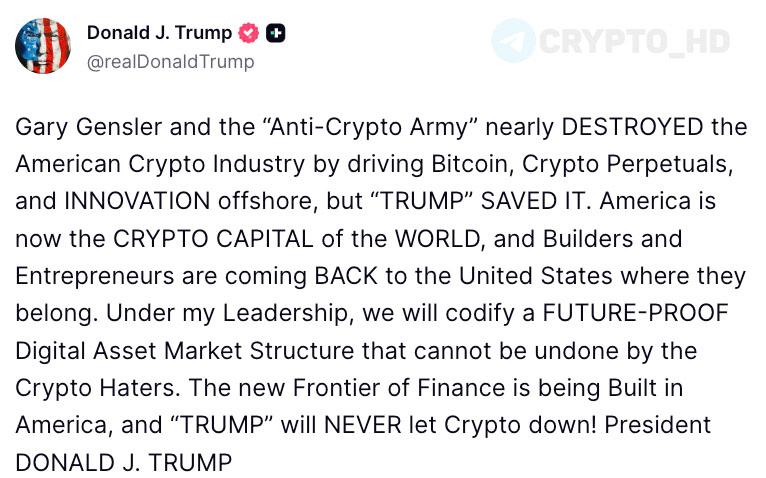
Trump’s newest pro-crypto post puts Washington back in the middle of the trade for trump crypto industry usa traders. He says Gary Gensler and the “Anti-Crypto Army” nearly wrecked the American crypto industry, while “TRUMP” saved it. Strip out the political volume and the message is pretty direct: regulation is the trade. BTC, ETH, COIN, and U.S.-linked crypto venues do not price the same way when investors think Washington may move away from enforcement and toward written market rules.
In the post, Trump blames Gary Gensler and the “Anti-Crypto Army” for pushing Bitcoin, crypto perpetual futures, and crypto builders offshore. He also calls America the “crypto capital of the world.” Developers and entrepreneurs, he says, are returning to the United States, and his administration will put a lasting digital asset market structure into law. Why does this matter? Because traders have been staring at the same fork in the road since 2021: does U.S. crypto grow under rules people can actually understand, or do volume, talent, offshore venues, and perpetual futures activity keep drifting away?
Crypto prices have moved on regulation before. Bitcoin’s ETF run is the cleanest recent example.
This is the part I would not wave away as just another crypto post. Regulation has moved price before. BTC traded near $49,000 around the Jan. 10, 2024 spot Bitcoin ETF approval window, then climbed above $73,000 by Mar. 14, 2024. That was about a 48% move from approval week to the cycle high. No, that does not mean Trump’s post automatically creates another 48% rally. Markets are not that tidy. We saw that lesson get overused after the ETF approval: people copied the number and forgot the setup. But traders learned something real in 2024. When U.S. access gets easier, money tends to show up. For BTC, the question is whether traders start pricing in a smaller U.S. regulatory discount. For ETH, it is whether staking and exchange access start looking more like investable infrastructure than legal exposure.
Trump’s direct mention of Gensler, Bitcoin, crypto perpetual futures, and innovation leaving the United States makes the regulatory pressure hard to miss.
That is why the regulation angle matters. Trump names Gary Gensler. He names Bitcoin. He mentions crypto perpetual futures. He says innovation left the United States. Short version: this is not subtle. BTC and ETH spot markets already trade globally, but perpetual futures remain a major liquidity engine outside the U.S. A real U.S. market structure would matter less as a slogan and more as market plumbing: exchange listings, custody rules, ETF product expansion, staking treatment, stablecoin rails, tax reporting, and whether offshore volume can move back onshore. COIN is the obvious public stock to watch because equity traders often use Coinbase as a bet on U.S. crypto rules. If the market believes the “Anti-Crypto Army” period is ending, COIN can move before a bill reaches the finish line. BTC and ETH would then absorb the broader liquidity signal.
Trump’s claim that America is the “crypto capital of the world” points to domestic crypto adoption, though the post does not prove that adoption is already happening.
The adoption point needs a cleaner split from the slogan. Trump says America is the “crypto capital of the world” and that developers and entrepreneurs are returning to the United States. That is not proof that a bank, company, reserve program, or treasury buyer has stepped in. The source does not name one. I’ll be honest: this is where crypto bulls sometimes outrun the document in front of them. Still, markets care because adoption often starts with permission. In 2024, spot BTC ETFs turned regulatory permission into a product people could buy through a mainstream brokerage account. By Mar. 14, 2024, BTC above $73,000 showed how fast distribution can change when U.S. access opens up. If the next policy phase gives builders clearer rules, the trade reaches beyond BTC and ETH. Base-linked activity, Solana apps, stablecoin rails, U.S.-listed exchange revenue, and custody businesses could all reprice if founders stop treating the United States as the hardest place to ship a crypto product.
Politics can move crypto, but macro still has the wheel more often than crypto traders like to admit.
Rates still matter. A lot. Crypto does not trade in a policy bubble, even when the headline is loud. BTC still behaves like a liquid risk asset when real yields rise, and it still catches bids when traders expect easier financial conditions. That is why the next Federal Reserve meeting on June 16-17, 2026 sits right next to Trump’s post on the calendar. Counter to the usual advice, I would not read the political headline first if BTC is already leaning into that FOMC window. Read liquidity first. A friendlier U.S. regulatory tone can improve the structural bid, but rates decide how much leverage traders want to use. If BTC is pushing into a major technical level near that FOMC window, the political headline can add fuel. If liquidity tightens, even a pro-crypto Washington message can become a quick positioning reset.
Trump’s comments show where he wants to take crypto policy, but they do not give traders a price level, a bill, or a timetable.
The source gives no market level, no price target, no bill text, and no timeline beyond Trump’s pledge to put a durable digital asset market structure into law. That limits what anyone should claim today. The useful part is direction. Trump is framing crypto as a U.S. competitiveness issue, not just a speculative asset class. Is that enough by itself? No. But it matters for BTC because Bitcoin already won the institutional wrapper fight through ETFs. It matters for ETH because the next fight is not only price. It is whether staking, apps, and tokenized finance can operate under U.S. rules without constant enforcement risk.
Trump is trying to separate his crypto policy from the Gensler-era approach, with a move from enforcement pressure toward a written market framework.
The message draws a clear political line between two regimes: the Gensler-era “Anti-Crypto Army” and a promised market structure that crypto opponents “will no longer be able to cancel.” Most guides say to wait for the actual bill. That is only half right. Markets often trade the signal before the law. I get why. Waiting for Congress is not exactly a fast strategy. But the gap between a social media post and a statute is huge. BTC can move on narrative within hours. ETH, COIN, and U.S.-based crypto businesses need rule text, agency coordination, exchange guidance, custody definitions, and court-tested language before the valuation change sticks.
What this means
U.S. crypto regulation is back as a market driver, not background noise. BTC, ETH, and COIN are the names most exposed to this trade. BTC is the institutional benchmark. ETH is the programmable finance asset still tied to staking and app regulation. COIN is the listed U.S. exchange proxy. The thing to watch is whether “crypto capital of the world” becomes an actual market structure bill or stays political branding. My take: if traders start pricing legal clarity, the 2024 ETF move from roughly $49,000 to above $73,000 is the comparison they will reach for first, even if it is an imperfect one.
Watch for proof, not louder posts. The June 16-17, 2026 FOMC meeting is the macro date because rate expectations shape BTC and ETH risk appetite. Any digital asset market structure draft would be the regulatory trigger. In the market, watch BTC spot ETF flows, CME BTC futures open interest, ETH staking headlines, COIN’s reaction to U.S. rulemaking language, and whether U.S.-linked venues start outperforming offshore proxies. The test is simple. If BTC rallies while COIN and ETH also strengthen, traders are buying a U.S. policy reprice. If BTC moves alone, the market is probably trading momentum, not a lasting Trump crypto industry USA shift.