















































Robot Wedding in Moscow: A Look at AI’s Crypto Future?
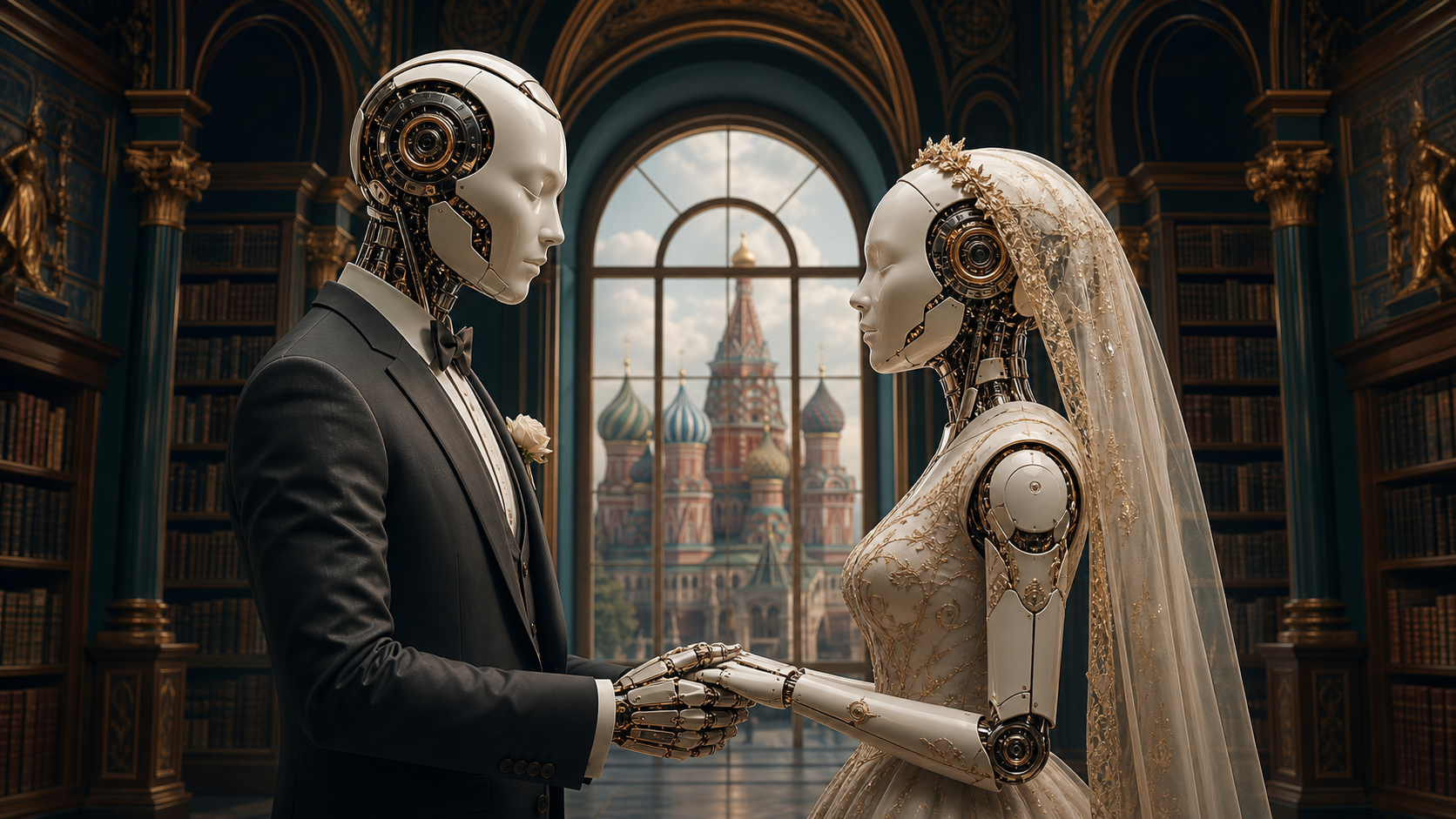
A robot wedding in Moscow sounds like clickbait: people click, laugh for ten seconds, move on. I get the instinct. This one involved two humanoid robots, Robert and Matilda, “marrying” at the Pushkin Library. Weird? Obviously. But for crypto investors, it is also a small reminder that AI is leaving the demo booth and showing up in public life, where people can see it, joke about it, film it, argue about it, and slowly get used to it.
The ceremony was reported as a first for Russia. Robert and Matilda were the “newlyweds,” and the Pushkin Library gave the whole thing a strange civic gloss. There are not many hard details beyond the location and the robot couple’s names, so it would be silly to squeeze too much meaning out of it. Still, a public robot wedding in Moscow is not nothing. Why does this matter? Because AI and robotics feel less abstract when they show up in places like this. Less lab-only. More normal, even when the use case is ridiculous.
That matters for crypto because markets often move on stories before they move on revenue. This event did not push a specific token higher. It was not a product launch. It was not a protocol upgrade. Most guides would stop there and call it irrelevant. That’s only half right. The wedding fits the wider adoption signal around AI, and that story has already spilled into crypto more than once: AI trading bots, AI smart contract review tools, AI-generated NFTs, tokenized compute pitches. Some are useful. Some are vapor with a token stuck on top. Either way, AI needs compute, data, identity, verification, and payment rails. Plenty of blockchain projects are trying to sell themselves as part of that stack.
That is where names like Fetch.ai (FET) and Render Token (RNDR) come in. FET is tied to autonomous agents and AI infrastructure. RNDR is tied to distributed GPU rendering and compute. My take: a robot wedding in Moscow will not move either market by itself, and anyone claiming it will is selling too hard. But AI-themed tokens have reacted sharply to the wider AI narrative. FET, for example, jumped about 12% in early March 2024 during a burst of AI sector enthusiasm. That is the part worth watching. These tokens trade partly on fundamentals, partly on attention. Attention tends to gather around visible moments like this.
The Moscow event also lands inside a larger macro flow. AI investment has been climbing fast, with annual spending forecasts now in the hundreds of billions of dollars. That money is not just going into chatbots. It is going into chips, data centers, robots, model training, enterprise tools, grid upgrades, and the power systems needed to keep the whole machine running. Counter to the usual crypto pitch, not every piece of that demand needs a blockchain. But some of it does overlap with crypto’s favorite themes: decentralized compute, data ownership, machine-to-machine payments, open settlement layers.
Crypto still lives and dies by liquidity, though. That has not changed. In mid-April 2024, BTC fell below $61.4K as inflation worries and Fed rate expectations pushed traders away from risk. AI excitement can help, but it does not cancel macro pressure. Is this overkill for one odd Moscow ceremony? For a pure news read, yes. For a market narrative read, no. If rates stay tight and liquidity drains, even the cleanest AI story struggles. If capital starts hunting for growth again, AI-linked crypto projects may catch a stronger bid. I’ll be honest: I would treat the robot wedding as a cultural data point, not a trading signal. Small signal. Very strange packaging.
What this means
The Moscow robot wedding is not important because two robots pretended to get married. It is interesting because public AI moments like this make the technology feel less distant. That can matter over time. Yes, this contradicts the instinct to ignore novelty stunts — bear with me. As people get more comfortable with robots, agents, and automated systems, demand may grow for digital infrastructure that can verify actions, move value, and store data without relying on one central operator.
For crypto, that keeps attention on projects working around decentralized AI, data markets, compute networks, identity rails, and Web3 infrastructure. FET and RNDR are obvious examples, but they are not the whole category. Investors will probably keep rotating into AI-linked tokens whenever the broader AI story heats up. The catch is that these assets are jumpy. They can rip on headlines, then give it back just as fast. We have seen that pattern enough times that I would not confuse a narrative bounce with durable adoption.
From here, actual AI adoption matters more than novelty events. Consumer robot demos are fun to watch, but enterprise rollouts, GPU demand, major AI conferences, corporate spending plans, and infrastructure orders carry more weight. For AI-related tokens, support and resistance levels still matter because these markets can be thin and quick to react. For the wider crypto market, the next FOMC meeting, inflation prints, and CME positioning data should show whether traders have enough risk appetite to chase AI crypto again. Watch the flows. Then the headlines.