
















































Nvidia hits $5.5 trillion and the AI-crypto trade has to be re-read
Nvidia just became the first public company to print a $5.5 trillion market cap. No equity has ever cleared the $5 trillion line before. For crypto, this matters more than the headline suggests. When the cleanest proxy for AI compute keeps melting up, the money funding GPU buildouts and hyperscaler capex has to come from somewhere. Risk appetite at this altitude rarely stays fenced inside one ticker. It leaks into BTC and ETH in weeks, not quarters. I have watched this pattern play out twice already this cycle.
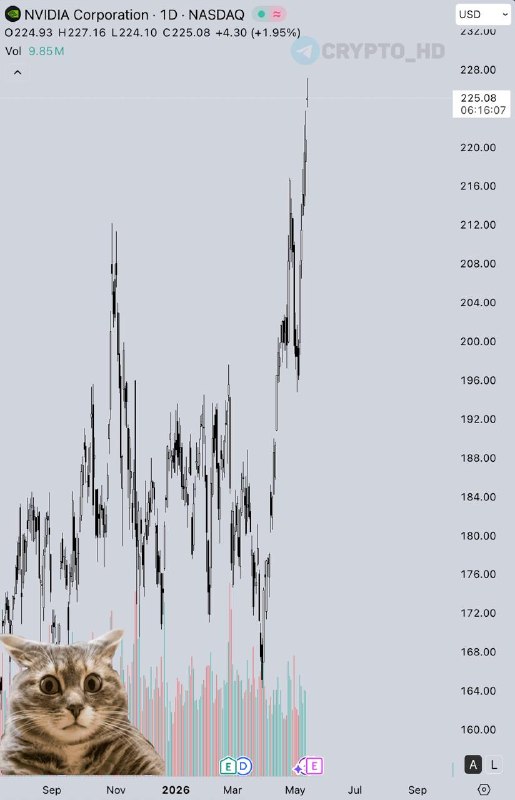
$5.5 trillion is bigger than every listed bank in Europe combined, per Bloomberg and S&P Global aggregates. It is also roughly 2.5x the entire crypto market cap. That comparison is almost too blunt, which is why it works. One stock. One ticker. One thesis. AI demand is not cooling, and the market is willing to underwrite it at a valuation that would have sounded ridiculous eighteen months ago.
Nvidia is the cleanest live read on global risk-on positioning that traders have right now. Here is the first crypto angle, and I would not skip it. Every prior leg of this rally, from the $1T cross in mid-2023 to the $3T break in 2024, overlapped with BTC printing a higher low inside the same window. Correlation is not destiny. Most guides stop there. That is only half right. When the largest growth name on earth keeps setting records, the marginal dollar in macro books is usually not hiding in cash; it is hunting beta. Bitcoin, as the highest-beta liquid macro asset outside equities, sits right in that flow.
The second angle is structural, and less cute. Nvidia’s revenue depends on the four biggest hyperscalers committing record capex to AI infrastructure. Per public disclosures from Microsoft, Meta, Amazon, and Google, combined 2025 AI data center spend is north of $200 billion. Those same data centers fight Bitcoin miners for power and land. They also fight them for transformers and grid interconnects. Why does this matter? Because a $5.5 trillion Nvidia is shorthand for “AI capex is not slowing,” which means power prices stay sticky, hosting contracts stay tight, and listed miners with locked-in cheap megawatts (the kind of capacity that took three years to permit) get harder to replace. My take: that is an adoption signal dressed up as a hardware story, and most macro desks are still reading it as a hardware story.
Worth flagging: the AI narrative has already started bleeding into specific crypto plays. Compute-token projects and decentralized GPU networks trade as Nvidia’s shadow. So do miners pivoting toward AI hosting. When NVDA breaks out, that cluster usually catches a bid in the same session. The catch is that the relationship runs one way. Nvidia leads. The crypto AI cohort follows. It unwinds the same way when sentiment cracks. I keep reminding myself of that on green days.
A $5 trillion concentration in a single equity forces passive index funds, pensions, and sovereign allocators to hold the largest single-name exposure in modern market history. There is a quieter signal here too. The standard response is to diversify into uncorrelated assets, which is exactly the pitch Bitcoin ETFs have been making to the same allocators since January 2024. Per BlackRock and Fidelity ETF flow data, spot BTC ETF cumulative inflows passed $50 billion in 2025. Counter to the usual advice, crypto does not need to win the AI narrative directly here. Nvidia’s vertical move strengthens the Bitcoin ETF pitch without anyone in crypto having to say a word.
What this means

The macro regime supporting a $5.5 trillion AI leader is the same regime supporting risk assets broadly, which directly includes Bitcoin and Ethereum. The takeaway is not “buy BTC because Nvidia went up.” It is that this regime runs across asset classes: loose financial conditions, strong corporate earnings at the top of the stack, and an institutional bid that refuses to fade rallies. Bitcoin trades inside that regime, not against it. Yes, that sounds like I am giving one equity too much credit. Bear with me. If NVDA holds these levels through the next two earnings prints, the path of least resistance for BTC is a re-test of its own cycle highs, with ETH and the AI-adjacent token basket as the higher-beta expressions.
Three measurable indicators will tell us whether the Nvidia-to-crypto spillover keeps going over the next four to six weeks. First, Nvidia’s next earnings release. Any guidance crack would hit crypto AI tokens before it hits NVDA itself, because liquidity is thinner. Second, hyperscaler capex commentary from Microsoft and Meta. Sustained capex guidance keeps the power-and-hosting trade intact for listed miners. Third, the BTC-NVDA 30-day correlation. Is this overkill? For a market trading one macro story across semis, miners, and spot BTC ETFs, no. When it tightens above 0.6 (it has done this twice in 2025, per rolling correlation data from Kaiko and Coin Metrics), Bitcoin tends to follow Nvidia’s intraday tape session by session. Lose that correlation, and the AI-crypto trade has to be re-underwritten from scratch.
FAQ
What is Nvidia’s current market cap record?
Nvidia hit a market cap of $5.5 trillion, the first public company in history to clear the $5 trillion line. That number is about 2.5x the entire global crypto market cap. It is hard to overstate how strange that sentence still looks.
How does Nvidia’s market cap affect Bitcoin?
Nvidia’s rally is a leading indicator of global risk-on positioning. Every major NVDA milestone so far has overlapped with Bitcoin marking a higher low inside the same window. As the highest-beta liquid macro asset outside equities, BTC sits right in the path of capital flows chasing AI exposure. Not always cleanly. But often enough to matter.
Why do hyperscaler AI capex levels matter for crypto miners?
Per public disclosures from Microsoft, Meta, Amazon, and Google, AI data centers compete directly with Bitcoin miners for power, land, transformers, and grid interconnects. Sustained hyperscaler capex keeps power prices and hosting contracts tight, which raises the strategic value of listed miners holding pre-permitted cheap megawatts. I would watch Microsoft and Meta commentary first, not vague “AI infrastructure” chatter.
Which crypto sectors benefit most from Nvidia’s run?
Compute-token projects and decentralized GPU networks trade as Nvidia’s shadow. Bitcoin miners pivoting toward AI hosting usually move with that same basket and often catch a bid in the same session NVDA breaks out. The relationship runs one way. Nvidia leads, the crypto AI cohort follows, and it unwinds the same way when sentiment cracks.
What is the BTC-NVDA correlation level to watch?
Watch the 30-day rolling correlation between BTC and NVDA. When it tightens above 0.6, Bitcoin tends to follow Nvidia’s intraday tape session by session. Per Kaiko and Coin Metrics correlation data, this threshold has been crossed twice in 2025.
Could Nvidia’s earnings derail the crypto AI trade?
Yes. Any guidance crack at Nvidia’s next earnings release would likely hit crypto AI tokens before it hits NVDA itself, because crypto liquidity is thinner. A negative print combined with weak hyperscaler capex guidance would force the whole AI-crypto trade to be re-underwritten from scratch. Skip the victory lap if guidance slips.