
















































Russian ruble dollar exchange rate volatility: what it means for crypto
A sharp drop in the Russian ruble against the US dollar would make Bitcoin’s safe haven pitch harder to ignore. A Russian analysis is asking what would need to happen for the dollar to trade at 120-150 rubles. That is not background noise. When a country as large as Russia starts talking openly about that kind of currency pressure, crypto traders notice fast. My take: the exact number matters less than the fact that 120-150 rubles is now being framed as a live scenario. Bitcoin has already seen sudden demand during geopolitical stress.
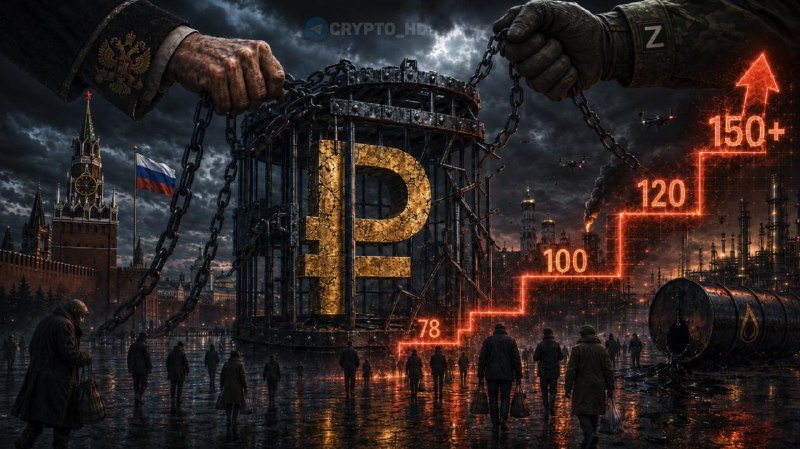
Russian media is now asking how weak the ruble could get. The source, a Russian wire post, asks a blunt question: “What must happen in Russia for the dollar to cost 120-150 rubles?” It points readers to an unnamed research document and promises “facts and a little more” with “no water, just specifics.” The post does not include the research itself. Annoying, frankly. If you want to check the assumptions, you cannot. Still, the framing matters. This is not a soft little “currency pressure” headline. A Russian outlet is asking what kind of situation gets the dollar to 120-150 rubles. That reads less like theory and more like local anxiety leaking out.
Bitcoin has pulled attention before when fiat currencies came under pressure. Most guides say people “move into Bitcoin” when local money weakens. That’s only half right. People first look for exits, and Bitcoin is one of the louder exits on the board. In February 2022, after Russia invaded Ukraine, BTC trading against the ruble jumped on some exchanges, and ruble buyers reportedly paid premiums at times. Globally, Bitcoin was still messy and volatile. Locally, demand said something different. BTC also rose 8% around the January 2020 Soleimani strike, another moment when geopolitics hit markets fast. Why does this matter? Because a ruble move toward 120-150 per dollar would give traders a familiar crisis template. I would expect some investors to scramble again. Not everyone. Not magically. But enough to matter, especially if Bitcoin is already pushing near the $70,000-$75,000 area.
A weaker ruble would not stay neatly inside Russia. Russia is a major energy exporter, so a currency shock there could spill into oil, gas, inflation expectations, central bank decisions, and dollar demand. This part gets messy. Markets do not like chain reactions with that many moving pieces. Some money would probably move to gold. Some would move to dollars. Some might move into Bitcoin, and Ethereum could catch a bid too if investors start worrying about local banking risk or currency controls. Counter to the usual crypto-bull advice, I would not call crypto a clean hedge. It still sells off with risk assets more often than its fans admit. But when a G20 economy is looking at a 120-150 ruble dollar rate, the “money outside the system” argument stops sounding so abstract.
What this means
The Russian discussion around a possible ruble slide points to real economic anxiety, and crypto could benefit from that fear. The 120-150 ruble figure is what sticks. It gives traders a level to watch, even if the source has not published the underlying research. Is that enough to trade on? No. But it is enough to put BTC/RUB volume, ruble premiums, and Russian Central Bank language on the screen. If the ruble keeps weakening, Bitcoin’s safe haven story gets another test. Currency stress and geopolitical tension have already pushed more attention toward BTC in the past. A similar move in Russia could pull new buyers into the market and, if momentum builds, put Bitcoin back near record highs.
Traders should watch Russia news, ruble liquidity, and BTC/RUB activity instead of trading the headline alone. The useful signals are specific: BTC/RUB trading volume, ruble premiums on exchanges, the $70,000 BTC level, and any statement from the Russian Central Bank about intervention or forecasts. Skip the vague panic. A clean break above $70,000 would matter more if it comes with heavy ruble demand. Yes, this contradicts the simple “Bitcoin is a hedge” version of the story — bear with me. The next few weeks should show whether crypto is acting like an escape valve or just catching another headline-driven bid.
FAQ
Q: What is the current concern regarding the Russian ruble?
A: A Russian wire post is asking what would need to happen for the dollar to reach 120-150 rubles. That points to rising concern inside Russia about the ruble’s stability.
Q: How might a ruble devaluation impact Bitcoin?
A: A large ruble drop could increase demand for Bitcoin as some investors look for assets outside traditional fiat currencies. I would watch whether that demand shows up in BTC/RUB volume first.
Q: Has Bitcoin acted as a safe haven during past geopolitical events?
A: Bitcoin saw stronger demand during past geopolitical shocks, including Russia’s February 2022 invasion of Ukraine and the January 2020 Soleimani strike.
Q: What are the broader implications for the crypto market if the ruble devalues significantly?
A: A sharp ruble devaluation could push some capital toward Bitcoin and Ethereum, especially if investors become more worried about banks, currency controls, or local market stress.
Q: What should traders monitor in light of these potential developments?
A: Traders should watch Russia related news, BTC/RUB volume, ruble premiums, the $70,000 Bitcoin level, and Russian Central Bank statements.