















































US refunds illegal Trump tariffs as crypto watches liquidity
The U.S. has started refunding importers after a court ruled Donald Trump’s tariffs illegal. About $20,000,000,000 has already gone back, with another $65,000,000,000 still in process. For crypto, the US refunds illegal Trump tariffs story matters for one blunt reason: cash returning to businesses can loosen a little pressure, while the court fight reminds BTC and ETH traders that policy still moves liquidity. This is not a crypto story, exactly. My take: it still belongs in crypto’s macro pile.
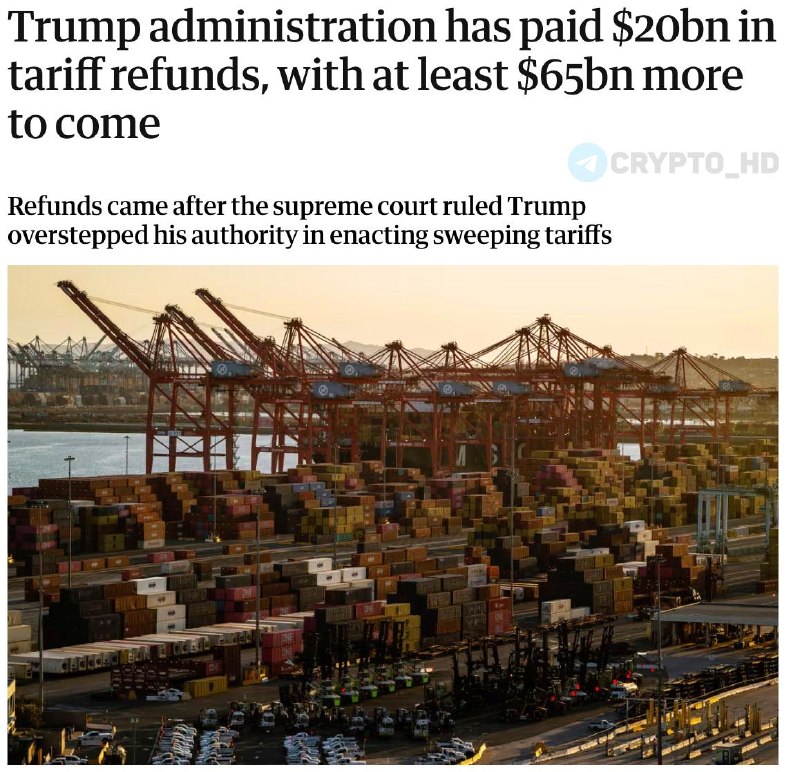
The source says U.S. companies paid higher duties on goods brought into the United States, and some of that money is now returning to businesses. Customs and Border Protection reportedly collected about $166b under the disputed duties. So far, $20,000,000,000 has been refunded to importers, and $65,000,000,000 is waiting. Traders probably will not treat that as a giant corporate windfall. I’ll be honest: I would read it more as evidence that Trump-era trade policy still has a market afterlife in 2026.
The macro read is simple. Tariffs work like a tax on imported goods, and refunds reverse part of that damage. If businesses get $20,000,000,000 now and another $65,000,000,000 later, that can help margins and working capital at the edges. Risk appetite too, but only indirectly. Why does this matter? Because BTC often cares less about crypto-native narratives than about whether cash is tight or loose. Context, not source fact: on March 12, 2020, BTC fell roughly 39% in one session and traded near $4K as investors dumped risk assets for cash. It was ugly. Crypto learned that when liquidity vanishes, BTC usually trades like a risk asset first.
A tariff refund is not a Fed pivot. It does not cut rates. It does not expand bank reserves. It does not guarantee new buying in BTC, ETH, or COIN. Most macro takes will overstate that part. That’s only half right. The refund can still remove one pressure point in the real economy, and crypto traders notice when policy changes touch inflation, corporate cash flow, or Treasury-market expectations. If import costs fall after an illegal-tariff ruling, markets may see less stress in supply chains. That is better for risk assets than another tariff shock.
The other piece is legal pressure. A court ruling against Donald Trump’s tariffs shows that U.S. policy can be unwound after companies have already paid. Crypto knows that feeling. Context, not source fact: on Jan. 10, 2024, the SEC approved spot Bitcoin ETFs, and BTC traded around the mid-$40K area as the market repriced legal access to the asset. One legal decision changed how money could enter the market. This tariff case is different, but the lesson is familiar: courts can move capital long after the political headline gets stale.
For COIN, ETH, and BTC, that matters because traders care whether rules survive a legal challenge. If a court can unwind $20,000,000,000 in paid tariffs and send another $65,000,000,000 into refund processing, investors will keep watching how courts define agency power in crypto cases too. To be clear, the source does not mention the SEC, CFTC, ETFs, staking, or exchanges. That link is analysis. Yes, this stretches beyond the tariff article itself; that is the point. The same legal-risk premium that hits importers can hit crypto venues when rules arrive first and court clarity comes years later.
There is also a safe-haven angle, though I think it is weaker than the liquidity angle. Tariffs are not war. Refunds are not a banking panic. Still, messy policy headlines often make investors compare BTC with gold, especially when Washington and courts collide with trade. Is this the cleanest BTC thesis? No. Context, not source fact: during the Jan. 2020 Soleimani strike episode, BTC gained about 8% as traders tested the safe-haven argument. That did not prove BTC had become digital gold. It showed how fast political shocks can pull crypto into macro hedging debates.
This refund story points the other way. It is partial relief, not escalation. That could take some urgency out of safe-haven BTC bids while helping the wider risk trade if investors see the refunds as disinflationary or growth friendly. Timing matters. $20,000,000,000 has already been returned, while $65,000,000,000 is still being processed. The boring question is the useful one: does that money change spending, inventory, or pricing decisions before the next major Fed event? If yes, crypto may notice through risk appetite before it notices through headlines.
What this means
The message is that U.S. trade policy is still being repriced in court, not just in campaign speeches or tariff announcements. For crypto, BTC and ETH remain tied to the dull but powerful stuff: inflation expectations, dollar liquidity, legal certainty, and court timing. Counter to the usual advice, I would not treat this as a direct BTC catalyst. I would treat it as another macro input. If tariff refunds ease pressure on importers, BTC could benefit indirectly through stronger risk appetite. COIN may move more on the broader legal-risk premium attached to U.S. markets. The number to watch is $65,000,000,000, because refunds matter more once companies can actually use the cash.
Watch the June 16-17, 2026 FOMC meeting, confirmed on the Federal Reserve calendar, to see whether policymakers treat tariff relief as meaningful for inflation or too small to change the rate path. For BTC, the first levels are psychological: $100K as a risk-on confirmation area and $90K as a stress line if macro appetite fades. Also watch CME Bitcoin futures open interest after the refund headlines settle. If leverage rises while BTC holds those levels, traders may be betting that court relief and softer tariff pressure can keep the risk trade alive. Simple read. Follow the cash.