
















































Pyth Network outage exposes crypto oracle risk for traders
The pyth network outage matters because Pyth Network’s Pythnet/Hermes services have been down for more than 4 hours, according to the source post. The team says it has found the cause, and validators are working on a network restart. My take: this is not some back-room infrastructure footnote. Oracle uptime sits under DeFi prices, leverage, liquidations, and trust. When it breaks, people notice fast.
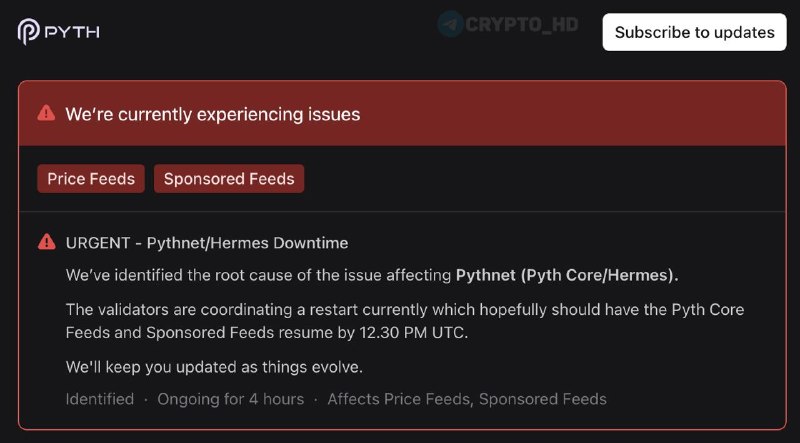
Keep the facts narrow. The source does not say funds were lost. It does not name affected protocols. It does not give a restart time. It says Pyth Network had a failure, Pythnet/Hermes have been offline for more than 4 hours, the cause has been found, and validators are coordinating a restart. That’s it. I would be careful here: anything beyond those five points is market interpretation, not a new claim from the source.
The crypto angle starts with plumbing. BTC and ETH do not need a macro shock to move if traders stop trusting the pricing rails. Is 4 hours enough to matter? Yes, if a desk has leverage, live pricing rules, or automated strategies tied to the feed. A 4-hour oracle interruption can push traders to cut leverage, widen spreads, or pause execution. We’ve seen a harsher version before: on March 12-13, 2020, BTC dropped more than 40% during a brutal liquidity squeeze, and DeFi learned that price feeds matter most when markets are already moving too fast. This Pyth Network outage is not 2020. Still, the lesson lands in an uncomfortable place.
There is a regulation angle too, even though the source does not mention any regulator. Most outage writeups skip straight to developer status updates. That’s only half right. SEC and CFTC pressure on crypto markets often comes back to market integrity, exchange controls, and whether trading systems can survive stress. A Pythnet/Hermes outage lasting more than 4 hours gives critics an easy line: crypto still relies on thin pieces of infrastructure that can fail at the wrong time. COIN, BTC, and ETH investors should care. Institutional money needs reliable data pipes. Not just deep spot markets.
The adoption signal cuts both ways. Pyth Network exists because crypto markets need fast oracle infrastructure across venues and protocols. That demand shows DeFi has moved well beyond simple token swaps. Fine. But adoption does not excuse downtime. I’ll be honest: if traders are watching a service during a 4-hour failure, that service is part of the market’s machinery and should be judged that way.
For BTC and ETH traders, the question is not whether Pyth Network is “good” or “bad.” That framing is too neat. The better question is whether oracle instability changes positioning during a volatile session. Counter to the usual advice, this is not just a developer incident to monitor in Discord or a status page. If traders rely on Pyth-linked pricing for derivatives, lending, or automated strategies, a validator-coordinated restart becomes a market event. Infrastructure risk is boring until it hits margin. Then it becomes everyone’s problem.
The safe haven angle is indirect, but it is there. BTC’s safe haven pitch usually gets tested during wars, sanctions, bank stress, or inflation scares. Gold is still the old benchmark. Crypto’s claim to 24/7 finance also depends on systems staying up. Why does this matter? Because an exchange can stay open while the data layer underneath DeFi looks fragile. If a core data layer can sit offline for more than 4 hours, BTC’s “always open” exchange story may survive, but DeFi’s “always reliable” story takes a hit.
One detail helps. The source says the team has already identified the cause. It also says validators are coordinating a restart. Those points matter because outages get uglier when teams cannot diagnose the problem or validators cannot agree on recovery. Yes, this slightly softens the criticism above. Bear with me. The market will still judge the restart, the postmortem, and whether Pythnet/Hermes come back cleanly.
What this means
This outage shows that oracle reliability remains a real risk for crypto market structure in 2026, especially for DeFi traders using BTC, ETH, and Pyth-linked pricing on leveraged venues. The protocol named is Pyth Network. The services named are Pythnet/Hermes. Watch whether the restart lands just after the 4-hour mark or drags further into the trading day. The longer it lasts, the more likely desks are to cut exposure or demand wider risk buffers. That part is simple.
Next, watch for a Pyth Network postmortem, the exact restart timestamp, and any protocol notices tied to BTC or ETH pricing. I would also keep an eye on CME BTC futures basis in the next trading session and the next FOMC decision date, June 17, 2026. Macro leverage and infrastructure confidence can collide quickly when rates, volatility, and liquidity move at the same time. The technical level to watch is not a made-up price target. It is whether BTC and ETH hold their pre-outage ranges after Pythnet/Hermes return.
FAQ: Pyth Network outage
What is the Pyth Network outage?
The Pyth Network outage is an incident where Pyth Network’s Pythnet/Hermes services were offline for more than 4 hours, according to the source post.
What services were affected by the Pyth Network outage?
The source post names Pyth Network’s Pythnet/Hermes services as the affected services.
Has the cause of the Pyth Network outage been identified?
Yes. The project team says it has identified the cause of the outage.
Are validators coordinating a restart for the Pyth Network?
Yes. Validators are coordinating a network restart, according to the source post.
Were any funds lost during the Pyth Network outage?
The source post does not say any funds were lost during the outage.
Why does oracle uptime matter for DeFi?
DeFi relies on oracle uptime for prices, leverage, liquidations, and market confidence. When the feed stops, traders have to question the numbers under their positions.
How does a Pyth Network outage affect crypto traders?
A Pyth Network outage can push traders to reduce leverage, widen spreads, or pause strategies that depend on live data. That can change market positioning, especially during volatile sessions.
How might regulators view crypto infrastructure outages?
Regulators such as the SEC and CFTC focus on market integrity. A long outage gives them another reason to question whether crypto infrastructure is reliable enough for larger institutional use.
What is the “safe-haven” angle related to this outage?
BTC’s “always open” market story may still hold at the exchange level, but a core data layer being offline for more than 4 hours weakens DeFi’s “always reliable” story. That matters for anyone treating crypto as resilient financial infrastructure.
What should traders monitor after the Pyth Network outage?
Traders should watch the restart, the official postmortem, any protocol notices, and whether BTC and ETH keep trading inside their pre-outage ranges.