
















































Zcash bug AI discovery impact: privacy coin flaw hits market
A serious Zcash bug, reportedly found by Anthropic’s Claude Opus 4.8 after years of missed human audits, hit the privacy coin market hard. ZEC fell from about $600 to $312, and the news put more pressure on crypto protocols that ask investors to trust hidden accounting. The bug sat in Zcash’s Orchard shielded pool and could have let someone create unlimited, untraceable ZEC. That is not a side issue for a privacy coin. It is the nightmare case. My take: once supply integrity is in doubt, the privacy pitch stops sounding elegant and starts sounding expensive. Arthur Hayes liquidating his position made the selloff feel less like a routine dip and more like a public warning.
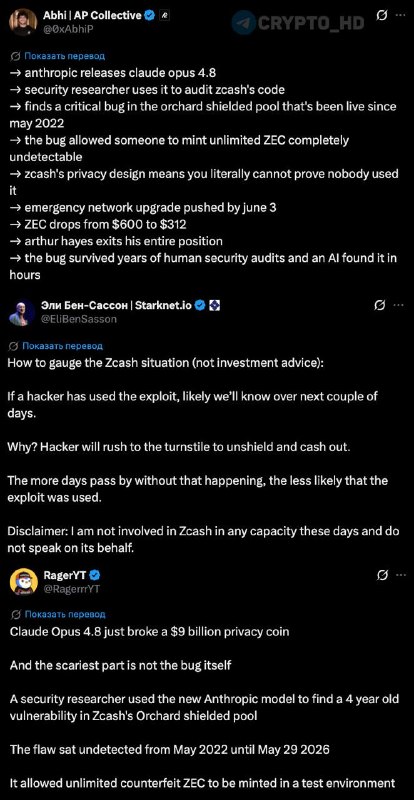
An AP Collective founder said a security researcher using Claude Opus 4.8 found the bug in Zcash’s Orchard shielded pool. The flaw had reportedly been active since May 2022 and could have allowed unlimited ZEC to be minted without detection. The report landed badly because it hit Zcash’s core design, not some peripheral wallet feature. The researcher used Claude Opus 4.8 to audit the code, and the model flagged a flaw human reviewers had apparently missed for years. I’ll be honest: that is impressive, but also grim. The awkward part is not only that the bug existed. It is that Zcash’s privacy model makes it impossible to prove cryptographically that nobody used it. Why does this matter? Because investors are being asked to trust a clean supply without getting the kind of visibility they usually rely on. The emergency network upgrade was in place by June 3 to patch the issue.
The market did not wait for a careful postmortem. ZEC dropped from roughly $600 to $312, and Arthur Hayes exited his position, a sign of how fast confidence can crack when a protocol’s supply integrity comes into question. ZEC had been trading near $600 before the news. Afterward, it crashed to $312. It got ugly fast. That kind of move is not just traders taking profit; it is people asking whether the balance on the screen means what it claims to mean. Hayes leaving his ZEC position added pressure because his trades tend to get noticed. Most guides say security bugs are temporary if patched quickly. That is only half right. This was not Zcash’s first scare either: a similar vulnerability surfaced in 2019 after going unnoticed for years. So the uncomfortable question is simple: if audits missed this twice, what else have they missed?
The Zcash bug weakens the safe haven case for crypto because it points to a different risk: the protocol itself may be less verifiable than investors assumed. Bitcoin often attracts money during geopolitical stress or financial uncertainty, but this case is not about banks or capital controls. It is about whether a coin’s supply can be trusted. For privacy coins, that question gets messy almost immediately. If a hidden supply flaw can sit there for years, and nobody can prove whether it was exploited, investors may hesitate before treating the asset as a store of value. Counter to the usual advice, more privacy is not automatically more resilience. The damage may not stop with Zcash. A less severe version of this problem in a major DeFi protocol could push traders toward more transparent assets like ETH, or briefly drag down the wider crypto market as people cut risk. We have seen that panic before. During the Terra-Luna collapse in May 2022, BTC briefly fell below $27,000 as trust drained out of the market.
The episode also gives regulators another reason to press privacy coins. RagerYT put the tradeoff bluntly: “maximal privacy for users = minimal transparency for everyone else.” Regulators were already wary of privacy coins because of illicit finance concerns. This gives them a cleaner argument. If even the project team cannot prove the supply was never inflated, regulators can ask how exchanges, auditors, and compliance teams are supposed to verify anything. Is that overreach? Maybe in tone, not in logic. That pressure could lead exchanges to delist privacy coins or tighten KYC and AML checks around assets such as Monero (XMR) and Dash (DASH). Liquidity would probably take the hit first. The SEC’s scrutiny of tokens as unregistered securities could also widen if privacy coin vulnerabilities start to look less like isolated bugs and more like a recurring risk category.
Ellie Ben-Sasson argued that the chance of exploitation falls as time passes, since a hacker would probably try to “cash out” within “a couple of days.” That helps a little. It does not solve the bigger problem. His point is practical: if someone had quietly minted a pile of ZEC, they would likely move quickly to turn it into something else. Silence after a few days makes exploitation less likely. Fair enough. But I would not confuse “less likely” with “settled.” Yes, this softens the worst-case scenario from the previous paragraphs; no, it does not erase the issue Claude Opus 4.8 exposed. The model found a bug buried in a live privacy protocol, and now the market has to wonder how many similar flaws are still sitting in other codebases.
What this means
The Zcash incident changes how investors will look at privacy coins and crypto security. AI-based auditing looks more useful now, but privacy-heavy protocols also look harder to trust when supply questions come up. This was not just another bug report. It showed that an AI model could find a serious issue that human auditors missed for years. That part really matters. Privacy is the product for Zcash users, but that same privacy becomes a problem when investors need proof that the supply is clean. My view: the market will start pricing privacy coins with a bigger risk discount, especially compared with assets that are easier to audit in public. Over time, that could separate transparent protocols from coins where opacity is not a feature bolted on later, but part of the design.
Investors should watch ZEC’s price, other privacy coins, and official Zcash Foundation updates. The next few days matter, especially if no evidence of exploitation appears after Ben-Sasson’s “couple of days” window. ZEC’s next moves will show whether traders see this as a patched bug or a lasting trust problem. Monero (XMR) and Dash (DASH) are worth watching too, since fear rarely stays inside one ticker. Any further statement from the Zcash Foundation could affect how much damage sticks. I would also watch whether AI-driven audits become part of standard crypto due diligence. After this, it will be harder for projects to argue that a normal human audit is enough.