
















































Privacy Crypto Developer Activity Jumps: What It Means for Your Portfolio
Privacy crypto developer activity, measured through code commits and project updates, shows whether teams are still shipping or just filling the feed. Santiment’s latest 30-day data shows a noticeable rise in development work across privacy crypto projects, with ChainLink at the top. That matters. I’ll be honest: I trust this signal more than I trust half the noise that hits crypto feeds before lunch. Developer activity does not promise returns. It does show where people are still building while regulators, exchanges, traders, and infrastructure teams argue over what this sector should become.
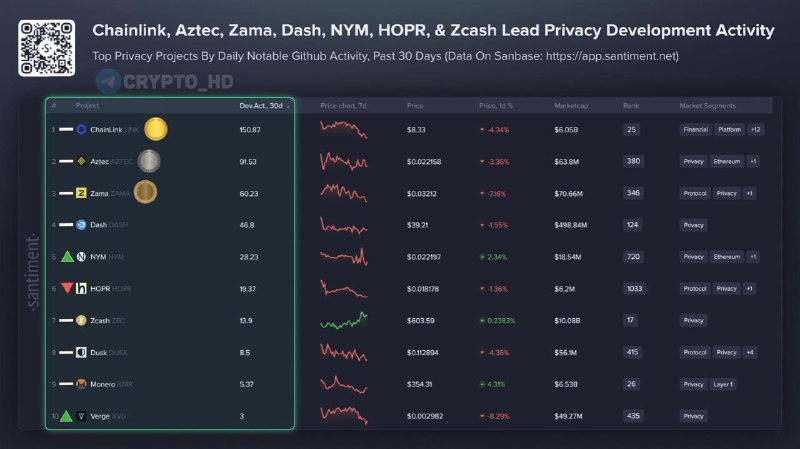
Developer activity can help investors judge whether a crypto project still has technical momentum. Santiment recently ranked the top 10 privacy focused crypto projects by developer activity over the past 30 days. ChainLink came first, followed by Aztec, Zama, Dash, NYM, HOPR, Zcash, Dusk, Monero, and Verge. Retail traders often ignore this metric because it is less fun than a price chart. Fair enough. A GitHub commit does not hit like a breakout candle. Most guides say price action tells the real story. That’s only half right. A steady run of commits can show whether a team is fixing bugs, adding features, maintaining infrastructure, or barely keeping the lights on. In crypto, that gap matters.
Privacy protocol development is picking up while regulators are looking harder at digital assets. This is where the story gets uncomfortable. The renewed developer push is happening as regulation pressure keeps building across the crypto market. Regulators in the United States and abroad are focused on anti money laundering rules and know your customer requirements. Privacy coins sit in the awkward middle because their main feature makes transaction tracing harder. My take: caution is rational here, not cowardly. Some investors will read that as a warning sign, and they are not wrong. But active development may also mean teams are trying to build privacy tools that are sturdier, more selective, or easier to fit around future rules. Why does this matter? Because enforcement has not been neat or predictable. The SEC’s long running case involving Ripple (XRP) showed how messy that can get. ETH felt something similar when the SEC’s stance on staking weighed on the market for a while, before Ethereum recovered as developers kept expanding the network’s capabilities.
The rise in privacy crypto development also points to demand for private blockchain infrastructure. Regulation is only part of the picture. This developer activity also fits the adoption signal for decentralized technology. Banks, payment companies, and large businesses keep testing blockchain systems, but they do not want sensitive data sitting in full public view. No surprise there. Bitcoin (BTC) and Ethereum (ETH) still dominate the market, but privacy focused protocols may have room to grow where public transparency is a liability, not a selling point. ChainLink is a useful example because its oracle network is about secure, verifiable data transfer, not just privacy in the old “privacy coin” sense. Counter to the usual advice, the privacy story is not only about hiding transactions. It is also about selective disclosure, enterprise data handling, and infrastructure that can move information without exposing everything. PayPal’s crypto payment rollout in 2020 gave the market a similar adoption signal, and BTC moved from about $10,000 to more than $20,000 by the end of that year, according to historical market data.
What this means
Steady developer activity in privacy focused crypto projects suggests teams are still working on utility instead of waiting around for another hype cycle. That is the part investors should care about. The privacy sector has taken hits from exchange delistings and regulatory concerns. Reputation damage too. Monero (XMR) and Zcash (ZEC) know that story well. Still, the latest Santiment data suggests developers have not walked away. I would not treat that as a buy signal by itself. But I would treat it as a reason to keep the sector on the watchlist. Older projects may get another look if they keep improving. Newer names like Aztec and Zama could also attract attention if their privacy preserving technology proves useful beyond the narrow privacy coin market.
Investors should watch project milestones, partnerships, and regulatory guidance around privacy technology. Track what these teams release, not just what they announce. We tried this lens on crypto infrastructure names before, and the pattern is usually blunt: shipped integrations beat polished roadmaps. Partnerships matter too, especially when they involve exchanges or institutions. Infrastructure providers count as well. Regulation is the other big variable. Clearer guidance on privacy tools would change the risk profile for many of these tokens quickly. Is this overkill for retail investors? No, not when a single delisting notice can change liquidity overnight. For Monero (XMR), some technical analysts are watching whether price can hold above $150, which may point to improving confidence. For ChainLink (LINK), new integrations and continued developer engagement are the cleaner signals to follow.
FAQ
- What is developer activity in crypto?
- Developer activity means the work happening behind a crypto project, including code commits, updates, bug fixes, and new features. It can show whether a project is still moving forward. Simple test: look for work, not slogans.
- Why is ChainLink leading in privacy crypto developer activity?
- According to Santiment, ChainLink leads this 30-day ranking because developers are still working on secure data transfer and oracle network infrastructure, which can support private and enterprise blockchain use cases.
- How does regulatory pressure affect privacy coins?
- Privacy coins can draw more scrutiny because they make transaction tracing harder. That can create problems with AML and KYC rules, and in some cases exchanges have limited or removed support. Yes, this sounds like it contradicts the bullish developer signal. It does not. It just means the upside comes with a heavier compliance shadow.
- What does increased developer activity signal for investors?
- It suggests a team is still building. That does not make a token a buy, but it can be a useful sign that the project has technical momentum instead of relying only on market hype.
- Are privacy coins becoming more compliant?
- Some privacy technologies are moving toward more flexible designs that try to protect user data while leaving room for compliance. Whether regulators accept that balance is still an open question. My take: that question matters more than the next short-term price spike.