
















































Michael Saylor Bitcoin Sale Dividend Would Test BTC Treasury Demand
A Michael Saylor bitcoin sale dividend would mean Strategy sells some Bitcoin and sends the cash to shareholders. Simple on paper. Ugly in the tape. If the reported plan is real, Strategy would sell part of its BTC to fund dividends and try to prove that a public company can turn a Bitcoin treasury into shareholder income. The source gives no sale size, BTC amount, dividend amount, execution plan, or confirmed date. So on May 5, 2026, the market is not really asking, “How much Bitcoin gets sold?” It is asking whether corporate Bitcoin treasuries can become cash flow machines without losing the whole scarcity mystique. Why does that matter? Because BTC holders care about scarcity, while dividend investors care about the check. Those are not the same crowd.
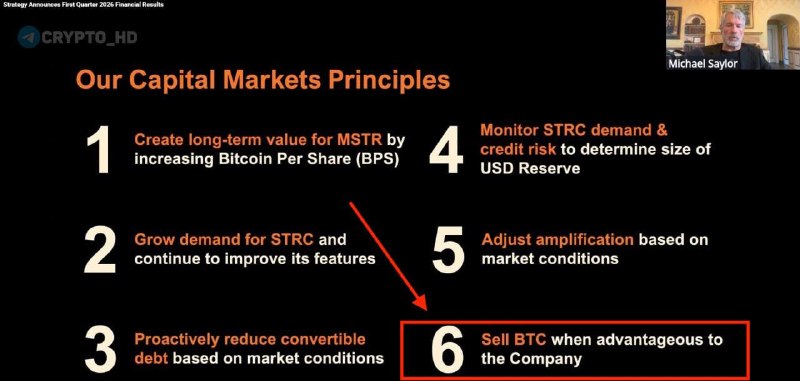
The idea cuts straight into the Strategy trade because investors have long used Strategy as a listed shortcut for Bitcoin exposure. Michael Saylor and Strategy are named directly in the source, and BTC is the only asset mentioned. So this is not just one balance sheet decision. It goes at the model Strategy has sold to public markets for years: hold Bitcoin, raise capital around Bitcoin. Then give equity investors a leveraged way to bet on BTC through a company. Strategy’s own Bitcoin disclosures call Bitcoin its main treasury reserve asset. I’ll be honest: that is why even a small dividend tied to a partial sale would get dissected far beyond its actual dollar size.
A partial BTC sale for dividends would test whether Bitcoin treasury companies can turn holdings into cash without damaging the accumulation story. It could show that a Bitcoin-heavy treasury can pay shareholders and still keep Bitcoin at the center of the company. Most guides frame treasury Bitcoin as a clean accumulation story. That’s only half right. The second a dividend enters the picture, investors start pricing management behavior, not just BTC exposure. Even a small sale would dent the clean “never sell BTC” idea that made Saylor’s holdings such a loud market signal. My read: traders would judge any confirmed sale against BTC’s big round levels, especially $100,000 and $90,000, because treasury-sale headlines hit harder when price is already packed around obvious zones.
The first crypto angle is adoption. A dividend funded by Bitcoin sales would turn corporate treasury strategy into a shareholder payout tool. If Strategy can sell some BTC and pay dividends, other public companies may see a playbook: Bitcoin as treasury reserve first. Bitcoin as shareholder payout source second. That is not the same as a country making BTC legal tender. It is also not a bank launching custody. Still, it fits the adoption bucket because the company, not the protocol, becomes the payout channel. For crypto traders, BTC is the ticker that matters. For equity-linked crypto traders, the question is sharper: after May 5, 2026, does Strategy keep trading like a BTC proxy, or does it start trading more like a capital allocation company?
The second angle is macro flow. Dividends compete with yield, interest rates, and the plain investor desire for income. Yield always has a rival. When U.S. rates stay high, investors ask the obvious question: why hold non-yielding BTC instead of cash, Treasuries, or dividend stocks? Treasury yields are the benchmark for low-risk income, so any BTC-linked dividend structure touches capital allocation. Counter to the usual advice, the danger is not only that Strategy sells BTC. The danger is that investors decide a BTC-linked stock should now be judged partly like an income vehicle. A Strategy Bitcoin dividend would blur the line. It would not make BTC itself yield-bearing. The protocol would not change. But it could make a BTC-linked stock feel more income-oriented. If traders read the move as forced selling, BTC could take the hit first, especially near $100,000, before anyone gives the structure credit.
The liquidity point is hard to dodge because a Bitcoin sale creates spot supply. Borrowing, share issuance, debt financing, and outright BTC selling all hit markets differently. The source says Strategy may sell part of BTC. It does not say borrow against BTC, issue shares, or raise debt. That wording matters. Selling BTC adds spot supply. Full stop. Even without a disclosed BTC amount or dollar figure, the signal could move order books because Saylor-related headlines travel fast across BTC, crypto equities, and derivatives. In market structure terms, spot selling can pressure price when it adds supply into active order books. Is this overkill for one unconfirmed report? Maybe. But for a Saylor-linked BTC headline near $100,000, no. Watch CME BTC open interest and perpetual funding after any confirmed announcement dated after May 5, 2026. If funding jumps above neutral while spot weakens, that looks like leverage chasing the headline, not durable demand.
What this means
A Strategy Bitcoin dividend would suggest the corporate Bitcoin treasury trade may be shifting from pure accumulation to managed monetization. For BTC, that is a tougher market test than another corporate purchase announcement. Can a company sell part of its Bitcoin without making investors think the treasury thesis is cracking? That is the whole trade. BTC is the affected ticker. Strategy is the corporate signal. The level I would watch first is $100,000, because big round BTC prices tend to collect options strikes, leverage, liquidation levels, and headline-driven trading. Yes, this slightly contradicts the clean adoption framing above. Bear with me. A payout can be adoption and still be bearish in the first reaction if the market sees supply before it sees maturity. That does not make $100,000 magic. It just makes it crowded.
The next tradable event is official confirmation from Strategy, not chatter about an unconfirmed sale. Watch the filing. Watch the board statement. Watch the dividend announcement. The source does not provide a date, BTC amount, dividend size, or execution plan, so the next real event is any official Strategy filing, board statement, or dividend announcement after May 5, 2026. My take: do not overtrade the rumor and then pretend it was thesis work. Crypto traders should also watch CME BTC futures positioning, spot ETF flow data, and BTC behavior around $100,000 and $90,000. If BTC absorbs the headline and holds those levels, a Strategy Bitcoin dividend could become an adoption signal. If it breaks, the market may call it by the uglier name: treasury selling dressed up as shareholder return.