
















































Summer.fi Closes After $6M Hack: Another DeFi Casualty
Summer.fi is shutting down after a $6 million hack. Another DeFi project gone. Not the biggest wreck in DeFi history, no. Wormhole and Ronin were much larger. But $6 million is still real money, and if your funds were exposed, that comparison probably lands badly. My take: this is the part DeFi keeps underpricing. Users are not only trusting code. They are trusting audits, multisigs, bridges, admin keys, upgrade paths, and teams they may never meet.
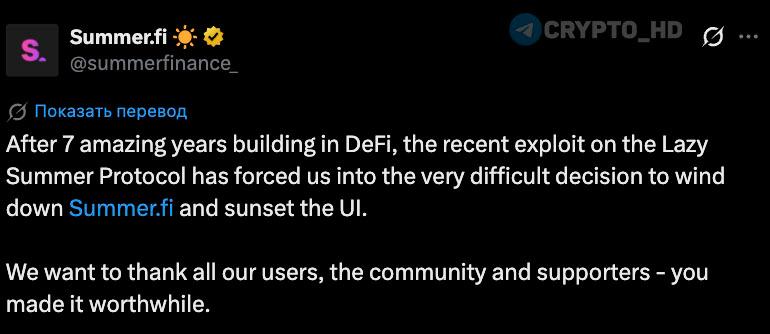
The shutdown was confirmed after a breach drained $6 million from the platform. The first report did not explain exactly how the exploit worked, so the technical details are still worth watching. That part matters. Still, the outcome is already plain: Summer.fi is closing, users took a hit, and DeFi has another bad headline. Most guides say the lesson is “do better audits.” That’s only half right. Wormhole lost more than $320 million. Ronin Network lost about $625 million. Different systems. Different exploits. Same ugly result: one weak spot can erase years of trust in minutes.
Why does this matter? Because trust damage does not show up cleanly on a one-day chart. A hack like this does not hurt only one protocol. It gives banks, funds, and corporate treasury teams another reason to keep DeFi at arm’s length. I’ll be honest: I cannot really blame them. If a firm is thinking about adding BTC to its balance sheet or testing DeFi for treasury management, it has to ask a boring, expensive question: who takes the loss when the code fails? Each hack means another legal review, another security review, and colder faces in the boardroom. Bitcoin may move on after a few hours. The reputation damage takes longer. Market data from a larger DeFi exploit in late March showed BTC slipping 1.2% to $61.4K. Not a crash. Still a warning.
Regulators will use this too. They already had plenty to point at: consumer losses, opaque teams, strange token structures. Also platforms that look decentralized until something breaks. A $6 million hack gives them a clean example. The SEC has been pushing for more transparency and stronger controls around digital assets, and incidents like this make that pitch easier. Counter to the usual crypto reflex, some extra pressure might not be all bad. More licensing rules, audit requirements, enforcement actions, or centralized controls could slow reckless behavior. It could also squeeze the open experimentation that made DeFi interesting in the first place. Yes, that tension is annoying. It is also real. If the industry cannot show it can handle security itself, someone else will write the rules.
What this means
Summer.fi’s closure fits an uncomfortable pattern: DeFi can offer high returns, but the downside can hit all at once. Smart contract risk is not just a line in a disclaimer. It can decide whether user funds are still there tomorrow morning. Is this overkill for a $6 million incident? No, because the number is only part of the story. The immediate effect on BTC or ETH may be small, but the buildup of incidents matters. It can weaken sentiment and make institutional adoption slower, more cautious, and more expensive. Anyone putting serious capital into a protocol should look harder at audits and bug bounties. Then look again at admin controls, upgrade permissions, and the recovery plan after an exploit.
Traders should watch the exploit details first. Skip the victory laps. If the attack used a pattern that applies to other protocols, the story may not stop with Summer.fi. DeFi TVL is worth tracking too. A steady drop would suggest users are pulling back instead of treating this as a single failure. Comments from the SEC, CFTC, or other agencies also matter, especially if they tie DeFi security failures to new enforcement or compliance demands. For BTC, $60,000 is the obvious support level. A break below it could turn a security story into a broader market move if confidence keeps slipping.