
















































Ethereum Staking Volume Record Tops 85M ETH as $196B Locks Up Supply
Ethereum staking has hit a fresh high of 85 million ETH (about $196 billion) in 2026, with roughly 29% of circulating supply now locked across validator contracts, liquid staking tokens, and restaking layers. Glassnode on-chain data puts total staked ETH above 85,000,000 coins, worth around $196 billion at spot. My take: this is not just another chart high. It is a structural supply squeeze, and it is tightening float right as institutional ETH products keep vacuuming up what remains on exchanges. Why does this matter? Because less liquid ETH means thinner books, sharper reactions to flow, and a volatility profile that no longer behaves like 2023 ETH.
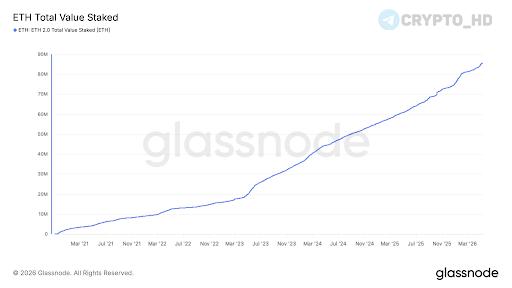
The number is blunt. 85 million ETH locked. More than a fifth of total supply is sitting in validator contracts, liquid staking protocols, and restaking layers. Per Glassnode, this print is a fresh all-time high for ETH staking. The trend started compounding after Shapella in April 2023 unlocked withdrawals and proved the exit queue actually works. People could leave. They mostly didn’t.
Staked ETH is duration capital, not short-term trading inventory, which structurally reduces sell-side liquidity on exchanges. Here’s the part I keep coming back to: nobody stakes $196 billion for a yield they plan to dump next week. Yes, that sounds obvious. It still gets underpriced. Every coin pulled into staking is a coin that is not sitting on Binance or Coinbase waiting to get sold into strength. Most supply-side takes stop there. That’s only half right. The bigger issue is what happens on rallies, when sell-side liquidity thins faster than order books imply and the staked share starts acting like a one-way door until exit queues say otherwise.
US spot ETH ETFs currently do not pass staking yield through to holders, which leaves native on-chain stakers as the only participants earning Ethereum’s roughly 3% base reward plus restaking premiums. There is a regulation angle stitched into this number, too. Per public SEC filings and issuer disclosures, US spot ETH ETFs still do not pass staking yield through. That leaves TradFi flows parked in a non-yielding wrapper while on-chain stakers collect roughly 3% native plus restaking premiums. Is that inefficient? Absolutely. If the SEC eventually green-lights staked ETH ETFs (a fight that’s been quietly building for two years), the 85M figure starts looking less like the ceiling and more like the floor of a much bigger institutional bid. Issuers have been telegraphing this for months. The on-chain side is already positioned.
With approximately 29% of circulating ETH now staked, combined with EIP-1559 fee burn, Ethereum’s net issuance has trended toward zero and occasionally turned negative since the Merge in September 2022. Worth slowing down here. About 29% of circulating ETH is staked, the highest ratio the asset has ever recorded. Combine that with EIP-1559 burn during high-fee periods and ETH’s net issuance keeps drifting toward zero. Sometimes negative. I’ll be honest: the deflation case used to sound cleaner in pitch decks than it looked on-chain. This staking print gives bulls the proof slide they wanted after the Merge.
The largest concentration risk in ETH staking sits with Lido (the dominant liquid staking protocol) and EigenLayer (the leading restaking layer), which together stack protocol and slashing risks on top of base validator economics. Counter to the easy bull read, more staking is not automatically cleaner market structure. Per Dune Analytics and DefiLlama, Lido custodies a meaningful chunk of staked ETH on its own, and EigenLayer restaking has stacked new slashing surfaces on top of base validator risk. That does not break the thesis. It complicates it. The $196 billion is not homogenous capital, and a protocol-level incident at the largest LST or a major AVS slashing event would hit price faster than the headline number suggests.
What this means
The 85M ETH staking milestone is a supply-side signal: it reduces float available to absorb large market buys, which makes ETH price reactions more asymmetric in both directions. The signal is supply-side, not demand-side. That distinction matters if you trade ETH from here. With 85M ETH staked and ETF flows still net-positive on green days, the float available to clear large market buys keeps shrinking. Expect sharper upside wicks on positive catalysts. Expect faster drawdowns when stakers rotate, because exit queue unwinds show up on-chain before they hit spot. Yes, this slightly contradicts the “locked supply” framing two paragraphs ago. Bear with me: locked supply is bullish until the market starts pricing the unlock path. ETH/BTC is the cleaner expression than ETH/USD as long as Ethereum-native yield stays above zero.
Watch four things next. First, the validator entry queue on beaconcha.in. If it stays positive into the next FOMC, the supply squeeze thesis holds. Second, any SEC commentary on staking-enabled ETH ETFs; even an informal signal would re-rate the 85M figure as a launching pad. Third, the staking yield itself. If it compresses below 2.5% net of MEV, marginal stakers may unwind. Fourth, Lido and EigenLayer risk signals, because that is where the clean headline can get messy fast. The 85M number is now the level to defend, not just the floor to build from.