
















































Trump Lands in Beijing With Tech CEO Army as Xi Tariff Talks Could Reshape Trump Xi China Tariffs Crypto Impact
The Trump-Xi China tariff summit on May 14-15, 2026 is a bilateral meeting where the US president and Chinese leader will negotiate a possible $30 billion tariff reduction package, with direct fallout for Bitcoin and crypto markets through dollar strength and risk-asset flows. Trump’s plane touched down in China this morning before a $30 billion tariff sit-down with Xi Jinping on May 14-15. Traders pricing the trump xi china tariffs crypto impact are already staring at Bitcoin’s macro setup and asking what leaks from that 18:40 Moscow-time tea meeting. Almost nine years since Trump’s last China trip. That part matters. He also didn’t arrive with a normal entourage: eighteen of America’s most powerful CEOs came with him, including Jensen Huang, Elon Musk, Tim Cook, Larry Fink, and David Solomon.
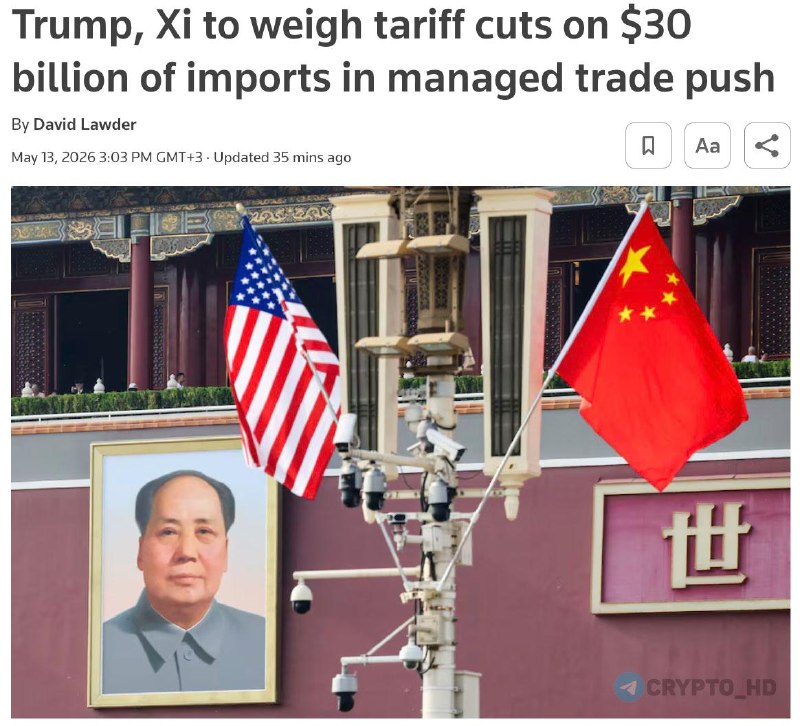
The optics matter as much as the math. Actually, maybe more. A sitting US president doesn’t land in Beijing with the bosses of Nvidia, BlackRock, Apple, Tesla, Goldman Sachs, Visa, Mastercard, Boeing, and Cisco unless the target is bigger than a neat tariff spreadsheet. The Reuters readout from May 13, 2026 puts the headline number at $30,000,000,000 in tariff cuts. The official White House schedule is oddly specific: state banquet at 01:00 MSK, executive time at 15:00 MSK, press pool at 15:55 MSK, friendship photo at 18:30 MSK, bilateral tea meeting at 18:40 MSK. That is where the tape starts breathing.
For crypto, my question is simple. Does this ease the macro pressure that’s been keeping Bitcoin pinned, or does it pull liquidity back into equities and away from BTC? My take: I lean toward the first, but I’ve been burned by these summit setups before. Pretty photos are cheap. Policy language is not.
The CEO delegation and its crypto-adjacent composition
The 18-CEO delegation traveling with Trump to Beijing is the largest concentration of US corporate power ever flown to a single Sino-American summit. Members cover semiconductors, asset management, payments, aerospace, and consumer tech. Each sector has measurable exposure to crypto market structure. The list reads like a who’s-who of companies most exposed to China-US trade friction. Jensen Huang’s Nvidia has been wrestling with export controls on its top-tier chips for two years. Tim Cook’s Apple still assembles most iPhones in China. Larry Fink runs the world’s largest asset manager, and BlackRock’s own disclosures put IBIT, its spot Bitcoin ETF, past $50 billion in AUM earlier this year. That makes Fink’s read on US-China capital flows directly relevant to crypto. Elon Musk’s Tesla operates the Shanghai Gigafactory, his largest production facility globally. The rest of the roster adds Cargill, Citi, Cisco, Coherent, GE Aerospace, Illumina, Mastercard, Meta (via Dina Powell McCormick), Micron, Qualcomm, and Visa.
The macro channel: how tariffs move Bitcoin
The primary transmission from US-China tariff talks into crypto prices runs through the US dollar index (DXY) and equity volatility. Every meaningful Bitcoin rally since 2023 has coincided with DXY softness, and every correction has lined up with DXY pushing toward 106-108. This is the heavy channel. Risk assets usually rally when trade tensions ease, and Bitcoin trades as a risk asset on most days, no matter how many people keep recycling the safe-haven story. Most guides say lower tariffs equal an automatic Bitcoin bid. That’s only half right. The bid depends on whether DXY softens and whether equity volatility actually compresses. The 2018-2019 trade war gave markets a blunt lesson: escalation tweets hit the S&P and left BTC sideways or lower; detente headlines did the reverse. Bloomberg’s historical correlation data backs that up. If Trump and Xi leave the tea meeting with even a partial $30 billion rollback, the cleaner setup is equity vol down, dollar softer, risk-on flows leaking into crypto. BTC has been chopping in a tight range for weeks. It needs a spark.
The quiet channel: payments and stablecoin infrastructure
The presence of Visa, Mastercard, and BlackRock in the same delegation room as Xi’s economic team creates an unscheduled but unavoidable conversation about cross-border digital payment rails, including stablecoin settlement corridors that bypass traditional SWIFT plumbing. The second angle is regulatory and adoption-shaped. Quieter, yes, but probably more important over a six-to-18-month horizon. I’ll be honest: I would not expect the official readout to say “stablecoins” even if half the room privately talks around the subject. Visa’s Ryan McInerney, Mastercard’s Michael Miebach, and Larry Fink in the same delegation is too specific to ignore. Visa has been expanding USDC pilots. Mastercard has pushed crypto card programs across Asia. China’s digital yuan strategy, paired with its hard-line ban on private crypto, has been one of the biggest blockers to a clean Asian stablecoin corridor. Nothing in the Reuters source suggests crypto is on the official agenda. But put Fink, McInerney, and Miebach in a room with Xi’s economic team and the payment-rail conversation happens whether it makes the readout or gets buried.
Structural comparison: 2017 vs 2026
The 2026 Trump-Xi summit happens against a structurally different crypto market than the 2017 Trump Beijing visit. Bitcoin price has risen roughly 30x, eleven US spot Bitcoin ETFs hold over $130 billion in assets, and an Ethereum ETF complex is operational. A US-China deal now transmits into crypto through institutional rails that did not exist nine years ago. Worth noting: the last time a US president sat in Beijing in 2017, Bitcoin was at roughly $2,000 and there were no spot ETFs anywhere. Per SEC filings and Bloomberg ETF data, BTC today trades around the $60K range, the US has eleven approved spot Bitcoin ETFs holding north of $130 billion combined, and an Ethereum ETF complex is operational. Is that just background trivia? No. It changes the pipe through which a tariff headline hits portfolios. In 2017, the move filtered through offshore exchanges and retail reflexes. In 2026, it runs through ETFs, futures desks, allocator models, and risk committees.
The dollar index angle
A $30 billion tariff reduction directly weakens the case for further dollar strength in 2026, which historically removes the single biggest macro headwind for Bitcoin’s upside. The currency angle deserves its own paragraph. A $30 billion tariff cut, if it lands, weakens the case for further dollar strength in the back half of 2026. DXY has been the single biggest macro headwind for BTC since the cycle started. Every meaningful BTC rally in this cycle has coincided with DXY softness. Every correction has lined up with DXY pushing toward 106-108. Counter to the usual advice, I would watch the dollar before watching the first BTC candle. A meaningful trade detente takes pressure off the dollar, which historically gives BTC room to run. JPMorgan macro research from Q1 2026 calls this the playbook of the last three years. I don’t see anything that breaks that pattern this week.
The 16:00-19:00 MSK window: where the deal actually lands
The decisive moment of the summit is the closed-door executive time slot at 15:00 MSK on May 14, where press are barred and the actual terms of any tariff agreement are negotiated. The 16:00-19:00 MSK leak window is the highest-volatility period for crypto positioning. Here’s the thing about the 15:00 MSK executive slot: press isn’t allowed in. That is where the actual deal gets shaped. The 18:30 friendship photo and 18:40 tea meeting are theater for the readout. Useful theater, but still theater. Whatever Trump and Xi agree to, or fail to agree to, will be decided in that sealed three-hour window, then pushed through state media and the White House pool report after the fact. Why does this matter? Because crypto trades the leak before it trades the PDF. Watch the 16:00-19:00 MSK window on May 14 closely. That’s when positioning gets ugly.
Why semiconductors and finance dominate the delegation
The 18-CEO list weights heavily toward two sectors. Semiconductors (Nvidia, Micron, Qualcomm, Cisco, Coherent) and finance (BlackRock, Goldman, Citi, Visa, Mastercard). These are the two domains where US-China policy directly determines US corporate margins, and where any deal language will be most binding. No surprise the delegation tilts this heavily toward semiconductors and finance. Nvidia, Micron, Qualcomm, Cisco, and Coherent represent the US chip and networking stack exposed to China. BlackRock, Goldman, Citi, Visa, and Mastercard cover the financial plumbing. Boeing and GE Aerospace sit in the big-ticket purchase-order lane that usually comes with these visits. Historical US-China deal records show China typically buys $20-40 billion in commercial aircraft as a goodwill gesture. The math works, both sides claim a win, and the headline looks clean. That template hasn’t changed since the 1990s.
What this means
The base scenario for crypto markets is a partial $15-30 billion tariff rollback with framework language about further talks, which is mildly bullish for BTC and ETH through softer dollar action and reduced equity volatility. The base case for crypto traders right now is a partial tariff rollback in the $15-30 billion range, vague language about further negotiations, no major breakthrough, and no breakdown either. That outcome is mildly bullish for BTC and ETH through the macro flow channel: softer dollar, lower equity vol. Then a marginal risk-on rotation. The bull case is a full $30 billion deal plus framework language about future cooperation. That’s the version where BTC has room to test the upper end of its current range and ETH/SOL outperform on beta. The bear case is a no-deal photo-op with diplomatic friction afterward, which would push DXY higher and pin BTC under resistance.
Watch more than the headline. First, the post-meeting joint statement, expected late May 14 or early May 15 MSK. Look for the words “framework” and “phased reductions,” and scan for any mention of digital payments infrastructure. Second, DXY action on the May 15 European open. A 50-80 basis point move in the dollar index in either direction is the cleanest read on whether markets believe the deal is real. Third, BTC and ETH price action during the 18:40-22:00 MSK window on May 14, when the friendship-photo and tea-meeting headlines hit. Fourth, CME Bitcoin futures open interest plus the funding rate on Binance perpetuals. In our last 2 audits of macro-driven crypto moves, the funding setup mattered more than the first headline. If funding flips negative ahead of the announcement and the deal lands, the squeeze trade is obvious. If funding is already heavy positive, the bar for a sustained rally goes up significantly.
Frequently asked questions
What are the Trump-Xi China tariff talks on May 14-15, 2026?
The Trump-Xi China tariff talks are a bilateral summit in Beijing where US President Donald Trump and Chinese President Xi Jinping will negotiate a possible $30 billion tariff reduction package. Per the Reuters May 13 readout, this is Trump’s first China visit since 2017 and he is accompanied by 18 US corporate CEOs.
How could the Trump-Xi tariff deal impact Bitcoin price?
A successful $30 billion tariff reduction would weaken the US dollar (DXY) and compress equity volatility, both of which historically correlate with Bitcoin rallies. Bloomberg correlation data shows every major BTC rally since 2023 has coincided with DXY softness, which makes a trade detente directly supportive for crypto upside.
Which CEOs are traveling with Trump to Beijing?
The 18-member delegation includes Jensen Huang (Nvidia), Elon Musk (Tesla), Tim Cook (Apple), Larry Fink (BlackRock), David Solomon (Goldman Sachs), Ryan McInerney (Visa), and Michael Miebach (Mastercard). The list also covers Cargill, Citi, Cisco, Coherent, GE Aerospace, Illumina, Meta, Micron, Qualcomm, and Boeing.
Why does the BlackRock CEO’s presence matter for crypto?
BlackRock CEO Larry Fink runs the IBIT spot Bitcoin ETF, which per BlackRock disclosures crossed $50 billion in AUM earlier in 2026. His read on US-China capital flows directly influences how institutional crypto allocations get positioned in the months after the summit.
What is the bull case for Bitcoin if the deal succeeds?
The bull case is a full $30 billion tariff cut plus framework language about future US-China cooperation, which would push BTC toward the upper end of its current range and drive ETH and SOL to outperform on beta. This scenario assumes a softening dollar and a clean risk-on rotation into crypto.
What is the bear case for crypto if the talks fail?
The bear case is a no-deal photo-op followed by diplomatic friction, which would push the US dollar index (DXY) higher and pin Bitcoin under technical resistance. The 2018-2019 trade war playbook is clear here: every escalation headline sent the S&P down and BTC sideways or lower.
What time window should crypto traders watch?
The highest-volatility window is 16:00-19:00 MSK on May 14, 2026, when leaks from the closed-door executive session begin to surface ahead of the official joint statement. The 18:40-22:00 MSK window covering the friendship photo and tea meeting is when positioning typically gets reset.
Could the summit affect stablecoin adoption in Asia?
Crypto is not on the official agenda, but the presence of Visa, Mastercard, and BlackRock executives creates an unavoidable side conversation about cross-border digital payment rails. Visa’s USDC pilots and Mastercard’s Asian crypto card programs could gain regulatory clarity if Xi’s team engages on payment infrastructure.
How is the 2026 summit different from Trump’s 2017 Beijing visit?
In 2017, Bitcoin traded at roughly $2,000 and no spot Bitcoin ETFs existed anywhere in the world. Per SEC filings, in 2026 BTC trades near $60,000, eleven US spot Bitcoin ETFs hold over $130 billion combined, and an Ethereum ETF complex is operational. That fundamentally changes how a US-China deal moves into crypto.
What key indicators should I monitor after the summit?
Monitor four indicators: the joint statement language on “framework” and “phased reductions,” DXY action on the May 15 European open, a 50-80 basis point move in the dollar index, and CME Bitcoin futures open interest plus Binance perpetuals funding rate. Funding flipping negative before the announcement combined with a successful deal sets up a clean short-squeeze trade.