
















































US government crypto transfers continue: $19.6M USDT to Coinbase Prime
The US government moved another $19,615,000 in Gotbit-linked USDT to Coinbase Prime. My take: this looks less like a random wallet shuffle and more like another inch forward in the slow sale of seized crypto. By itself, $19.6 million will not shake the market. It matters anyway. Why? Because it puts supply closer to exchanges at the exact moment traders are already jumpy about enforcement-linked assets.
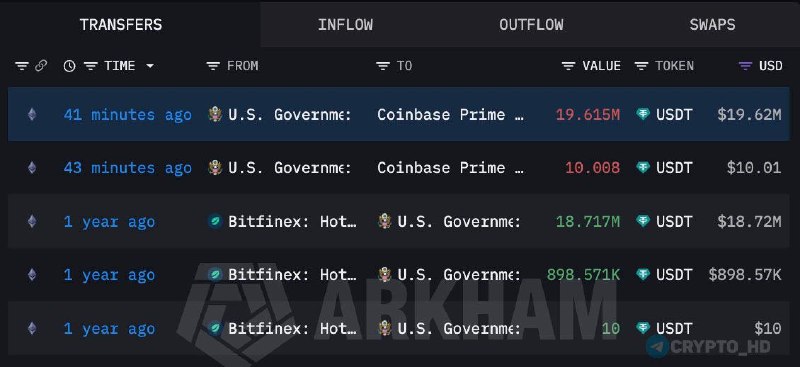
This did not happen in isolation. Earlier transfers included ETH, USDT, and USDC tied to FTX/Alameda, plus $244 million in BTC. Most guides frame these moves as simple “government selling.” That is only half right. The real pattern is procedural: authorities seize digital assets through court cases or enforcement actions, then eventually need to convert those assets into dollars.
That creates a real macro flow problem. When the government sends millions in USDT to Coinbase Prime, it probably is not just tidying up a wallet. It is likely preparing to sell the assets or manage them through a regulated venue. That can add exchange supply. It can also make traders hesitate. Again, $19.6 million in USDT is small next to the total stablecoin market, so I would not overstate the single transfer. The repeated transfers are the signal. A $244 million BTC move during thin liquidity can hit order books quickly. BTC briefly traded below $60,000 in early May. Government sales were not the only reason. Still, they did not exactly give buyers a reason to lean in.
There is also the regulation pressure angle. I’ll be honest: this part gets overstated by crypto Twitter, but it still matters. When law enforcement seizes crypto and liquidates it through Coinbase Prime, it shows how visible these funds have become. It also shows where the government is willing to transact: regulated platforms built for institutions. You could treat that as a quiet nod to Coinbase, but I would not push that too far. The clearer message is simpler. Funds tied to illegal activity can be tracked, frozen, seized, and sold. SEC and CFTC pressure is still hanging over exchanges and asset managers, especially around staking, stablecoins, and token listings. Ongoing cases against major exchanges keep weighing on confidence. Money avoids legal smoke.
These are not just wallet movements on a block explorer. They change trader behavior. Counter to the usual advice, the transfer itself can matter before the actual sale happens, because traders price in the next step. Regular selling of seized BTC, ETH, or stablecoins creates a supply overhang, even when the timing is uneven. Is this overkill for one USDT transfer? Maybe. For a sequence that includes ETH, USDT, USDC, and $244 million in BTC, no. The risk gets sharper around news events or quiet market hours, when liquidity is thinner and one large transfer can make everyone stare at the chart. Volatility often picks up around these moves. No mystery there.
What this means
The $19.6 million USDT transfer suggests the US government is still working through seized crypto assets. More sales are likely. Not every transfer will move the market, but repeated BTC and ETH liquidations can affect sentiment, especially when traders are already watching support levels closely. I would watch Coinbase Prime flows first, then widen out to other major venues. These moves can appear before a sale or right around it. They also support the idea that regulated platforms will keep attracting institutional flow, partly because governments and large asset managers need venues that can handle compliance.
Watch known government wallets for large transfers. BTC and ETH matter most. Big stablecoin moves can still be a clue. If a government-linked wallet suddenly sends assets to a prime brokerage or major exchange, a sale may be coming, and short term dips become more likely. Yes, this slightly contradicts the “$19.6 million is small” point above. Bear with me: size matters, but timing matters too. Legal updates matter as well. FTX bankruptcy news or new enforcement actions can set up the next round of liquidations. For BTC, the $60,000 area is still worth watching. If government selling lands during weak liquidity, that level could get tested again.