
















































Japan AI Blockchain Financial System Push Signals Stablecoin Adoption Trade
The “Japan AI blockchain financial system” refers to a national plan, approved by Japan’s ruling party, that brings together AI agents, blockchain, yen stablecoins, and tokenized banking. My take: the source post reads less like crypto marketing and more like a blueprint for payment plumbing. Japan wants a 24/7 on-chain financial system for an “agent economy,” backed by a five-year investment plan involving the state and private companies. That is the part traders should not wave away. BTC, ETH, and tokenized cash rails are being discussed as infrastructure, not just speculative chips on a screen.
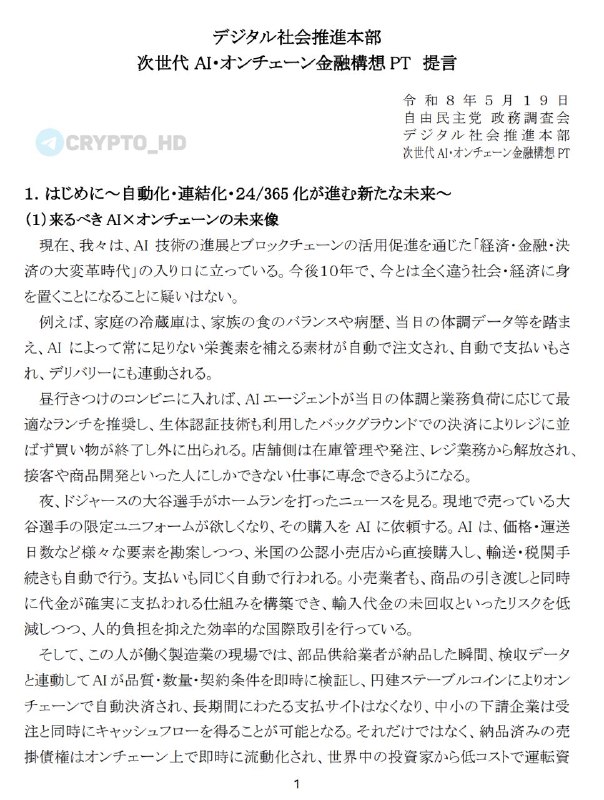
According to the source post, Japan’s ruling party has approved the idea of a national financial system built on AI and blockchain. Japanese authorities expect AI agents to buy goods and services for people in the future. Why does that matter? Because autonomous payments need programmable rules, traceable records, and transactions that are difficult to alter later. Blockchain fits neatly into that policy problem. The plan includes tokenized banking infrastructure, Japanese yen stablecoins, and discussions about tokenizing Bank of Japan deposits. It also mentions Japan-Asia cooperation on AI and blockchain. Borders get messy fast.
For crypto markets, Japan’s move is a serious adoption signal. This is not a pocket-sized pilot or another token demo with a press release attached. Japan is talking about basic financial infrastructure. When a G7 country describes blockchain as payment infrastructure for AI agents, ETH gets attention because smart contracts are still the main language for programmable settlement. BTC matters too, mostly because institutions still use it as the cleanest liquid proxy for sovereign-level crypto adoption. After the U.S. spot Bitcoin ETF approvals on January 10, 2024, BTC moved from about $46,000 to more than $73,000 by March 14, 2024. Regulated access can reprice crypto quickly. We have already seen that.
Yen stablecoins may be the cleaner trade here. I’ll be honest: BTC will get the headline, but the source points more directly at settlement tokens. It specifically mentions Japanese yen stablecoins and tokenized banking infrastructure, which puts the action closer to banks, merchants, and machine-to-machine payments. That shifts attention beyond BTC. ETH and L2 networks deserve a closer look. So do tokenization-linked protocols. ETH traded around $3,800 when U.S. spot Ether ETFs began trading on July 23, 2024. The flows were not instant magic, but the market still treated ETF access as validation. If Japan moves from concept to working infrastructure over the next five years, regulated on-chain money could get a similar stamp.
The macro-flow angle is easy to miss, but traders should not ignore it. A 24/7 on-chain financial system for AI agents could make money more programmable, more trackable, and faster to move. That sounds bullish. Not so fast. That does not mean BTC is automatically bullish on May 19, 2026. Rates, inflation, and the dollar still run the room. If yen stablecoins grow inside Japan’s banking system, though, crypto gets another fiat bridge that is not tied only to U.S. dollar stablecoins. That could matter during rate cycles, especially around the June 16-17, 2026 FOMC meeting, when risk assets will again trade on real yields and dollar liquidity.
Regulation is part of the story. The source does not say Japan is loosening rules or giving crypto a free pass. It describes a state and private sector framework for AI, blockchain, tokenized deposits, and stablecoins. Most crypto takes treat regulation as a brake. That is only half right. In this setup, regulation could become the distribution channel, which usually favors exchanges, custodians, and banks that can handle heavy compliance. COIN is the obvious listed proxy for U.S. exchange regulation, but Japan’s signal is wider than one stock. COIN rallied more than 300% in 2023 as U.S. spot ETF optimism, higher crypto volumes, and the post-FTX custody trade came back into public markets.
Investors need to separate what the source says from what markets want it to say. The source does not say Japan has launched a live yen stablecoin. It does not say a Bank of Japan deposit token has been approved. It does not name a private partner. It gives no launch date. It says the ruling party approved a concept, authorities are discussing tokenized Bank of Japan deposits, and a five-year investment plan is being prepared with state and private sector involvement. That is still material. Slow policy can look boring until the market suddenly decides it was obvious all along.
The AI-agent piece may be the part traders should take most seriously. If software agents are going to buy goods and services on their own, payment systems need rules, identity checks, spending limits, audit trails, fraud controls, and fast settlement. Card networks can handle some of that. They were not built for autonomous software buying things at all hours. Is blockchain the only answer? No. But it gives policymakers a tidy package: transparent records, programmable money, and data that is harder to tamper with. For crypto traders, that points more toward infrastructure assets, stablecoin issuers, and custody providers than another retail altcoin rush.
There is also a regional angle. The source says Japan wants more cooperation with other Asian countries on AI and blockchain. Asia already accounts for a large share of global crypto trading hours, stablecoin use, and exchange liquidity. If Japan pushes yen stablecoins and tokenized banking through regional channels, cross-border settlement rails could see more institutional demand. BTC remains the broad global beta trade. ETH is the programmable settlement trade. Stablecoin infrastructure is quieter, more balance-sheet driven, and probably less flashy on crypto Twitter. One detail matters: the source names Japan and Asia, but it does not name Singapore, South Korea, Hong Kong, or any other specific partner.
The risk is that markets treat a policy concept like a finished product. Crypto has done this before. A government mentions blockchain. A policy paper uses tokenization language. Traders start pricing in a live rollout by Monday morning. We tried this mental shortcut in prior cycles. It broke. The source says five years. It does not say immediate launch. That makes this a medium-term adoption signal, not a near-term catalyst. For BTC, the direct price impact may be muted unless global liquidity improves. For ETH and tokenized finance, the signal is cleaner because the plan talks directly about programmable infrastructure, stablecoins, and bank deposits.
The Bank of Japan deposit-token discussion deserves close attention. Tokenized central bank or commercial bank money could compete with private stablecoins, support them, or box them in. Yes, this complicates the clean stablecoin bull case from a few paragraphs ago. Bear with me. The design decides the outcome. If tokenized deposits become the preferred regulated settlement asset, private yen stablecoins may need bank partners and strict reserve rules. If stablecoins can circulate alongside deposits, exchanges and payment firms could get a new on-chain funding rail. The source does not answer that question. It only says Bank of Japan deposit tokenization is under discussion. For a serious crypto desk in 2026, that is enough to keep Japan banking policy on the screen.
What this means
Japan’s ruling-party approval suggests the next crypto adoption cycle may be less about retail speculation and more about national financial infrastructure for AI agents, tokenized banking, and stablecoins. My take: the trade is wider than BTC, but BTC still sets the emotional temperature. BTC works as the broad adoption proxy. ETH matters for programmable settlement. Yen stablecoin rails matter for fiat liquidity. Public equities like COIN matter as high-beta markers for compliant crypto infrastructure. The market test is simple enough: can BTC hold major psychological levels during macro stress while ETH and tokenization-linked assets outperform on policy headlines? Traders should also watch June 16-17, 2026, when the FOMC decision could reset dollar liquidity and risk appetite across BTC and ETH.
For the next move, traders should watch Japan’s timeline, yen stablecoin details, and CME BTC futures positioning around the June 2026 FOMC window. More specifically, look for any date tied to the five-year state and private investment plan, any official language on yen stablecoins or tokenized Bank of Japan deposits, and any shift in BTC futures positioning before the Fed decision. Is this overkill for one policy source? For a one-day scalp, yes. For a medium-term adoption trade, no. If BTC holds above major round-number support while ETH shows relative strength on tokenization headlines, the market will treat Japan as an adoption trade. If dollar liquidity tightens after June 17, 2026, even a strong Japan AI blockchain financial system story may have to wait before it shows up in price.