















































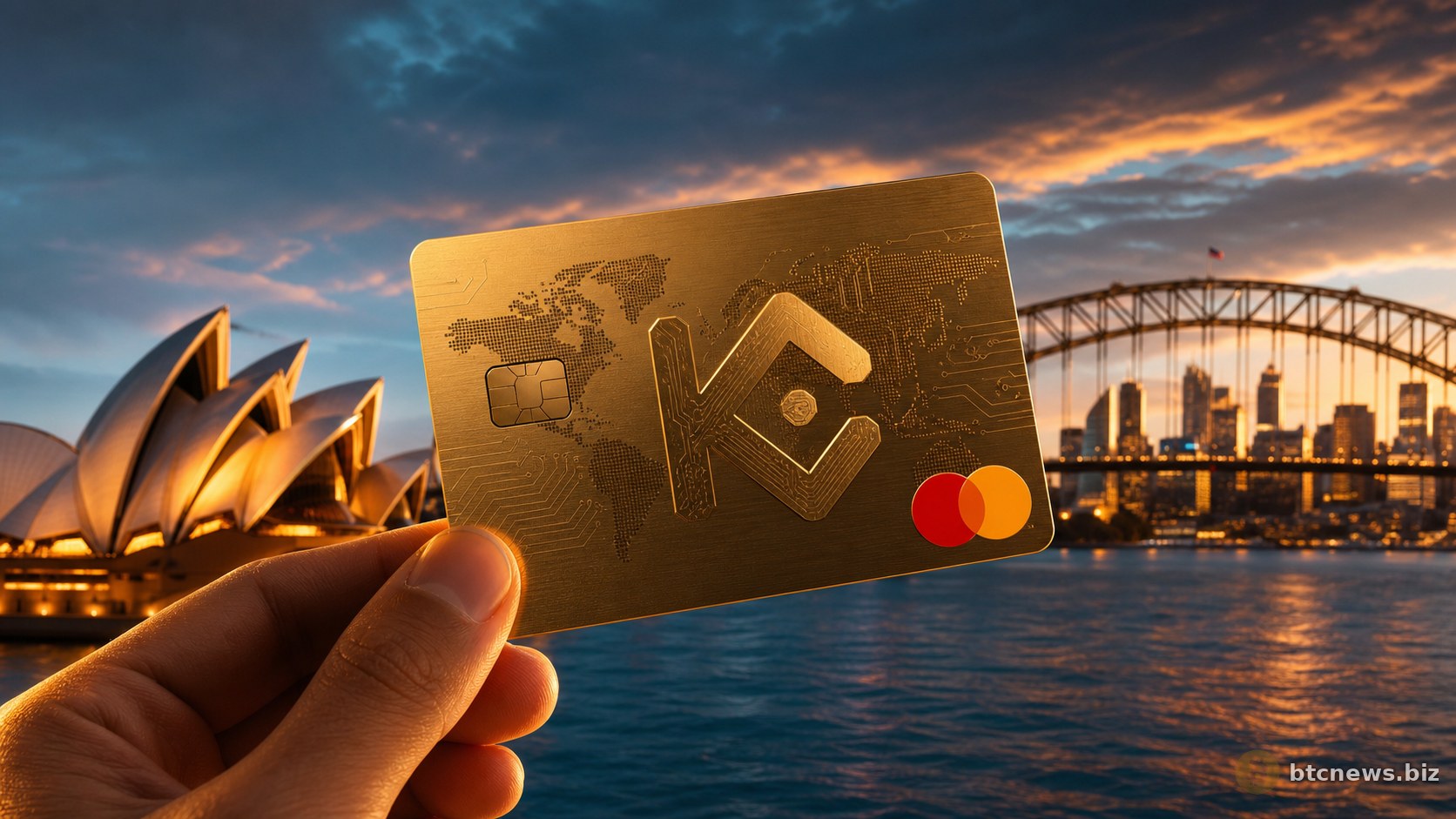
KuCoin Australia’s “Evolution” Points to Regulation and a Mastercard Launch
KuCoin Australia’s “evolution” story is not really about branding. It comes down to two moves: AUSTRAC oversight and a Mastercard-linked crypto debit card. The timing looks deliberate. KuCoin says 22% of Australians now hold digital assets, and it wants $USDC to feel less like money parked on an exchange and more like money you can use. At launch, the card supports 37 stablecoin trading pairs. My take: that number matters more than the launch copy. Price still matters, of course. But regulated access is starting to look like an advantage by itself.

Regulatory compliance and market expansion
KuCoin is building out its Australian operation with local compliance and an actual Sydney CBD office. That is not flashy. It is the point.
The exchange has appointed James Pinch as Australian Managing Director and opened an office in Sydney’s Central Business District. It also registered as a digital currency exchange with AUSTRAC in November 2025. That puts KuCoin under formal oversight in Australia and gives it access to more than 20 million adult consumers. Pinch called the move an “evolution.” CEO BC Wong called AUSTRAC registration “a key milestone” in KuCoin’s global compliance setup. Most crypto launch stories try to make the product sound bigger than the paperwork. Here, I think the paperwork is the story.
KuCard launch and stablecoin utility

KuCard is KuCoin’s attempt to make crypto payments feel like an ordinary card purchase, not another crypto chore.
KuCoin announced KuCard on April 24, 2026, alongside a 500 $USDC giveaway share. The card launched first as a virtual card. Australian users can make crypto-backed purchases anywhere Mastercard is accepted, including through Apple Pay and Google Pay. Payments can use $USDC, then convert into fiat for settlement right away. Simple pitch. Hard product. Why does this matter? Because the weak spot in crypto payments has never been the slogan; it has been the awkward jump from exchange balance to real-world checkout.
The impact of regulation on exchange valuations
Regulation now changes how investors value exchanges. Fast.
For traders, this is the sharper angle. When the SEC sued Coinbase on June 6, 2023, COIN fell about 12% that day, according to market data. That showed how fast legal risk can hit exchange valuations. KuCoin is taking the other route in Australia by emphasizing AUSTRAC registration, local supervision, and a product built around compliance. Counter to the usual advice, this is not just about avoiding enforcement risk. It is about making regulated distribution part of the product. If more exchanges copy that model, regulated access may matter as much as fees. Listings and leverage still count, but they may not be enough in 2026.
Stablecoin utility and market structure

KuCard gives $USDC a cleaner payment use case by letting users spend stablecoins instead of volatile crypto assets.
The second angle is stablecoin utility. KuCard’s use of $USDC and 37 related trading pairs gives users a way to spend without pulling out BTC or ETH at checkout. That matters. Nobody wants to buy lunch with an asset that might move 5% before dinner. Yes, this partly contradicts the usual “crypto is for upside” framing. Bear with me. Distribution can change a market when people have a real reason to use the product. BTC traded near $46,000 around the January 11, 2024 U.S. spot bitcoin ETF launch, then rose above $73,000 in March 2024. KuCoin is applying a similar distribution idea to payments. Not ETFs.
Macroeconomic factors and crypto liquidity
Rates still matter. Better payment tools do not make crypto immune to liquidity cycles.
There is also a macro layer for BTC, ETH, COIN, and stablecoin liquidity. The next FOMC meeting is scheduled for June 16-17, 2026, and rate expectations can still decide whether crypto trades like a risk asset or an adoption story. I would separate the two here: KuCard may help usage, while rates may still crush appetite. A Mastercard rail does not magically protect $USDC demand from tighter liquidity. If rates stay high, investors may prefer cash-like yield over speculative rotation, even as payment use cases improve. Is that unfair to the product? Maybe. Markets are not fair.
Understanding user behavior and product design
KuCoin’s product choice fits how Australians already move money into crypto accounts.
KuCoin’s Australia Market Report found that funding access was a “defining theme” for local crypto users. More than half use bank transfers to top up crypto accounts. Just over 40% use credit and debit cards. Less than a third use digital wallets. Less than a quarter use P2P trading. Those numbers explain KuCard better than any launch slogan. I’ll be honest: this is the cleanest part of the strategy. KuCoin is not asking Australians to learn a new payment habit. It is attaching crypto to cards, tap-and-pay, and mobile wallets they already use.
Industry perspectives on compliance and utility
Mastercard and KuCoin are both talking about KuCard as a tool for everyday spending, not speculation.
Christian Rau, Mastercard’s senior vice president of digital commercialization, said KuCard helps make crypto “truly usable in everyday life” by letting people spend digital assets at scale in a safe, secure, and compliant way. Pinch said it more plainly: “For everyday users, utility is the turning point.” That is the pitch. My read: this is deliberately boring language, and that is probably useful. Compliance comes first. Usage comes next. Moonshot price talk can wait. It is probably the tone regulators and mainstream users want to hear in 2026.
What this means
KuCoin’s Australia push suggests exchange competition is moving away from pure offshore liquidity and toward regulated local product ecosystems. For $USDC, the near term effect is clearer payment utility through KuCard, Mastercard, Apple Pay, and Google Pay. For COIN and other exchange-linked equities, the read-through is that compliance spending may become a valuation filter. For BTC and ETH, this is not a direct price catalyst. That distinction matters. It does support the adoption case, though: regulated rails can bring in users who are not sitting on trading desks all day.
The dates to watch are June 16-17, 2026, when the FOMC decision may reset risk appetite across BTC, ETH, COIN, and stablecoin flows. Also watch whether KuCard usage grows after the April 24, 2026 launch campaign and whether $USDC demand tied to the 37 trading pairs shows up in exchange liquidity. KuCoin’s source data does not include a technical level, so the cleaner market checkpoint is BTC’s reaction around the June FOMC window. If risk assets weaken while regulated payment adoption keeps growing, traders will get a useful test of whether crypto utility can hold up under macro pressure. I would not assume it can. But the test is coming.
FAQ
- What is KuCoin’s primary focus in Australia?
- KuCoin is focused on regulatory compliance and local growth, including products such as KuCard.
- What is the KuCard?
- KuCard is a Mastercard-linked virtual debit card that lets Australian users make crypto-backed purchases with $USDC wherever Mastercard is accepted.
- When was the KuCard launched?
- KuCoin announced KuCard on April 24, 2026.
- How does KuCoin handle regulatory compliance in Australia?
- KuCoin registered as a digital currency exchange with AUSTRAC in November 2025 and added local supervision in Australia.
- What stablecoin is mainly used with KuCard?
- KuCard mainly uses $USDC for transactions, with 37 related stablecoin trading pairs available.
- How does KuCoin’s strategy fit Australian user habits?
- KuCoin is tying crypto payments to familiar habits such as card spending, tap-and-pay, and mobile wallets, which its market report identified as common user behaviors.
- Why does AUSTRAC registration matter for KuCoin?
- AUSTRAC registration gives KuCoin formal oversight in Australia, access to a large consumer market, and a stronger compliance position.
- How does KuCard support crypto adoption?
- KuCard makes it easier to move from holding crypto to spending it on everyday purchases.
- What role does Mastercard play in KuCard?
- Mastercard gives KuCard access to its payment network, so users can make crypto-backed purchases wherever Mastercard is accepted.
- What macroeconomic factor could affect crypto liquidity?
- Interest rate expectations, especially around FOMC meetings, can affect whether crypto trades like a risk asset or an adoption story.