
















































MegaETH Token Buyback Launches With USDm Yield, Tightening MEGA Supply Loop
The MegaETH token buyback program is an automated mechanism that uses net yield from the USDm stablecoin to repurchase MEGA tokens on the open market. MegaETH just rewired how value comes back into its ecosystem, and if you trade layer-2 tokens, I would read this twice. On May 7, 2026, the MegaETH Foundation executed its first MEGA buyback, paid for entirely by net yield from the chain’s native stablecoin USDm. USDm supply already sits above $480 million. That matters. This is not some vague treasury gesture dressed up as tokenomics. It is a structural commitment to recycle stablecoin revenue back to MEGA holders instead of letting that value drift toward Tether or Circle.
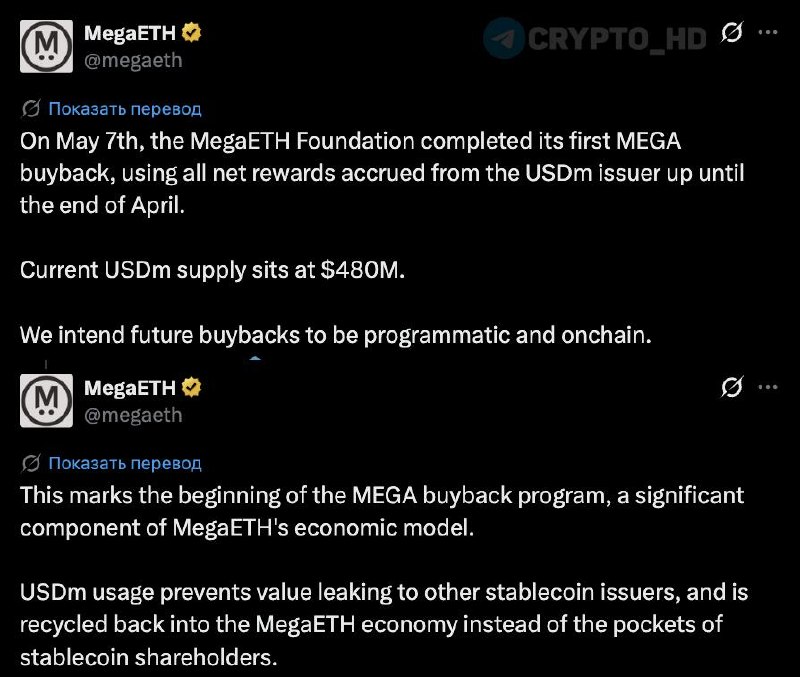
USDm is MegaETH’s native stablecoin, currently sitting at $480 million in supply, whose net yield now funds open-market MEGA buybacks. The mechanics are the story. Every dollar of yield that stablecoin generates, whether from Treasury-backed reserves, DeFi deployment, or whatever the foundation runs under the hood, now routes into open-market MEGA purchases. The first buyback already cleared. My take: the first transaction is less important than the rule it proves. What comes next is the part anyone tracking sustainable tokenomics in 2026 should keep on screen.
According to the MegaETH Foundation, the buyback program rests on three commitments: full automation, no market timing, and on-chain execution through MegaETH-native DeFi protocols. The list sounds clean, maybe too clean, but the details are useful. Buybacks become fully automated, removing human discretion from the buying schedule. The team said directly that they will not try to time the market. No dip hunting. No announcement games. Execution runs through on-chain markets and DeFi protocols built on MegaETH itself, keeping the revenue loop inside the ecosystem instead of pushing activity outward.
The core thesis: revenue generated inside an ecosystem should be captured by that ecosystem rather than by external stablecoin issuers. Most guides would frame this as a stablecoin adoption story. That’s only half right. The load-bearing piece is value capture. Today, layer-2 chains can host billions in stablecoin economic activity while Circle and Tether capture the yield and the underlying chain gets little direct recirculation. MegaETH is making a different bet. I’ll be honest: that framing is sharper than the usual “native asset utility” pitch. The team’s point is blunt enough to be useful: revenue earned inside the ecosystem belongs inside the ecosystem.
Macro flow angle. The MegaETH buyback model functions as a non-discretionary, mechanical bid on MEGA that operates independently of Federal Reserve policy or macro sentiment. This arrives while crypto markets are still hunting for sustainable yield narratives that do not depend on Fed rate cuts. The Fed funds rate is still elevated and inflation prints stayed choppy through Q1 2026, with risk-asset rotation hitting small and mid-cap tokens hard. MEGA, like other layer-2 governance tokens, has been fighting that tape. Why does this matter? Because a programmatic buyback funded by stablecoin yield gives MEGA a bid that does not care about FOMC meetings or CPI surprises. The buy pressure is mechanical, sourced from a $480 million stablecoin float, and it expands as USDm expands. For traders modeling token supply dynamics, this looks closer to a corporate share buyback than a typical crypto burn event.
Adoption signal angle. A $480 million USDm float is large enough to convert the MEGA buyback program from symbolic gesture into a material recurring bid on the token. USDm scaling tells its own story here. Crossing $480 million in supply puts USDm in serious territory for a chain-native stablecoin, past the point where smaller ecosystem stablecoins often stall and start losing share to USDC bridge versions. A $50 million USDm float would create noise. A $480 million float generating yield in current rate conditions can create recurring buy flow. Is this overkill? For a token with scheduled unlock pressure, no. If USDm keeps scaling, and the foundation is clearly betting it will, the MEGA buyback turns into a self-reinforcing loop: more USDm adoption, more yield, more MEGA purchases. Then holders become more tightly aligned with the chain itself.
MegaETH’s value-capture model differs from Ethereum’s EIP-1559 burn and Solana’s inflation-offset design by tying token value to stablecoin balance sheet activity rather than transaction fees. Counter to the usual advice, transaction fees are not always the cleanest value-capture base. EIP-1559 ties ETH supply reduction to network usage, which works but depends on transaction volume staying high. Solana’s economic model leans on inflation offsets. MegaETH is taking a different route by pinning value capture to stablecoin balance sheet activity, which can be stickier than transaction fees during bear stretches. That said, no magic here. The model is only as strong as USDm’s continued growth and the yield environment behind it.
Full automation removes the discretionary timing risk that has historically undermined foundation-run buyback programs in both crypto and traditional equities. The automation point is more important than it sounds. Discretionary buyback programs across crypto and traditional equities often underperform because human operators try to be clever. They wait for crashes that never arrive. They pause during volatility when buybacks would be most accretive. They create timing questions that markets immediately sniff out. Pulling the human out of the loop and committing to on-chain execution through DeFi protocols means the buying happens regardless of price action or market mood. We have seen this pattern before in token treasuries: discretion sounds flexible until it becomes hesitation. For long-term MEGA holders, automation is a cleaner structure than the typical foundation-controlled treasury operation.
The buyback program creates a counterweight to scheduled token unlocks by introducing yield-funded buy pressure independent of holder sentiment. Yes, this slightly contradicts the bullish framing above. Bear with me. The buyback does not erase unlock-driven supply. The previously published context around MEGA’s listing, its broader tokenomics, and the unlock schedule is still relevant because tokens with active unlock schedules usually face structural sell pressure as vesting cliffs hit. A mechanical buyback funded by external stablecoin yield revenue creates an offsetting bid that exists outside holder sentiment or market conditions. It changes the absorption math. It does not delete the supply.
What this means
MegaETH has established a template where chain-native stablecoin yield directly funds governance-token buybacks, reframing USDC and USDT dominance on layer-2s as economic leakage rather than convenience. MegaETH just handed the layer-2 sector a new template for value capture, and the broader signal is hard to miss: chain-native stablecoins are becoming one of the most underrated revenue lines in crypto. If MEGA’s buyback works as designed, automated, on-chain, and scaling with USDm, competitor chains will have pressure to copy the structure. The question shifts from “which stablecoin is easiest to use?” to “who captures the economics?” USDC bridge dominance on layer-2s suddenly looks less like convenience and more like leakage. My take: that is the real fight. Watch rival ecosystems that have native stablecoin alternatives but have not yet tied them to token economics.
The single most important leading indicator for MEGA’s buyback flow is USDm supply growth, with $1 billion identified as the threshold where the program becomes materially supply-side. For MEGA specifically, the next data points are USDm supply growth through Q2 and Q3 of 2026, the cadence and size of subsequent buybacks, and any visible impact on MEGA’s circulating supply absorption against scheduled unlocks. The first buyback executed on May 7, 2026 is the baseline. Every later execution becomes measurable. Traders modeling MEGA should track USDm’s TVL trajectory as a leading indicator for buyback flow, since USDm growth directly determines yield available for MEGA purchases. According to the foundation’s stated framework, if USDm crosses $1 billion before year-end, the buyback transitions from interesting tokenomics experiment to material supply-side force on MEGA’s price discovery. If USDm growth stalls, the program becomes a footnote. Simple as that. The number to keep on screen is USDm supply, updated weekly.