
















































Vitalik Buterin AI cybersecurity software warning tests Ethereum security trade
“Vitalik Buterin says AI and mathematical code verification could change how teams find software bugs, and Ethereum is right in the middle of that problem.” For ETH traders, the takeaway is not subtle. If AI makes bug hunting faster, protocol security stops being background plumbing and starts trading like balance-sheet risk.
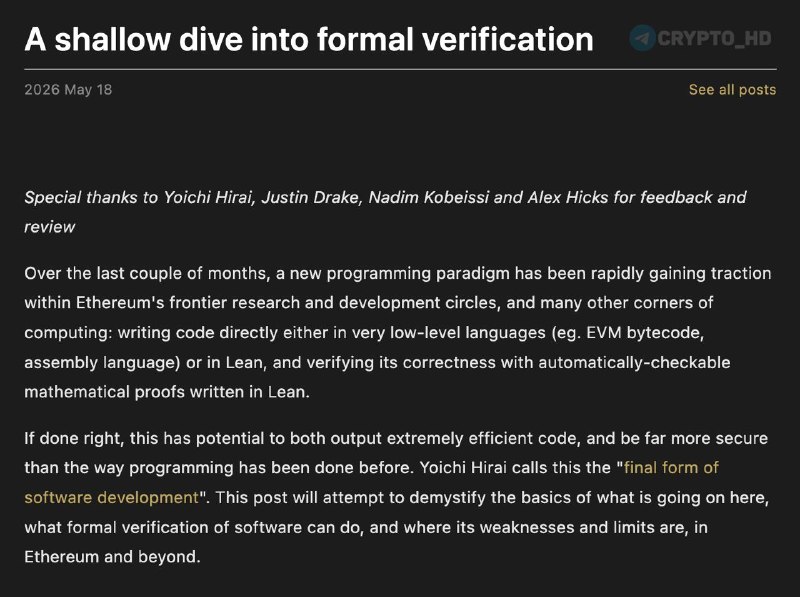
The source post says Buterin expects stronger AI models to find code vulnerabilities at much larger scale. Good news? Sometimes. Bad news? Also sometimes. Teams may catch more bugs, but attackers may get the first clean look at old code, stale forks, and forgotten assumptions. His answer is “mathematically provable” code: software whose safety and correctness can be checked through machine verifiable proofs. The post applies that idea to Ethereum, ZK systems, STARKs, post-quantum cryptography, and other infrastructure where one wrong assumption can turn into a very expensive headline. One catch: the post mentions a Web3 Festival appearance but gives no date, price target, or direct Buterin quote.
For ETH, this is not just a developer issue. It is risk pricing. Ethereum supports tokens, exchanges, lending markets, staking systems, bridges, and ZK-linked scaling stacks. If AI starts finding more vulnerabilities, the read-through hits ETH, L2 tokens, and protocols whose value depends on smart contract trust. We have seen the market version of this before: after the DAO exploit in 2016, Ethereum’s response became part of ETH’s memory. Traders still price protocol failure, governance intervention, and chain credibility through that lens.
My take: AI-assisted formal verification is probably bullish for Ethereum in the long run and messy before it gets there. Serious users, including institutions, wallets, bridges, and rollup teams, cannot build on “probably safe.” ETH adoption is not only about faster blocks or cheaper transactions. It depends on whether users trust the code that moves the money. A bank, exchange, or corporate treasury looking at tokenized settlement will want proof before it moves real assets. Still, the transition could be rough. The same AI tools that help defenders may help attackers first. Markets hate that lag.
Crypto still trades like a high beta risk asset, even when the topic sounds like a security engineering memo. If the Federal Reserve meeting on June 16-17, 2026 pushes traders toward risk reduction, a fresh exploit cycle would probably hit ETH and infrastructure tokens harder than BTC. Bitcoin often gets the cleaner “digital gold” treatment during stress. Ethereum has more moving parts. That does not make it worse by default. It does mean AI-driven vulnerability discovery could widen the perceived gap between Bitcoin’s simpler monetary story and Ethereum’s programmable settlement story.
ZK systems matter here because the source names ZK systems and STARKs directly. This is not decorative jargon. ZK infrastructure depends on cryptography, proving systems, implementation discipline, and assumptions that most token buyers cannot inspect. One verification error can damage confidence far beyond one app. For traders, ZK-linked tokens and rollup ecosystems may become more sensitive to security disclosures, audit quality, and proof system upgrades. The market already rewards speed and lower fees. If AI turns vulnerability discovery into something closer to an industrial process, investors may start caring more about proof correctness than headline throughput. Honestly, they probably should have cared sooner.
Regulation is only a side issue here, and the source does not mention the SEC, CFTC, or any country. So there is no basis for claiming a new legal push. Counter to the usual crypto reflex, this is not mainly a Washington story. But if AI-discovered bugs rise, regulators get an easy argument: crypto infrastructure is still too fragile for unsupervised retail exposure. COIN, ETH staking products, and exchange-listed tokens could face pressure if a major protocol fails during thin liquidity. The legal question would be practical, not philosophical. Can exchanges, custodians, and issuers show that important smart contract systems met stronger verification standards before customer assets touched them?
Buterin’s market relevant point is that AI should not just generate more code. It should help write and check security proofs. Why does this matter? Because more code creates more surface area, while stronger proofs may reduce the uncertainty that can blow up a protocol overnight. Crypto spent years rewarding fast launches and yield loops. Composability got treated like a free lunch. The next cycle may reward teams that can prove their core assumptions before launch. For ETH, that could mean a stronger builder base. For weaker protocols, it could reveal how much trust was really just branding, audits, and crossed fingers.
The timing problem is ugly. AI does not wait for governance votes, audit queues, or standards committees. If strong models can mass scan code, attackers can move through old repositories, forks, forgotten contracts, and copy-pasted libraries faster than teams can organize a fix. I would treat this less like abstract technology risk and more like liquidity risk. A bug that sat untouched for years could become tradable information in hours. That favors protocols with active maintainers, upgrade discipline, clear emergency processes, and careful treasury management. It hurts abandoned forks and over leveraged ecosystems. ETH may be the headline asset, but the weakest links are more likely to sit in bridges and smaller DeFi contracts.
The safe haven comparison is harder for Ethereum. BTC’s core pitch is monetary hardness and simplicity. ETH’s pitch is programmability and settlement utility. Most guides say complexity is just the cost of useful infrastructure. That is only half right. If AI raises the perceived hack rate, some capital may rotate toward BTC during security scares, even when the bug has nothing to do with Bitcoin. That does not mean BTC has no technical risk. It means traders like simple stories when they are nervous. Gold has the same advantage in traditional markets. Ethereum has to prove that programmable finance can become safer than legacy systems as proofs, verification, and cryptographic standards mature.
For builders, the message is blunt. The next security edge may come from proof automation, not another audit badge. For traders, the practical move is to watch how the market prices verified infrastructure against unaudited yield. Is this overkill? For a 50-page site, maybe. For ETH-linked settlement rails, no. If a protocol can show mathematically checked safety properties, that may become an edge in funding, listings, and institutional adoption. If it cannot, AI may expose the weakness at the worst possible time. That is where Buterin’s technical warning turns into a market signal.
What this means
Buterin’s warning points away from “move fast and audit later” and toward provable security as a real competitive filter. The main affected ticker is ETH because Ethereum remains the reference point for smart contract credibility, ZK systems, STARKs, and the post-quantum cryptography work mentioned in the source. I’ll be honest: the boring security teams may become the more investable ones. If AI speeds up vulnerability discovery, ETH investors should watch whether capital moves toward teams with formal verification pipelines and conservative upgrade paths. Security disclosure processes matter too. The trend is not simply “more AI in development.” It is pressure to prove that important code works before people trust it with money.
Investors should watch ETH against BTC before the June 16-17, 2026 FOMC meeting because macro liquidity may decide whether security headlines get absorbed or punished. CME futures positioning, ETH options skew, and any major ZK or STARK security disclosures after the post circulates also matter. Yes, this slightly contradicts the long-term bullish read above; bear with me. Time horizon changes the trade. The main market read is the ETH/BTC ratio. If it weakens after AI security headlines, traders may be treating Buterin’s warning as a reason to prefer Bitcoin’s simpler risk profile. If it holds, the market may be buying the better version of the story: AI-assisted proofs make Ethereum infrastructure more investable, not less.