
















































OpenAI’s Cyber AI Model Heats Up Smart Contract Security Race
OpenAI just released GPT-5.5-Cyber, a cybersecurity model built to find software flaws. For crypto, that is not background noise. Smart contracts, DeFi protocols, bridges, and wallet infrastructure all run on code that attackers can inspect at leisure. My take: this is where the AI security race stops feeling abstract. OpenAI is now directly up against Anthropic’s Mythos 5, which drew attention after finding more than 10,000 critical vulnerabilities in widely used software.
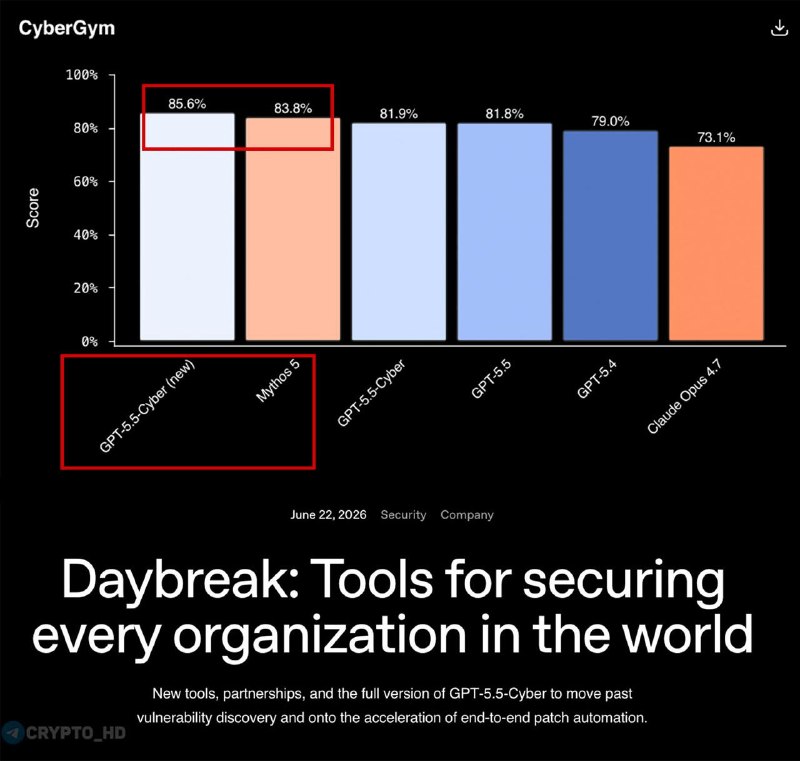
The model is meant to find code vulnerabilities, help with bug testing, and suggest security patches. Sounds dry. It is not. One missed bug can turn into a nine-figure loss before anyone finishes the postmortem. The release follows Anthropic restricting Mythos 5 and Fable 5 for foreign citizens in the US because of national security concerns, then disabling the models for all clients. OpenAI says GPT-5.5-Cyber scored 85.6% on CyberGym, just ahead of Mythos 5 at 83.8%. Tiny gap. Plenty of bragging rights.
GPT-5.5-Cyber is not being handed out like a normal API product. OpenAI is limiting access through a “Trusted Access” program for vetted cyber teams, with authorization, logging, usage limits, and monitoring. That part matters. Most guides frame AI security models as a pure defender upgrade. That’s only half right. A model that finds security holes can help audit teams move faster, but attackers want the same capability packaged neatly. For crypto, the upside is obvious: cheaper audits, faster bug hunts, better patch work, and more pressure on sloppy launch processes. The catch is just as obvious. Hackers want this too.
This ties straight into the adoption signal in crypto. Institutions and regular users do not want to park money in systems that keep getting drained. The $625 million Ronin Bridge exploit in March 2022 still hangs over the sector because it showed how one bridge failure can wreck confidence fast. Why does this matter? Because security failures do not stay technical for long; they become adoption problems. Better AI audits could help rebuild some trust. If AI-assisted reviews become a normal part of DeFi launches, weaker code should get caught earlier. That will not magically make crypto safe. Still, it could shrink the attack surface. In that market, stronger security could pull more capital toward Ethereum and other major platforms, especially if ETH is already battling around the $3,000 level.
The regulation pressure side is worth watching too. Regulators keep pointing to hacks, weak controls, and consumer losses when they push back on crypto products. The SEC has used security concerns in arguments around certain crypto offerings. If AI tools make smart contracts easier to verify, crypto firms get a cleaner argument: the systems are not risk free, but the review process is getting better. Counter to the usual advice, this is not only about avoiding the next exploit. It is also about producing evidence that reviewers, exchanges, and institutions can actually inspect. That could matter for spot ETH ETFs and other institutional products. A market with AI-checked protocols, clear audit logs, fewer blowups, and repeatable review records is easier to defend than one built on vibes. If that confidence grows, the total crypto market cap pushing beyond $2.5 trillion looks less far fetched.
What this means
GPT-5.5-Cyber speeds up the AI security race, and crypto is one of the first places where that could matter. Smart contracts are public, permanent, and often stuffed with money. Rough mix. AI that can find and help patch bugs faster may change how investors price risk in DeFi. I’ll be honest: projects that still treat audits as a launch-day badge may start looking dated fast. Projects using serious AI-assisted audits could win more users and capital. Projects skipping them may start to look careless. Infrastructure tokens like LINK could benefit if oracle networks and security tooling take up more of the conversation. Same for security focused projects that add AI to their audit stack. Bluntly: security is no longer just a human job.
Traders and investors should watch adoption, not press release noise. Look for major exchanges, lending protocols, bridge teams, DeFi platforms, and audit firms explaining exactly how they use AI for code review. Is this overkill? For a 50-page site, maybe. For protocols holding real capital, no. The next major DeFi hack will be the real test. If AI tools prevent it, limit the damage, or help teams patch faster, the market will notice. Yes, this slightly contradicts the benchmark obsession above; bear with me. CyberGym scores are useful, but production incidents are the scoreboard that actually counts. Open source AI security tools matter too, because smaller projects cannot all afford elite audit firms. For Bitcoin, the technical level to watch remains $60,000. Stronger security across crypto could support the long term case for digital assets, but only if these tools prove themselves outside benchmark tables.