
















































Pavel Durov’s “banana republic” jab: EU Chat Control sparks crypto privacy debate
Pavel Durov, Telegram’s founder, did not nibble around the EU’s Chat Control proposal. He compared the bloc to a “banana republic.” Subtle? No. Effective? Unfortunately for Brussels, yes. My take: crypto people heard the line because message scanning hits one of the industry’s rawest nerves, privacy.
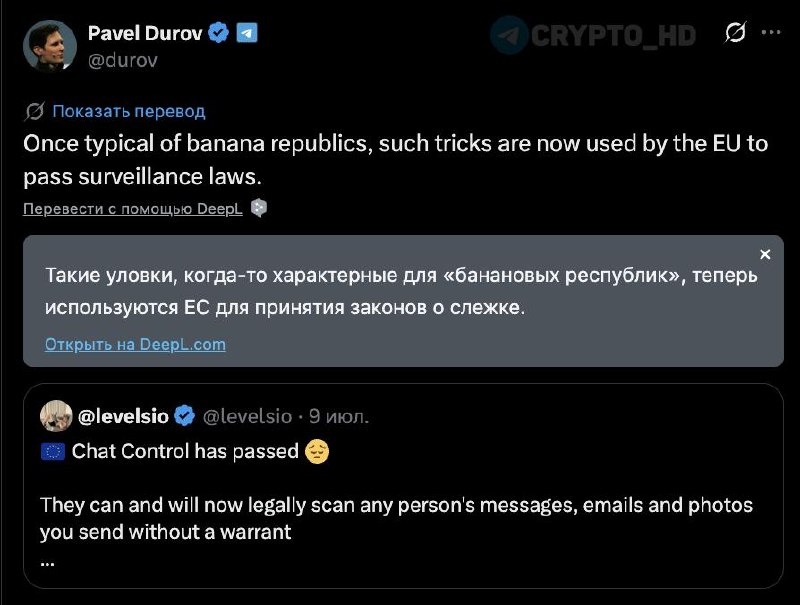
The fight centers on the EU’s Chat Control legislation. Critics say it could let authorities scan private messages, emails, and photos for illegal content without a court warrant. Supporters call it a child safety measure. Most official summaries stop there. That’s only half right. Critics see a second layer: private communication becoming searchable by default. Durov’s reaction, especially after his earlier questioning in Paris, lands inside that wider mistrust.
For crypto, this is not just a personal privacy story. It is a real regulation pressure issue. Bitcoin and Ethereum were built around a simple premise: users should not need permission from a central authority to hold or move value. Smaller privacy-minded projects push that idea even harder. When the EU pushes message scanning, even outside crypto, it changes the tone. Markets notice. The SEC’s long fight with Ripple kept XRP jumpy for years, with legal headlines sometimes moving the token 5-10% in short bursts. This EU fight probably will not knock BTC down overnight. Still, it gives users another reason to look at privacy coins. Self custody wallets too. Tools that do not depend on one company or regulator behaving well suddenly look less niche.
Durov was blunt. Telegram, he said, will not scan private messages, “no matter what banana republic tricks the EU uses.” The line is theatrical. It works. I’ll be honest: the insult matters less than the split underneath it. Governments want more visibility; users expect private chats to stay private. Crypto’s safe-haven story gets dragged in here as well. Bitcoin has often drawn attention when people lose trust in banks or payment rails. Political institutions are part of that same trust stack. Is this a banking crisis? No. But when digital rights shrink in a major economic zone, some users start treating censorship resistant assets as a backup plan. A rough version of that showed up during the Canadian trucker protests in early 2022, when banking access became part of the story and Bitcoin rose more than 8% in a week.
The EU move matters because other governments may copy it. Counter to the usual advice, the first market signal may not be a price candle. It may be wallet downloads, privacy coin chatter, or exchanges quietly changing policy language. If message scanning becomes normal, demand for private communication could rise. Private financial tools could follow. I would not expect a clean one day market reaction. Crypto almost never works that neatly. But this is the sort of policy fight that can push users toward privacy coins, self custody, and projects built around user control instead of platform trust.
What this means
This is part of a larger fight over digital communication. The EU proposal does not name crypto, but it still creates a surveillance precedent. Why does this matter? Because precedents travel faster than investors like to admit. Over time, that could help privacy focused assets, especially coins like Monero (XMR). It could also push more Bitcoin and Ethereum users toward self custody instead of leaving assets on centralized platforms. My read: the privacy trade is not just about hiding. It is about reducing dependency.
Investors should watch the next EU votes and drafts. Enforcement language matters more than press releases. Yes, this sounds less exciting than tracking BTC candles, but it is probably more useful here. Statements from exchanges and wallet providers matter too. If they start talking about compliance changes, user checks, or message related data policies, the impact is no longer theoretical. For Bitcoin, $60,000 is still worth watching if the broader market starts treating privacy as part of the safe haven trade.
FAQ: EU Chat Control and crypto
Q: What is the EU Chat Control law?
A: The EU Chat Control law is a proposed regulation that would require scanning private messages, emails, and photos for illegal content. Critics say it would weaken private communication.
Q: How does Pavel Durov view the EU Chat Control law?
A: Pavel Durov strongly opposes it. He compared the EU to a “banana republic” and said Telegram will not scan private messages.
Q: What are the potential implications for crypto privacy?
A: More surveillance could push some users toward privacy coins and self custody wallets, especially if they no longer trust major platforms to protect private data.
Q: Could this impact Bitcoin’s price?
A: Not directly. But if users start treating digital privacy as a financial safety issue, Bitcoin could benefit over time from its censorship resistant image.
Q: What is a “banana republic” in this context?
A: Durov used the phrase as an insult. He was accusing the EU of ignoring democratic norms and individual rights.
Q: Will Telegram comply with the EU Chat Control law?
A: Durov says Telegram will not comply with any rule that forces it to scan private messages.
Q: Are other countries considering similar laws?
A: The EU proposal could give other governments cover to pursue similar surveillance laws.
Q: What is the “safe-haven” narrative for cryptocurrencies?
A: It is the idea that Bitcoin and some other crypto assets can act as a fallback when banks, governments, or payment systems become less trusted.
Q: How might this affect privacy coins like Monero (XMR)?
A: If surveillance rules expand, privacy coins like Monero could draw more interest from users who want transactions that are harder to trace.
Q: What should crypto investors watch for next?
A: Watch EU legislative updates, similar bills in other countries, and statements from exchanges and wallet providers about how they plan to comply.