
















































The Sandbox co-founder wife kidnapping attempt tests crypto security premium
The attempted kidnapping of The Sandbox co-founder Sébastien Borget’s wife in France points to the risk crypto people still speak about too softly: visible wealth can follow you home. Masked attackers allegedly came to Borget’s house dressed as couriers, tried to force his wife into a car, and fled after neighbors heard screams. Police later detained 2 suspects. An unnamed source says France has recorded at least 42 crypto-linked kidnapping attempts since the start of 2026. I’ll be honest: that is not background noise.
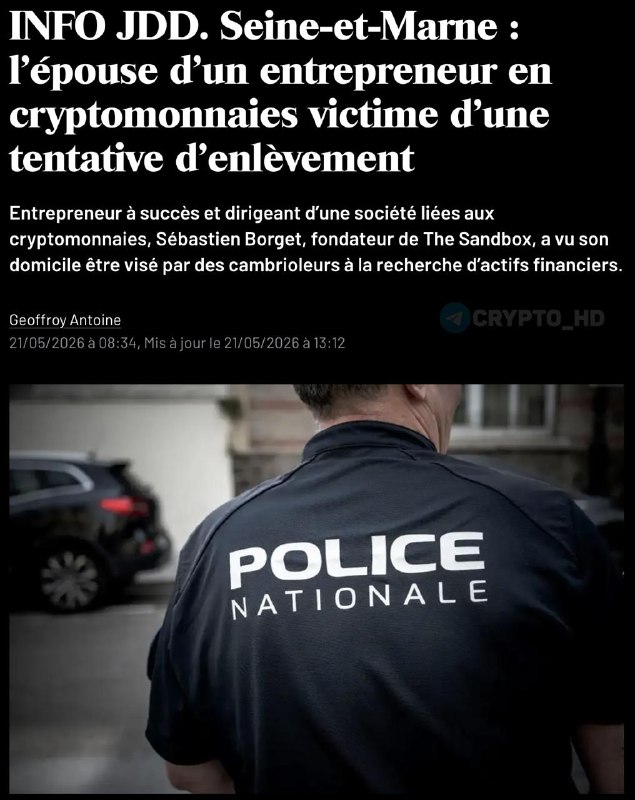
The mechanics are ugly and specific. According to the unnamed source, the attackers came to the house posing as delivery workers, waited until the woman opened the gate, and then tried to push her into a vehicle. Neighbors reportedly heard the screams. That appears to have stopped the attempt. Police later found a fake pistol, zip ties, and balaclavas with the two detained suspects, according to the same report. Not subtle. Not digital.
The crypto link comes from Borget’s role as co-founder of The Sandbox, a metaverse and gaming project tied to the digital asset market. The unnamed source does not mention token transfers, a ransom demand, or a wallet address connected to the attack. Most market notes would stop there and say “no direct token impact.” That’s only half right. 42 alleged crypto-linked kidnapping attempts in France since January 2026 is a market signal, just not one that appears on a chart. Public crypto wealth now carries a physical security cost.
For BTC and ETH traders, regulation usually gets first billing. After the SEC approved spot BTC ETFs on January 10, 2024, crypto became easier for traditional investors to access and harder for everyone else to ignore. That helped adoption. It also made some crypto wealth more visible. Founders, NFT collectors, gaming executives, exchange employees, and loud online personalities can start to look like walking pools of liquid assets, even when nobody outside their circle knows what they actually hold. My take: visibility is becoming its own liability.
This does not mean BTC or ETH caused the crime. The unnamed source only says France has seen at least 42 crypto-linked kidnapping attempts since the start of 2026. Why does this matter? Because regulators do not need blockchain evidence to expand a risk category. The narrower market read is this: repeated physical attacks may become another argument for tighter custody rules, exchange compliance, and identity risk standards. That would matter more for companies like COIN, large centralized exchanges, and self custody providers than for Bitcoin’s base layer.
The second signal is adoption, though not the clean version anyone puts in a pitch deck. Crypto has become valuable, portable, and recognizable enough that criminals appear to be planning around it. The Sandbox sits in the part of the market that sold people on digital ownership and tokenized worlds. Creator economies were the softer sell. Now the risk attached to that wealth is showing up at a private home in France. That is validation, but the grim kind.
Investors have to deal with a messier version of adoption. Usually the word means banks, ETFs, payment rails, corporate treasuries, and cleaner access for professional money. It also means attackers may believe crypto holders can move assets outside bank hours, away from branches, and sometimes outside institutional controls. BTC’s 21 million supply cap is simple. Human security is not. We have seen this framing get missed in custody debates: once crypto wealth leaves the screen, operational risk becomes part of the trade.
Safe haven traders should not overread this. BTC often gets compared with gold during wars, sanctions, and banking stress, but this is not an FOMC surprise or a geopolitical shock. It is local, personal, and severe. Still, repeated attacks could change behavior at the margin. Wealthy holders may move coins from hot wallets into institutional custody, multisig setups, exchange accounts with stricter withdrawal controls, or some mix of all three. I would not call that bullish or bearish. It is defensive.
The tickers to watch are probably not only gaming tokens. BTC, ETH, and COIN may matter more because they stand in for custody behavior. If investors start to see self custody as physically risky, Coinbase and other regulated custodians could get a narrative boost. Counter to the usual advice, though, centralized accounts may not feel safer to everyone. If investors decide those accounts make them easier to identify, hardware wallets and multisig services could benefit instead. Same headline. Opposite trades.
The unnamed source gives no market price for The Sandbox, no SAND token move, and no police timeline beyond the later detention of two suspects. So the clean editorial line is simple: do not trade this headline as a token catalyst. Treat it, if at all, as another data point in the security and regulation debate around crypto wealth in Europe. The 42-attempt figure since the start of 2026 is the part that matters.
Political pressure could build quickly if similar cases keep appearing. A fake pistol, zip ties, and balaclavas are not abstract cybercrime tools. Lawmakers understand them instantly. Is this more policy-relevant than another phishing loss? In some rooms, yes, because it puts crypto risk on a doorstep, not only on-chain. That kind of image travels fast.
For The Sandbox, the reputational issue is indirect but real. The unnamed source identifies Borget because he co-founded the project, not because The Sandbox is accused of wrongdoing. That distinction matters. Still, crypto founders often get treated as stand-ins for protocol wealth, even when the source does not disclose their personal assets, company holdings, or token exposure. Traders should keep those things separate. Skip the lazy linkage.
The broader market also needs to separate violence risk from protocol risk. BTC did not become less secure because attackers allegedly appeared at a home in France. Ethereum did not lose settlement integrity because suspects allegedly carried a fake pistol and zip ties. Yes, this contradicts the mood of the whole story a bit; bear with me. The protocol may be fine while the experience of storing wealth privately gets shakier, especially when at least 42 kidnapping attempts in one country have been linked to crypto since the start of 2026.
This is the uncomfortable part. Crypto spent years arguing that bearer assets give people more control. They do. But bearer-style wealth also pushes some bank-level security problems onto individuals and families. Investors love personal sovereignty when BTC is ripping through a major level. They like it less when a founder’s household becomes part of the threat model. We tried to separate “financial freedom” from “security burden” for years; in stories like this, the separation breaks.
There is no direct quote in the unnamed source, and inventing one would warp the story. The available facts are stark enough: France, Sébastien Borget’s wife, masked attackers, fake couriers, neighbors, 2 detained suspects, a fake pistol, zip ties, balaclavas, and at least 42 crypto-linked kidnapping attempts since the start of 2026. Markets have plenty to process without decoration.
What this means
Crypto’s next regulatory fight may not stay limited to ETFs, staking, stablecoins, or exchange listings. Physical security, public wealth exposure, institutional custody, and identity risk could move closer to the center of the debate. For BTC, ETH, and COIN, the immediate issue is not one price candle. It is whether investors start pricing personal safety and custody risk into the cost of holding digital assets in 2026. That’s the security premium.
Watch the June 16-17, 2026 FOMC meeting for risk-asset liquidity, CME BTC futures open interest for signs of institutional hedging, and BTC’s nearest major psychological level around $100,000 if spot markets are testing round-number support or resistance. For crypto-specific risk, watch whether French authorities report more than 42 crypto-linked kidnapping attempts after this case. That figure says more about the security premium than any adoption slogan.