
















































US Banks Push Stablecoin Yield Ban, Threatening Crypto Adoption
A group of 134 US bank executives and banking association representatives has asked Senate leaders to tighten the CLARITY Act’s restrictions on stablecoin yield. Why does this matter? Because earning a return without riding the price swings of Bitcoin or Ether is a basic reason investors hold stablecoins. My take: that incentive is doing more work than banks admit. If Congress accepts the change, stablecoin markets could lose liquidity. Crypto companies may have fewer services to offer. The stakes are real.
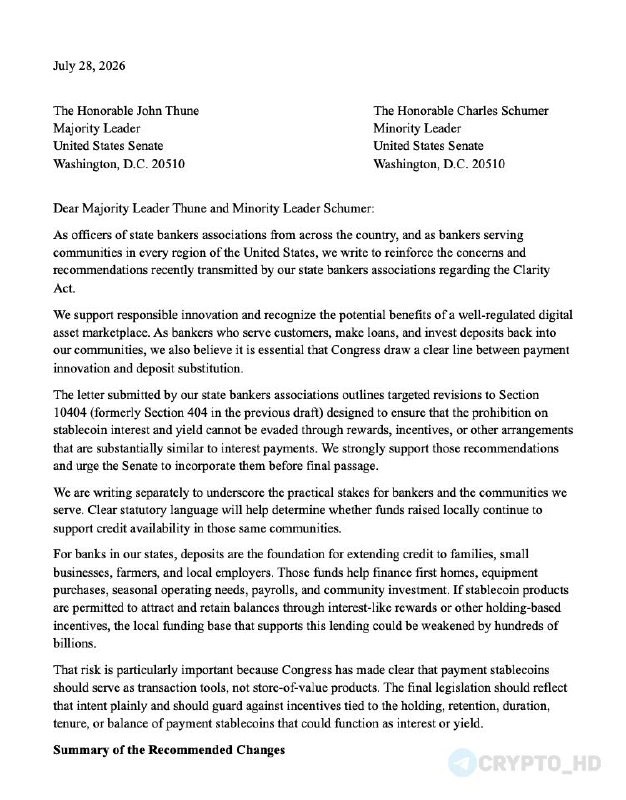
The argument centers on Section 10404 of the proposed law. The bill would prohibit interest paid solely for holding payment stablecoins, but it permits “rewards” connected to transfers, payments, liquidity provision, or the use of a service. Banks worry that crypto platforms could rename interest as a “bonus” or “reward” and carry on as before. Most summaries frame this as a simple labeling loophole. That’s only half right. The exact wording will determine what many decentralized finance (DeFi) protocols and centralized platforms can offer when they use stablecoins to generate customer returns. I’ll be honest: the banks’ concern is not hard to understand. A stricter definition could force those businesses to rebuild the products—or abandon them.
Large national banks, including Bank of America and U.S. Bank, support the letter. Regional institutions signed it too: Hancock Whitney, Ameris Bank, Banner Bank, Univest Financial, Bell Bank, Sunflower Bank, Johnson Financial Group, and First National Bank Alaska. That is not a token showing. The 134 US bank executives and banking association representatives appear determined to stop crypto companies from selling products they see as loosely regulated alternatives to bank deposits. For investors, the letter adds another source of regulation pressure. Yield gives people a concrete reason to own stablecoins when they want to avoid the broader crypto market’s volatility. Without it, USDC and USDT may become less attractive. Their market values could fall. Less liquidity for crypto trading would follow.
Banks are protecting their deposits. Fair enough. Counter to the usual advice, though, this is not merely a fight between banks and crypto platforms; the effects could travel well beyond either group’s balance sheet. Stablecoin yield has long been an adoption signal, particularly when ordinary bank accounts paid almost nothing. Federal Reserve rate increases eventually made bank yields more competitive, although some crypto platforms kept offering better returns. Remove those rewards, and a familiar route into crypto disappears. Stablecoins support trading and cross-border payments. People in countries with high inflation also use them to preserve value. Fewer reasons to hold stablecoins could mean less activity on exchanges such as Coinbase (COIN). Demand for assets such as ETH may weaken as well because many DeFi lending markets run on its network. My read: that second-order effect deserves more attention.
What this means
The banks’ position sets up a harder Senate fight over stablecoin rules. They consider yield-bearing stablecoins a threat to deposits and possibly a financial risk when supervision is loose. Investors can expect more scrutiny of platforms paying returns on USDC, USDT, or similar tokens. Some companies may reshape their products around payments or other services to comply with the final CLARITY Act. Does that solve the problem? Probably not. Regulators could decide that a service reward is simply interest under another name. Yes, that sounds like the same labeling dispute described above—but here enforcement, not drafting, becomes the pressure point. Until it is settled, the macro flow of money into stablecoins may slow. Stablecoins bring fresh capital into crypto. They also supply liquidity for many trading pairs, so the damage would spread beyond yield products.
Watch Section 10404 as the CLARITY Act moves through the Senate, especially the definition of “rewards.” Precise language would tell companies which products they can keep. Vague language would leave them guessing, with future enforcement battles more likely. Simple as that. The next committee hearing or Senate vote may reveal where the provision is heading, but the market could offer clues sooner. Persistent declines in the market values of USDT or USDC may signal that holders are growing uneasy; unusually large outflows would reinforce that reading. Major DeFi protocols deserve attention. So do centralized exchanges. If several platforms cut rates or overhaul their reward programs around the same time, the banks’ campaign is probably starting to bite. Is tracking all of that overkill? No—the rule could alter both product design and crypto liquidity. Stablecoins still have to maintain their $1.00 peg. Congress is now deciding whether their owners can earn a return while holding them.