
















































Bybit buy-side takers run 11x ask — what an extreme spot bid actually tells you
A Bybit buying-volume blowout means aggressive market buys (takers hitting the ask) are outpacing aggressive market sells by a multiple way past the usual 0.9–1.3 band. CryptoQuant’s on-chain feed has the Taker Buy/Sell Ratio on Bybit at roughly 11x on the buy side. That isn’t noise. I’ll be blunt: prints that far outside the usual band deserve attention, even if they do not deserve blind trust. It means market makers and aggressive bidders are lifting offers instead of waiting on the bid, and this same kind of tape has shown up before short-squeeze legs on BTC and ETH.
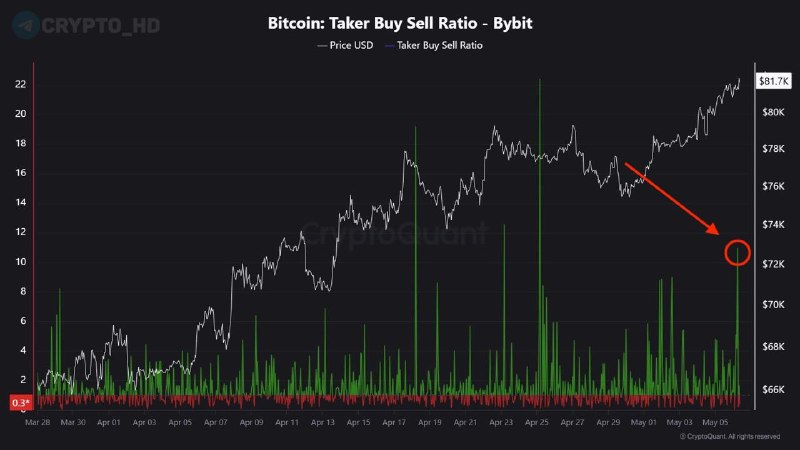
The number is the whole point. The Taker Buy/Sell Ratio asks one clean question: who is paying the spread? Buyers hitting the ask, or sellers hitting the bid. An 11-to-1 read on the buy side is rare. Most days, even when the chart already looks noisy, the ratio lives between 0.9 and 1.3. CryptoQuant flagged the move on Bybit specifically. That venue detail matters, because Bybit’s perp desk is one of the deepest derivatives books outside Binance.
Heavy taker buying on a major derivatives venue is the kind of macro flow you see when risk-on gets expressed through derivs first, then spot. Here is the macro read. Funds do not always tiptoe back into risk through clean spot accumulation. Sometimes they jam exposure through perps first, especially after a duration scare. BTC is parked near recent ranges, the wider crypto book is still grinding through rate-path uncertainty, and an 11x taker skew says somebody is not waiting for the next CPI print to size up. Why does this matter? Because derivs often move first, and spot either confirms the move or embarrasses it.
Taker pressure stacked on one venue is a venue-level signal that institutional and whale desks are routing size there. The adoption read is quieter, but I would not ignore it. Bybit has been pulling market share from competitors over the past year, and a lopsided taker print on its book, rather than on Binance or OKX, says larger desks are comfortable routing size there. Counter to the usual advice, concentration is not always a warning sign by itself. Sometimes it is exactly where price discovery starts. When the imbalance is this loud, that venue can become the engine everyone else has to follow.
An 11x Taker Buy/Sell Ratio is not 11 times more dollar volume bought than sold. It says takers, the side paying for immediacy, are mostly hitting the ask while passive limit sellers absorb the flow. This distinction matters. Passive limit sellers are still in the book. They’re just getting run over. My take: this is not the same as a market where nobody wants to sell. It is a market where buyers are willing to overpay for immediacy, and that version is usually louder, faster, and more reflexive.
No shock CryptoQuant’s analysts called it out. Taker imbalance is one of their core tells, and they have been right in both directions before. Still, most guides overstate this kind of signal. That’s only half right. An 11x figure puts this print in the upper tail of what we’ve seen historically, but the tail is not the trade by itself.
What this means
An extreme Bybit taker buy skew is a near-term bullish but fragile tape signal that usually resolves inside 24 to 48 hours, either through follow-through short liquidations or a fade as the bid evaporates. For BTC and the majors, I read this as near-term bullish tape, with a short fuse. Extreme taker skews usually resolve in one of two ways. Spot follows through and shorts get force-fed into liquidations, extending the move. Or the imbalance fades inside 24 to 48 hours and the bid disappears. Yes, this sounds like it contradicts the bullish read above. It does not. Bullish and fragile can both be true. Funding rates on Bybit perps are the next thing to watch. If they pop to multi-week highs alongside the taker print, that is the squeeze setup. If funding stays neutral, the buying is real money, not leverage chasing.
Watch the Bybit BTCUSDT and ETHUSDT books over the next 12 to 24 hours, plus CryptoQuant’s exchange netflow dashboard for any spot inflow confirmation. Is this overkill? For an 11x venue-level print, no. If the taker ratio normalizes back toward 1–2x without a price breakout to match, this was a flash, not a regime change. If price grinds higher while the ratio stays above 3x, then spot has to chase. Two sessions should tell us.