
















































Trump rejects Iran peace deal response as Brent crude spikes 5.4% above $100
Trump rejected Iran’s counter-offer on Saturday. Brent crude jumped 5.4% past $100 a barrel within hours, and that kind of energy shock usually forces a repricing across every risk asset, Bitcoin included. The president’s “absolutely unacceptable” verdict, posted hours after Reuters published Tehran’s response, blew up the diplomatic off-ramp traders had quietly started to price in last week. Bad timing for crypto. BTC was already fighting to keep the $61K shelf intact into the next FOMC. Now oil is screaming higher on top of it.
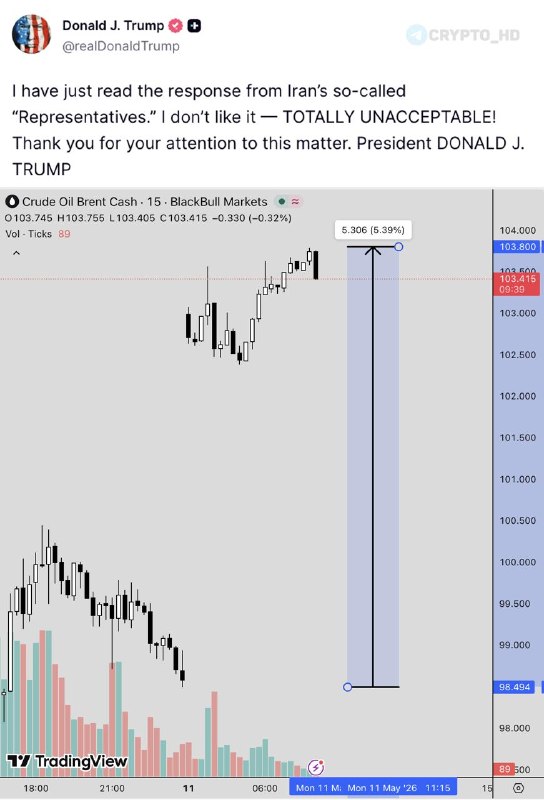
Iran’s counter wasn’t a soft one. Tehran put five non-negotiables on the table: lift the maritime blockade, full sanctions relief, written security guarantees, financial compensation for prior strikes, and formal recognition of its right to control the Strait of Hormuz. Per Reuters, the nuclear clause is what really lit the fuse. Iran wants to keep enrichment facilities intact, with only a partial transfer of enriched uranium to a third country. Trump replied with three lines on his platform: “I just read the response from the so-called ‘representatives’ of Iran. I don’t like it — ABSOLUTELY UNACCEPTABLE! Thank you for your attention to this matter.” My take: that is not a negotiating posture. It is a market event dressed up as a post.
The oil market called the diplomatic failure before the political desks did. Brent crossed $100 for the first time this cycle, an 18% rise since the standoff began. That’s not negotiation language. That’s a door closing. The 5.4% single-session move puts the contract roughly 18% higher than where it traded when this standoff began back in early spring. Trump heads to Beijing this week (per Reuters), and Iran is on the agenda with Xi Jinping. Washington’s working theory is blunt: China, which is Iran’s largest oil customer, can lean on Tehran in a way Western pressure cannot anymore.
Bitcoin’s response to oil-driven shocks tends to follow a two-stage pattern. First a dollar-strength dip, then a 48-72 hour safe-haven bid. Here’s the crypto angle that matters, and it has a wrinkle. When Brent moves 5%+ on geopolitics, the immediate dollar reaction is usually bid, and DXY firmness tends to cap Bitcoin for the first 24-48 hours. Then the second-order trade kicks in. During the January 2020 Soleimani strike, BTC initially dipped with risk assets, then rallied roughly 8% over the following week as the sanctions-evasion and capital-flight narrative took over. Gold did the heavy lifting on day one. Bitcoin caught the flow on day three. We saw the same lighter version during the April 2024 Israel-Iran direct exchange, with BTC moving 4-6% inside 72 hours of the escalation headline.
Oil above $100 directly reprices the inflation curve. Fewer Fed cuts get priced in, and crypto eats it because it trades like the longest-duration risk asset on the board. Most guides frame this as a simple safe-haven story. That’s only half right. The macro flow channel hits first, and it is less friendly. Two-year breakevens already nudged higher on the headline, which complicates the Fed’s path. A hotter CPI print driven by energy pass-through means fewer cuts priced for the back half of the year, and that has historically been rough for long-duration risk assets. ETH and the high-beta L1 basket (SOL, AVAX, SUI) usually absorb that pressure first. BTC dominance ticks up. Worth flagging: BTC dominance already pushed above 58% last week. An oil-driven rates repricing would accelerate that rotation, based on prior cycles.
The Strait of Hormuz channels roughly 20% of global oil flows. Iran’s demand for explicit control over it is a credible threat that could fracture the energy-stocks-vs-Bitcoin correlation we’ve watched all year. Most desks underprice this. Per U.S. Energy Information Administration data, about 20% of global oil flows through that chokepoint. Iran’s demand to control it is not symbolic. It is a credible threat to weaponize tanker traffic if Trump escalates. Past Hormuz scares, including the 2019 tanker seizures and the 2024 missile drills, produced 3-7% Brent spikes inside hours. Why does this matter? Because if the Beijing meeting fails to produce a Chinese pressure track on Tehran, the next leg in oil is structurally higher. The energy-stocks-vs-Bitcoin correlation, positive for most of 2026, would likely fracture there. That’s when BTC starts trading on its own narrative again instead of as a NASDAQ proxy.
Trump’s pivot to Xi creates a binary catalyst this week. A successful Chinese pressure track lifts crypto. A refusal extends dollar strength and caps every non-USD asset. The president is asking China to do diplomatic work the U.S. cannot do directly. I’ll be honest: that makes the market setup cleaner, not calmer. If Xi agrees, that signals a warmer U.S.-China posture, which has historically been a tailwind for risk and for Bitcoin’s Asian adoption narrative. If Xi refuses or stalls, the read flips. Iran becomes a proxy front. Oil stays bid. The dollar gets another leg of strength that caps every non-USD asset. The asymmetry on that meeting is sharp, and it gets resolved this week.
One detail from Tehran’s terms deserves more attention than it’s getting. The compensation demand is a play-for-time posture, not a settlement signal, and that’s quietly bullish for the Bitcoin-as-neutral-collateral thesis on a multi-month horizon. The compensation demand, meaning financial damages paid by the U.S. for prior strikes, is a non-starter politically. But it tells you Tehran is playing for time, not settlement. Counter to the usual read, that is not automatically bearish for crypto. That posture only works if Iran believes it has leverage: oil, the Strait, and the threat of nuclear breakout. Oil is the immediate weapon. The Strait is the escalation lever. Nuclear breakout is the long fuse. All of that is bullish for energy, bearish for the dollar’s long-term reserve premium, and, over a multi-month horizon, constructive for the Bitcoin-as-neutral-collateral thesis that has been quietly building inside sovereign wealth fund commentary all year.
Bitcoin’s decoupling from the NASDAQ doesn’t happen on one headline. It needs catalysts stacked into the same window, and the current setup is maybe one of three triggers away. No surprise that crypto Twitter is already framing this as a BTC trade. The reality is messier. Bitcoin has spent the past three weeks correlated more tightly with the NASDAQ than with gold, and that correlation does not unwind on a single headline. Yes, this slightly contradicts the clean safe-haven framing above. Bear with me. The decoupling, when it comes, tends to come in clusters: a sanctions escalation, a Hormuz incident, or a hawkish Fed surprise landing inside the same 10-day window. We are potentially one of those windows away.
What this means
This rejection isn’t a self-contained event. It activates three latent crypto trades at once: the energy-to-inflation-to-rates chain, the safe-haven rotation, and the China diplomacy overlay. Each has its own timing window this week. The first is the energy-to-inflation-to-rates chain, which compresses the path to Fed cuts and pressures the high-beta altcoin basket. ETH below $2,400 and SOL below $140 are the levels to watch on a sustained Brent move above $105. The second is the safe-haven rotation, which historically takes 48-72 hours to express in BTC after a geopolitical shock, meaning the window opens roughly Tuesday-Wednesday this week. The third is the China overlay: Trump’s Beijing trip will either defuse the trade or escalate it, and that meeting is the binary catalyst the market is mispricing. Is this overkill for one rejected counter-offer? No, because oil above $100 turns diplomacy into inflation math.
Three specific indicators will tell us whether this becomes a real Bitcoin regime change or just a tactical trade: CME futures basis, the next CPI print, and any Strait of Hormuz incident headlines. Watch them this week. First, the CME Bitcoin futures basis. If it stays compressed below 6% annualized through the Beijing meeting, institutional desks are not buying the safe-haven thesis yet, and BTC stays range-bound at $59-63K. Second, the next CPI release and the energy contribution to it. A hot print with Brent above $100 will force the Fed’s hand on cuts and likely send DXY to a new local high, which based on prior cycles caps Bitcoin for two-to-three weeks. Third, any headline tied to the Strait of Hormuz: tanker incidents, Iranian naval drills, insurance rate hikes for Gulf shipping. That’s the channel where the genuine safe-haven repricing for Bitcoin starts. Until one of those three confirms, this is a tactical setup, not a regime change. Treat it accordingly.