
















































Bitcoin and Ethereum ETF Outflows Point to a Cooler Mood
Spot Bitcoin and Ethereum ETFs saw heavy withdrawals on June 23, 2026. Bitcoin products lost $68.18 million. Ethereum products lost $66.04 million. That is real money leaving the ETF wrapper, not just some dashboard flicker, and it points to investors cutting crypto exposure through traditional market products. BlackRock also transferred 2,400 BTC, worth about $149.6 million, and 38,337 ETH, worth about $63.4 million, to Coinbase Prime. I’ll be honest: that part is hard to shrug off.
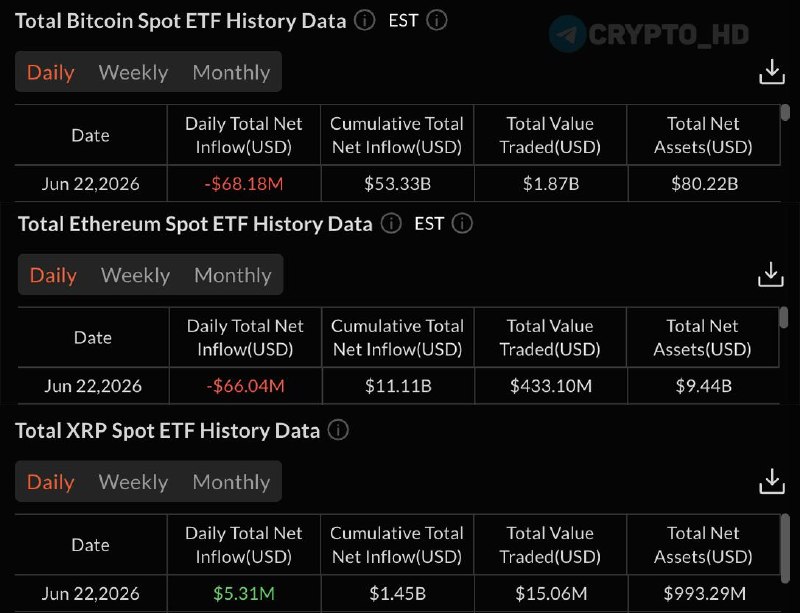
The flow data is rough. Outside the main Bitcoin and Ethereum numbers, other spot ETFs posted $490,920 in outflows, while one fund brought in $5.31 million. Several funds had no activity. Flat flows sound boring. They are not. Why does this matter? Because no activity still tells you buyers are not exactly rushing back in with both hands. This does not look like a few nervous retail accounts tapping sell after lunch. A transfer of that size to Coinbase Prime, a venue institutions use for custody and trading, looks more like a large holder changing how it wants to hold or move the assets.
My read: the ETF outflows are happening against a messy macro backdrop. Central banks are still dealing with inflation, possible rate cuts, and the usual guessing game around what comes next. Most guides frame ETF outflows as automatically bearish. That is only half right. Crypto tends to get hit when investors trim risk, yes, but the wrapper matters too. If the Fed sounds tougher than expected, or stocks start wobbling, Bitcoin and Ethereum can quickly go from upside bets to liquid things people sell first. Moving assets out of regulated ETFs and into Coinbase Prime could mean institutions are preparing to trade, sell, or use custody setups with more control. That is not automatically bearish for crypto. It may be bearish for the ETF wrapper, at least right now.
The Bitcoin safe haven story also looks weaker here. People lean on that narrative during geopolitical stress, and sometimes it works. Bitcoin rose about 8% during the January 2020 Soleimani strike, for example. But these flows suggest some institutional investors are not treating the ETF version of Bitcoin as their shelter. In our last few market notes, this is the kind of split I keep coming back to: Bitcoin the asset and Bitcoin the product are not always the same trade. Money is leaving the wrapper itself, not clearly rotating into gold or another classic hideout. That matters. The pressure may have less to do with broad fear and more to do with market structure. Regulation is another piece. So are custody preferences and portfolio cleanup. BlackRock moving that much BTC and ETH through Coinbase Prime does not prove panic, but it does show a change in tactics.
What this means
These Bitcoin and Ethereum ETF outflows suggest institutions may be cooling on the ETF wrapper, or at least changing how they hold exposure. The size matters. A 2,400 BTC and 38,337 ETH transfer is not routine housekeeping. It looks deliberate, possibly aimed at direct custody or faster trading access. Maybe both. Counter to the usual advice, I would not read this only as a price call on BTC and ETH. It is also a product-structure signal. In the near term, weaker spot ETF inflows mean less steady buy pressure from those products. That can make BTC and ETH feel less stable, especially if other risk assets are already under pressure.
The next few weeks matter more than one day’s print. Watch inflation data, Fed comments on rates, and ETF flow reports day by day. One bad day is noise. Several outflow days in a row would be different. Is this overkill? For a market leaning this hard on institutional demand, no. Also watch for more large transfers into or out of Coinbase Prime and similar venues. Those moves can say more than press releases. My take: traders should treat BTC and ETH support levels with less patience now because the flow backdrop is weaker. If buyers do not step in near those levels, this could move from a messy ETF day into a broader risk-off trade.