
















































Trump Iran Attack Delay Tests Bitcoin Safe-Haven Trade
Donald Trump’s delay of a possible U.S. strike on Iran lowers the immediate risk. It does not remove the war premium in crypto. Trump said he canceled the “planned for tomorrow attack on Iran” after requests from Qatar’s Emir Tamim bin Hamad Al Thani, Saudi Crown Prince Mohammed bin Salman Al Saud, and UAE President Mohammed bin Zayed Al Nahyan. The ask was simple: more negotiation. For Bitcoin (BTC) and Ethereum (ETH) traders, this is a pause. Nothing more. I’ll be honest: the phrase “full-scale military operation” does too much work here to let anyone call this clean de-escalation.
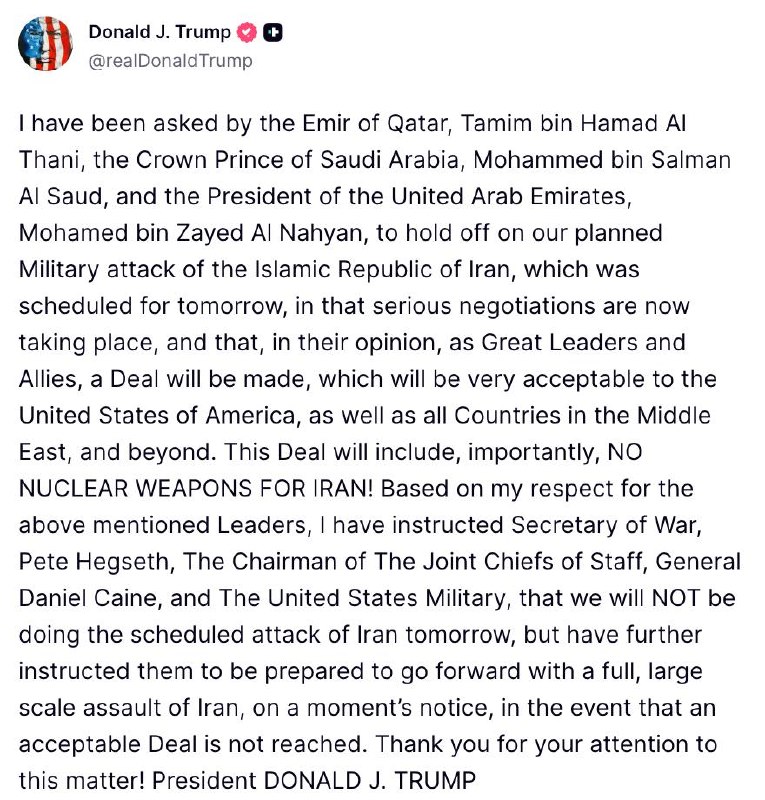
In the source post, Trump framed the delay as respect for Gulf leaders. He called the leaders of Qatar, Saudi Arabia, and the United Arab Emirates “great leaders and allies.” He said they still see room for a diplomatic deal that could satisfy the United States, Middle Eastern countries, and other parties. Fine. But the harder sentence is the one markets keep circling: Iran “must not have nuclear weapons.” Why does that matter? Because traders are not pricing the pleasant optics of talks. They are pricing the chance those talks fail.
Trump told military leaders to stop the planned strike, while also telling them to stay ready. He said he instructed Defense Secretary Pete Hegseth, Joint Chiefs Chairman General Daniel Caine, and the U.S. Armed Forces “not to carry out the planned attack on Iran tomorrow.” That is the relief line. Then the whole thing bends back on itself. Trump also ordered forces “to be ready at any moment to begin a full-scale military operation against Iran if an acceptable agreement is not reached.” The same source post says the White House had already rejected Iran’s proposal. So, yes, the strike was delayed. The threat was not.
Bitcoin’s safe-haven story is back, but I would be careful with it. BTC rose about 8% during the January 2020 market reaction to the Soleimani strike, which is the obvious comparison traders will drag into this headline. Most guides say geopolitical stress is good for Bitcoin. That’s only half right. Gold usually gets the cleaner bid first, while Bitcoin can flip between crisis hedge, liquidity source, and high-beta macro trade in the same session. When one statement names the United States, Iran, Saudi Arabia, Qatar, and the United Arab Emirates, nobody waits for a perfect framework.
The BTC question is simple: did the delay cut tail risk, or did it just move the deadline? If the delay holds and negotiations move toward a deal, BTC may start acting like a risk asset again. ETH and COIN would probably lean into broader equity sentiment. If talks break down and Trump’s warning about a full-scale military operation becomes the main story, the first move could be defensive. Gold likely catches a bid. Oil gets watched tick by tick. BTC only benefits if liquidity stays orderly. That’s the catch.
Energy risk is the macro channel crypto traders cannot ignore. A U.S.-Iran military shock would hit energy expectations fast, and energy shocks can make the Federal Reserve’s inflation problem harder. The path is not complicated: oil risk can move inflation expectations; inflation expectations can move rate-cut pricing; rate-cut pricing can move BTC, ETH, and COIN multiples. The next scheduled FOMC meeting is June 16-17, 2026, according to the Federal Reserve calendar. My take: that date now matters more to crypto desks than it did before this headline.
Buying BTC just because Iran is in the headline is lazy trading. The January 2020 move is context, not a rulebook. Bitcoin can rally when investors want non-sovereign exposure. It can also sell off hard when leverage gets cut and dollar liquidity tightens. ETH is more exposed to risk appetite because it trades with more crypto leverage and tech-sector mood. COIN is messier still. Coinbase stock reflects crypto volumes and equity appetite. It also carries regulatory discount-rate baggage. That is a lot to load onto one ticker.
The Middle East risk channel runs through oil, even though the source post does not spell that out. It does not mention barrels, production, or shipping lanes. Traders will make the connection anyway because Trump’s statement names Qatar, Saudi Arabia, and the United Arab Emirates alongside Iran and the United States. Counter to the usual crypto-first read, the oil screen may matter before the Bitcoin chart does. If oil volatility jumps, inflation breakevens and real-yield expectations can move with it. Those are direct inputs in BTC valuation debates. Iran risk can become Fed risk fast. Fed risk can become crypto risk even faster.
Trump’s statement leaves the United States in an awkward middle position. The planned attack for tomorrow is off. A full-scale operation can still begin “at any moment.” Markets got a relief headline and a threat headline in the same breath. I would not call that calm. Bitcoin traders usually punish that kind of ambiguity during the day, especially when futures leverage builds faster than spot conviction.
For ETH, this looks more like a risk-rotation story. If diplomacy holds, ETH may benefit from the relief bid that often lifts high-beta crypto after geopolitical stress cools. If talks fail, ETH could trail BTC because the safe-haven argument fits Bitcoin more naturally than smart-contract beta. Is that too neat? Maybe. The ETH/BTC cross is the cleaner tell here. Rising BTC with weak ETH says investors want crypto exposure but still want cover. Rising ETH/BTC says risk-taking is coming back.
COIN has its own problem: it trades like a proxy for crypto activity. Coinbase is not named in the source post, and Trump’s statement is not about exchanges, ETFs, staking, or the SEC. Still, COIN often acts like the public-market shortcut for U.S. crypto sentiment. If the delayed strike lowers volatility without killing trading volume, exchange-linked equities could catch a bid. If the story turns into a full-scale military operation, the equity-risk channel may take over and pressure COIN, even if BTC holds up at first. We have seen that pattern enough times in crypto equities to treat it seriously.
The named Gulf leaders matter because they show who pushed for the delay. The statement names Qatar’s Emir Tamim bin Hamad Al Thani, Saudi Crown Prince Mohammed bin Salman Al Saud, and UAE President Mohammed bin Zayed Al Nahyan. Those are major U.S. partners in the Gulf, so this does not read like a casual pause. It reads like serious diplomatic pressure. Still, the source gives only one clear condition for a deal: “Iran must not have nuclear weapons.” That is not enough detail for markets to remove the geopolitical premium.
The White House’s rejection of Iran’s proposal keeps this from turning cleanly bullish. Traders should read the postponement as lower immediate event risk, not proof that a deal is close. Yes, this sounds like it contradicts the relief angle above. Bear with me. The source says Trump believes “serious negotiations are underway” and that Gulf leaders expect a deal. It does not say Iran accepted the U.S. condition. It does not say the planned attack is permanently canceled. It says “tomorrow’s attack was called off while the U.S. remains ready.”
That distinction is where crypto markets live. BTC is not some niche asset floating outside geopolitics anymore. It is also not gold. It sits in the uncomfortable middle. When a U.S. president says he canceled a planned attack on Iran for the next day, Bitcoin traders listen. When the same statement says a full-scale military operation can start “at any moment,” leverage should get less brave. Skip the victory lap.
What this means
This is temporary de-escalation, not a clean reversal. For BTC, the near-term question is whether traders treat the headline as diplomatic progress or a delayed military deadline. ETH and COIN remain more tied to broad risk appetite. BTC has the stronger claim to a safe-haven bid if the situation worsens, but even that comes with conditions. Watch BTC’s latest 24-hour reaction range after the headline. A clear break above it would point to relief buying. A break below it would suggest traders are cutting geopolitical exposure instead of hedging through crypto.
The next catalysts are official statements from Trump, Iran, Qatar, Saudi Arabia, or the United Arab Emirates. The June 16-17, 2026 FOMC meeting also matters because it ties the geopolitical story to inflation expectations and rate pricing. CME futures positioning is worth watching too. If the long BTC trade is crowded, “postponed” can turn into “full-scale military operation” quickly enough to force an ugly unwind. The Federal Reserve calendar lists the FOMC date here: https://www.federalreserve.gov/monetarypolicy/fomccalendars.htm