
















































Tom Lee flags ethereum oil price correlation as ETH risk signal
The “ethereum oil price correlation” means ETH and crude oil have been moving in opposite directions lately. In Tom Lee’s latest market read, that link has turned sharply inverse: oil has climbed while Ethereum has fallen over the past six weeks. Crypto Headlines says Lee sees it as a near term warning for ETH. My take: this is the kind of macro signal crypto people ignore until it starts moving their PnL. Put simply, crude may matter more right now than the usual crypto headlines. Not ideal.
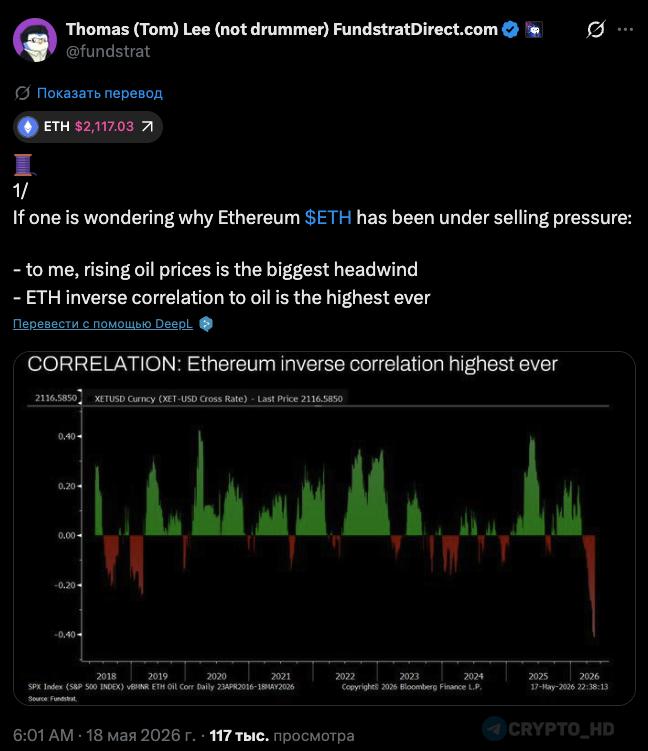
Lee, as cited by Crypto Headlines, says the inverse correlation between Ethereum and oil has reached a historical maximum. Over the last six weeks, ETH has tended to drop when oil rises. Lee expects Ethereum to move higher again once oil cools. Crypto Headlines also says he still expects market conditions to calm by 2026 and has repeated his earlier call for Ethereum to reach $12,000 this year. Big target. Not much room for mistakes.
Higher oil prices can make Ethereum look riskier because traders start worrying about inflation and tighter liquidity. Oil is not just another chart on a screen. When crude rises, markets start pricing inflation pressure, rate pressure, and less easy money. That can hit assets like ETH, especially when traders are already nervous. Most crypto commentary says network activity drives Ethereum. That’s only half right. In a six week stretch like this, macro can shove the network story to the side.
From a macro flow view, high oil prices could push investors to treat Ethereum like a high beta risk asset. Why does this matter? Because if crude keeps rising, traders may care less about Ethereum upgrades or network use and more about liquidity. Fair or not, markets do that when macro pressure gets loud. If oil rolls over, Lee’s view gets a cleaner test: ETH should have room to climb back toward the $12,000 target he has put on the table for this year. I’ll be honest: that is a clean thesis, but not a guaranteed trade.
Lee’s longer term Ethereum case rests mostly on asset tokenization and AI agents. Crypto Headlines names those two areas as the main drivers behind his bullish view. That is more serious than the usual “number go up” chatter. If real world assets move onto blockchains, Ethereum could be one of the main places that activity lands. If software agents need settlement rails, same answer. I would not treat that as proof of $12,000 ETH. It is more like the reason Lee separates a six week oil driven drawdown from a longer thesis running into 2026.
The report is about Ethereum and oil, not the whole crypto market. Crypto Headlines does not spend time on Bitcoin, ETFs, staking rules, or enforcement actions. That narrow focus matters. Counter to the usual advice, this is not a “watch everything” setup. Lee’s point is ETH specific: oil is the current pressure point, while tokenization and AI agents are the demand story. For traders, that distinction is practical. It separates an Ethereum beta trade from a possible Bitcoin safe haven bid.
Extreme correlations can snap back fast. If this relationship really is at a historical maximum, positioning may already be crowded. Is this overkill? For a short term ETH trader, no. If oil stays firm, ETH bulls may have to wait. If oil drops, Ethereum could reprice quickly, especially with Lee’s $12,000 target still attached to the call. Crypto Headlines does not list oil levels, ETH spot prices, or percentage drawdowns. That leaves less precision than people may want, and probably less than traders will pretend they have.
What this means
Ethereum’s 2026 story is still alive, but macro is steering the trade right now. Lee’s message is that ETH’s longer term drivers, asset tokenization and AI agents, have not disappeared. They are just not the only things moving price. Yes, this slightly contradicts the clean long term bull case. Bear with me. Over the past six weeks, oil has dragged on ETH, according to the Crypto Headlines report. The asset in focus is Ethereum, and the bullish number tied to the call is still $12,000 for this year.
Investors should watch whether ETH keeps selling off when crude rises. The next six weeks are the clean checkpoint as the market heads toward 2026. If oil falls and Ethereum starts climbing again, Lee’s correlation argument looks stronger. If oil falls and ETH still cannot recover, then crude probably was not the whole problem. That would be the more worrying outcome. We tried to make this cleaner than that, but markets rarely cooperate.