















































kiyosaki inflation gold silver btc eth call tests haven trade
Robert Kiyosaki’s latest post drags gold, silver, BTC and ETH right back into the inflation trade. The kiyosaki inflation gold silver btc eth point is plain enough: stop treating Bitcoin only as a speculative bet and ask whether it can defend purchasing power. My take: that question is better than the slogan, even if the slogan travels faster. Kiyosaki gives 2 reasons for the call. The war in Iran could keep oil prices high, which can push inflation higher. Government debt could also mean more printing of what he calls “fake” money. For traders on May 15, 2026, the test is simple and uncomfortable: does BTC behave like digital gold, or does it still trade like a high beta risk asset?
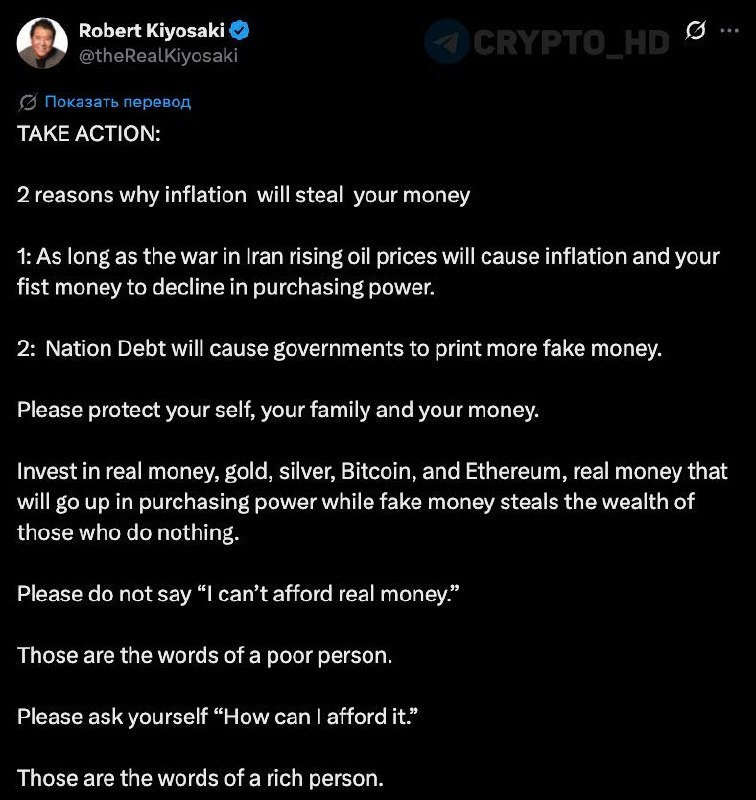
The source post is blunt, even by Kiyosaki standards. He tells readers to buy “real money”: Gold, Silver, BTC and ETH. His first point is oil. If the war in Iran drags on and oil keeps rising, inflation can bite harder and fiat purchasing power can keep slipping. His second point is debt. He says heavy government debt will push governments to print more “fake” money. Most guides stop there and call it a hard-money thesis. That’s only half right. From there, he tells people to protect themselves, their families and their money by owning gold, silver, BTC and ETH. In his view, those assets can increase purchasing power while fake money drains people who sit still. The post also points back to a “pension catastrophe,” so the retirement risk theme is still tied to his 2026 inflation warning.
That frame lands directly inside crypto’s macro argument. BTC traded near $79,931.79 on May 14, 2026, according to public market data. ETH opened near $2,257.71 that same day in another public price feed. Those prices matter because Kiyosaki is not pitching BTC and ETH here as moonshot tech bets. He is placing them beside gold and silver as money hedges. Different psychology. Different buyer. Why does this matter? Because in an inflation scare, traders usually check real yields, the U.S. dollar, oil, Fed pricing and cash demand before they rotate into BTC, ETH or sidelines. If Iran risk keeps oil firm, inflation pressure can keep rate cut hopes under pressure, and crypto may not get the clean bullish reaction retail expects.
Here is the awkward part: inflation can help the Bitcoin story while hurting the Bitcoin chart. BTC’s fixed supply looks appealing when investors worry about fiat, debt and money printing. But if inflation pushes the Federal Reserve toward tighter policy, speculative liquidity usually gets hit first. Yes, this sounds like it contradicts the hedge argument. It does, and that is exactly the point. The next FOMC meeting on June 16-17, 2026 matters for BTC and ETH traders because policy can overpower narrative. A softer inflation read could help BTC push through the $80,000 area. A hawkish read could turn Kiyosaki’s warning into a risk off trade. In that version, ETH near $2,250 probably takes more damage because it still tends to move with higher beta than BTC when liquidity tightens.
The safe haven argument has emotional pull. That is part of the risk. Kiyosaki links the war in Iran to oil, inflation and fiat weakness, which points investors toward gold first and BTC after that. Bitcoin has some history on its side here, but the record is not clean. During the January 2020 U.S.-Iran escalation after the Soleimani strike, BTC rose from about $7,355.55 on January 3, 2020 to about $8,070.83 on January 8, 2020. That was roughly a 10% move in less than a week. It works sometimes. It does not prove Bitcoin is a perfect haven. It does show that crisis headlines can pull fast money into BTC when traders expect fiat stress, oil shocks, political trouble or forced policy reactions.
ETH is the awkward name in Kiyosaki’s list. I’ll be honest: I understand why BTC sits next to gold more easily than ETH does. Gold and silver have centuries of monetary memory behind them. BTC has the fixed supply story, and crypto investors know that story by heart. ETH is harder to pin down. It is money inside the Ethereum economy, but it is also tied to staking, fees, stablecoins, tokenization, decentralized finance and developer demand. Counter to the usual advice, that extra utility does not automatically make ETH the better inflation hedge. It can make ETH more sensitive to risk appetite than gold, silver or BTC. On May 14, 2026, ETH near $2,257.71 did not look like a pure inflation hedge. It looked like a network asset that works better when liquidity comes back. If Kiyosaki’s inflation call becomes a pro crypto allocation trade, ETH can join in. If it becomes defensive hoarding, BTC probably gets the cleaner bid first.
One thing bothers me about the post: markets often punish phrases once they get too crowded. “Real money” versus “fake money” is a strong retail line, but traders still need levels, liquidity, timing and position size. BTC near $80,000 is not the same setup as BTC near $7,355.55 in January 2020. ETH near $2,250 is not the same thing as physical silver in a retirement account. Kiyosaki’s call fits long term hard money thinking, but the market will still vote through funding rates, spot ETF flows, CME positioning and dollar liquidity. The cleaner version of this trade is not “buy everything.” It is watching whether BTC can hold the inflation hedge story while ETH confirms that risk appetite is improving.
“Please protect yourself, your family and your money,” Kiyosaki says in the source post, urging investment in gold, silver, BTC and ETH.
He also turns affordability into a mindset test, contrasting “I can’t afford real money” with “How can I afford it?” That line matters because it changes a macro call into an instruction. For crypto investors, this is where discipline has to beat slogans. Dollar cost averaging into BTC or ETH is not the same as levering a futures position because oil is rising or Iran risk is on every screen. The post names 2 sources of inflation pressure. It does not give an entry, a stop loss, a time horizon or a portfolio weight. Is this overkill? Not if someone is turning a May 15, 2026 macro warning into a live BTC or ETH trade. Traders have to fill in those blanks before they act on Kiyosaki’s 2026 warning.
What this means
Kiyosaki’s post shows that the hard money trade is back in the crypto conversation in May 2026. But the point is not simply “buy BTC because inflation is bad.” The market is testing whether investors will treat BTC and ETH as monetary assets when debt, oil and war risk are moving prices. BTC is the cleaner ticker because investors already compare it with gold. ETH is more complicated because its price still depends heavily on network use and liquidity cycles. My bias: BTC gets judged against gold first, while ETH gets judged against liquidity. The first level to watch is BTC around $80,000. If buyers defend that area while inflation headlines stay hot, the haven story gets harder to ignore.
Watch the June 16-17, 2026 FOMC meeting, CME rate pricing data and spot trading around BTC $80,000 and ETH $2,250. If oil driven inflation keeps rate cuts off the table, crypto may need ETF inflows and stronger spot demand to offset tighter liquidity. If the Fed sounds more willing to tolerate inflation risk, BTC could get the hard money bid before ETH does. Kiyosaki’s quote is not the trade. The trade is whether BTC starts beating ETH and other risk assets while gold and silver rise too. That is the signal crypto investors should watch next.