















































AI Bypasses macOS Security WSJ Report Puts Crypto Custody on Alert
AI bypassed macOS security, according to WSJ reporting cited by the source post. Researchers in Calif used Anthropic Mythos to connect 2 Apple bugs into a working exploit. Crypto investors should treat this as a custody risk story, not just another Apple security headline. Here is my take: the scary part is not the Apple logo. It is the signing machine. The reported chain starts with Mac memory damage, moves into higher access rights, and reaches closed-off parts of macOS. That matters for BTC, ETH, and exchange users who still sign transactions on regular laptops in 2026. Too many still do.
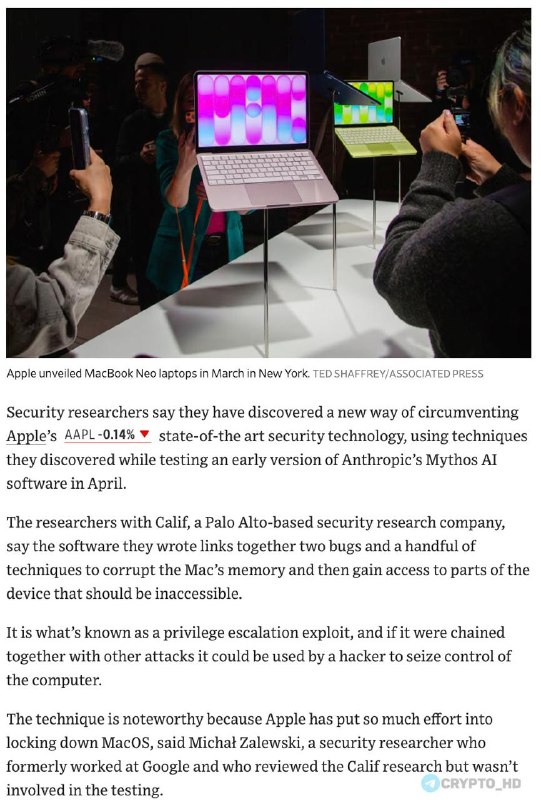
The source post, citing WSJ, says researchers in Calif used Anthropic Mythos to get around Apple protection by linking 2 bugs that human specialists later turned into a working exploit. The target was Memory Integrity Enforcement, a protection Apple had reportedly worked on for about 5 years. The researchers wrote a 55-page report and went to an Apple office in person to show the flaw. Apple is studying the issue, the source says. There is no patch yet. So the exploit details are still being held back.
Crypto people should not wave this away. Endpoint security is part of the market now. BTC can move on macro headlines at $60,000 or $70,000. ETH can react to ETF flows. COIN can trade on regulation. Fine. But the private key still often sits one bad click away from a desktop session. Most crypto security guides say the chain is secure. That is only half right. My read, not a new fact from the source, is that this is why the macOS part matters. A working exploit path against a 5-year Apple protection layer would not need to break Bitcoin. It would only need to take over the machine that signs a transaction, approves a wallet connection, or stores a recovery phrase screenshot.
The adoption signal is awkward. Since the U.S. spot Bitcoin ETF launch on January 11, 2024, BTC has been treated more and more like institutional market plumbing, while retail users still touch BTC, ETH, SOL, and stablecoins through browsers, wallets, and desktop apps. That leaves crypto with a 2-speed custody market. Big holders move keys into qualified custody and multi-party systems. Smaller traders often keep hot wallets on consumer operating systems. Why does this matter? Because an unpatched macOS vulnerability story does not land in crypto the way it lands in normal software. For traders, the issue is not only whether Apple ships a patch in 2026. It is whether wallet behavior and exchange sessions are still too casual for assets that can move 5% in one ugly session.
This is not a BTC protocol failure, and the source does not say crypto wallets were attacked. That distinction matters. The source says Anthropic Mythos helped connect 2 bugs, specialists built a working exploit, and Apple is studying the problem with no patch available yet. The crypto-market link is indirect. I would not call it minor. Endpoint compromise can step around clean on-chain security by hitting the user before the transaction ever reaches the network. ETH staking keys, BTC hardware wallet companion apps, exchange API keys, DeFi approvals: all of them depend on the machine being trustworthy at the moment the user signs. Small window. Whole ballgame.
The regulation angle is pretty direct too. After the SEC sued Coinbase on June 6, 2023, COIN fell sharply that day as investors repriced legal risk around U.S. crypto access. That was a regulatory shock. A macOS exploit is a different kind of shock, but it asks a similar 2026 question: who carries the blame when digital asset losses begin at the endpoint? If Apple has no patch yet, exchanges may add withdrawal checks. Wallet providers may make signing harder to rush through. Custodians may pitch security as the product itself. For COIN, HOOD, BTC miners with treasury exposure, and ETH staking providers, investor confidence depends on the chain and the access layer.
There is a safe haven problem here as well. BTC bulls often sell Bitcoin as independent money, especially during bank stress, sanctions, or political shocks. In March 2023, during the U.S. regional bank panic, BTC ran from around $20,000 to above $28,000 within weeks. That became a favorite example for the “outside the system” trade. Counter to the usual pitch, safe haven demand does not protect anyone from a compromised laptop. If a trader buys BTC because they distrust banks, then signs from an infected Mac, the thesis and the setup are fighting each other. Gold does not ask for a browser approval. Bitcoin does.
Macro flow still matters. Security can change where that flow goes. In a risk-on tape, traders chase BTC beta and ETH staking yield. They chase SOL momentum too. COIN equity exposure sits in the same conversation. In a risk-off tape, they cut leverage and move toward cash, T-bills, or cold storage. A no-patch macOS exploit story does not set the Fed path. It does not change inflation data either. Is this overkill? For a trader with real signing authority on a Mac, no. This kind of story can push money away from hot wallet use and toward ETFs, custodians, and hardware signing. That is a rotation inside crypto, not necessarily a rotation out of crypto. BTC spot demand can hold up while self-custody gets more defensive.
Anthropic Mythos is the detail that makes this feel very 2026. The source says the AI model linked 2 bugs, while specialists assembled the exploit. That is not the cartoon version where an AI “hacks Apple” on its own. The market read is more irritating, and probably more useful. AI can shorten vulnerability research. It can connect patterns across code behavior. It can help expert teams find combinations they might have missed or found later. I will be honest: that is useful for defenders and ugly for anyone relying on slow disclosure cycles. In crypto, where stolen ETH or BTC can move within minutes, faster exploit discovery means defenses need to speed up too. Waiting around is not a strategy.
The missing patch is the live risk. The source says the exploit details are not public because Apple has not patched the issue yet. That limits copycats, but it also leaves investors in a messy waiting period. Traders should assume uncertainty, not panic. Yes, that sounds like a hedge. It is. A 55-page report and an in-person Apple briefing make the issue sound serious, but the source gives no evidence of active exploitation, no victim count, no CVE number, and no crypto-specific loss amount. Those missing numbers matter. They keep this in the risk bucket, not the confirmed-damage bucket.
For BTC and ETH desks, the practical read is simple enough: endpoint risk belongs on the same checklist as CPI, FOMC, ETF flow, leverage data, and withdrawal behavior. A trader watching BTC near $70,000 or ETH near $4,000 should also ask where signing authority sits. Browser wallet on macOS? Hardware device with transaction review? Multisig? Custodian? These questions used to sound like back office hygiene. In 2026, they are market questions. One exploit wave can mean forced selling, delayed withdrawals, exchange friction, or sudden demand for safer custody products.
The Apple angle also dents crypto’s consumer adoption story. Apple spent about 5 years developing Memory Integrity Enforcement, according to the source, and researchers still found a path around it by linking 2 bugs. If a company with Apple’s resources can run into this, smaller wallet teams should not pretend a clean UI is enough. My take: polished wallet design is not the same thing as transaction security. Investors need to separate the two. The next BTC and ETH adoption leg will not come only from lower fees or easier onboarding. It also needs signing flows that hold up when AI-assisted vulnerability research becomes normal.
What this means
This event turns AI-assisted security research into a market risk, not just a technical curiosity. The source gives investors 3 facts worth keeping close: Anthropic Mythos linked 2 bugs, researchers wrote a 55-page report, and Apple has no patch yet. For BTC and ETH, the affected layer is not consensus. It is custody and wallet signing. It is also exchange access on macOS devices. That should keep traders calm, but not relaxed. Watch BTC and ETH custody flows in 2026, especially whether users move from hot wallets toward hardware wallets, multisig setups, and ETF-style exposure after high-profile endpoint scares.
Next, watch for Apple’s patch, any CVE disclosure, and wallet-provider guidance tied to Memory Integrity Enforcement. On the market side, track BTC around major levels such as $70,000, ETH around $4,000, COIN reaction during the next regular U.S. equity session, and CME Bitcoin futures positioning after the next weekly CFTC data release. The next FOMC decision on June 17, 2026, is still the macro date for risk assets. This story adds a separate checklist: if AI can help chain 2 bugs against macOS, crypto traders need to treat device security as position risk, not an IT footnote.