
















































Michael Saylor BTC Sale Bottom: History Rhymes for Bitcoin Bulls?
A recent observation from crypto Twitter bulls suggests a fascinating pattern: Michael Saylor’s BTC sales in 2022 coincided with a local bottom. This historical echo raises a critical question for traders: will history repeat itself this time around, offering a potential entry point for Bitcoin?
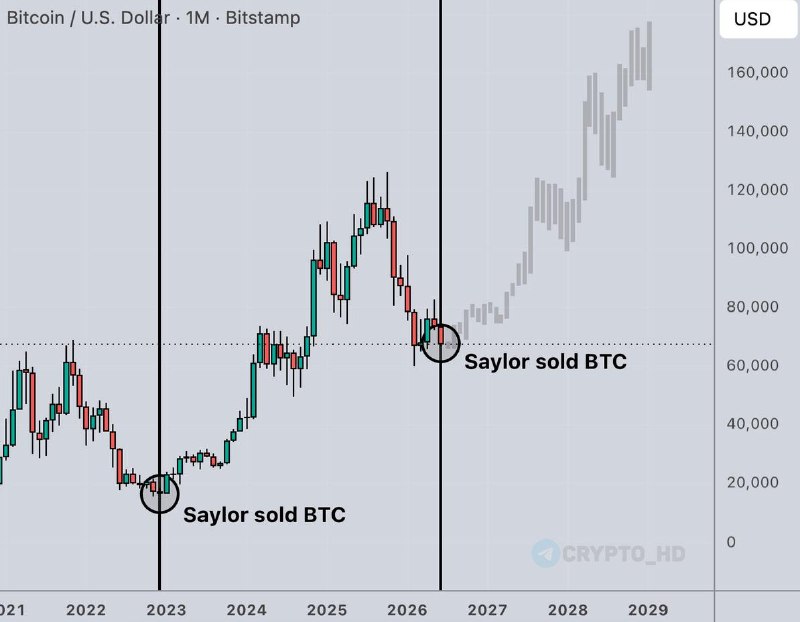
The core of this bullish sentiment stems from a look back at 2022. During that tumultuous year, whenever Michael Saylor’s MicroStrategy (MSTR) or he personally made headlines for selling BTC, the market often found a temporary floor shortly after. This isn’t a new phenomenon; market participants often look for “whale” activity as a signal, and Saylor, with his significant BTC holdings, is arguably the biggest whale in the room for many. The 2022 instances, while not explicitly detailed in the source, are etched in the memory of many long-term BTC holders who weathered that bear market.
This pattern, if it holds, offers a compelling adoption signal. Saylor’s actions, whether buying or selling, are closely watched because they represent a significant corporate treasury allocation to Bitcoin. When a major corporate entity like MicroStrategy adjusts its BTC holdings, it can send ripples through the market. If his sales indeed mark local bottoms, it suggests that institutional-level selling pressure, once absorbed, often precedes a rebound. This isn’t about Saylor being a market timer; it’s about the market’s reaction to his moves. For instance, if a large corporate sale of BTC at $20,000 in mid-2022 was followed by a bounce to $22,000 within weeks, it reinforces the idea that such events can clear out weak hands and set the stage for recovery.
Beyond the adoption signal, this observation also touches upon the broader macro flow impacting risk assets. In 2022, the crypto market was heavily influenced by rising interest rates and inflation concerns, leading to a significant de-risking across the board. Saylor’s sales, in that context, could have been perceived as a capitulation event for some, or simply a strategic rebalancing. The fact that these sales coincided with local bottoms suggests that the market was already oversold, and the additional selling pressure, while significant, was ultimately absorbed by buyers looking for value. This dynamic is crucial for traders today, as we navigate a similar, albeit different, macro environment. If BTC is currently trading around $61.4K, and a Saylor-related sale were to occur, the historical pattern suggests that this could be a point where the market finds its footing before a potential upward move.
What this means
This recurring pattern, if it continues, signals that significant corporate selling, particularly from a high-profile figure like Michael Saylor, might paradoxically act as a short-term capitulation event rather than a harbinger of deeper declines for BTC. It suggests that the market has sufficient underlying demand to absorb even large blocks of selling, indicating a robust base of conviction among Bitcoin holders. This could be a bullish signal for BTC, implying that major sell-offs are being met with strong buying interest, preventing prolonged downturns.
Traders should watch for any news regarding Michael Saylor’s or MicroStrategy’s BTC holdings. Specifically, any confirmed sales or significant rebalancing announcements could be a cue. Keep an eye on the BTC price action immediately following such news; a swift rebound from a temporary dip, especially if BTC holds above key technical levels like $60,000, would lend credence to this “Saylor bottom” theory. The next few weeks, particularly around any major economic data releases or FOMC meetings, could provide the macro backdrop against which this pattern might play out again.