
















































Sber Rostelecom Web3Gate Launch Signals Bank-Led Crypto Adoption
Sber and Rostelecom used CIPR-2026 to sign a deal for Web3Gate, a service for digital currencies and tokenized assets. The announcement is not modest: Bitcoin, Ethereum, custody, exchange, tokenized real assets, a Sber-to-Ethereum bridge, plus crypto-backed loans. For BTC and ETH traders, this is not just another Web3 headline. My take: Russia’s biggest bank ecosystem talking openly about regulated crypto infrastructure is the actual signal.
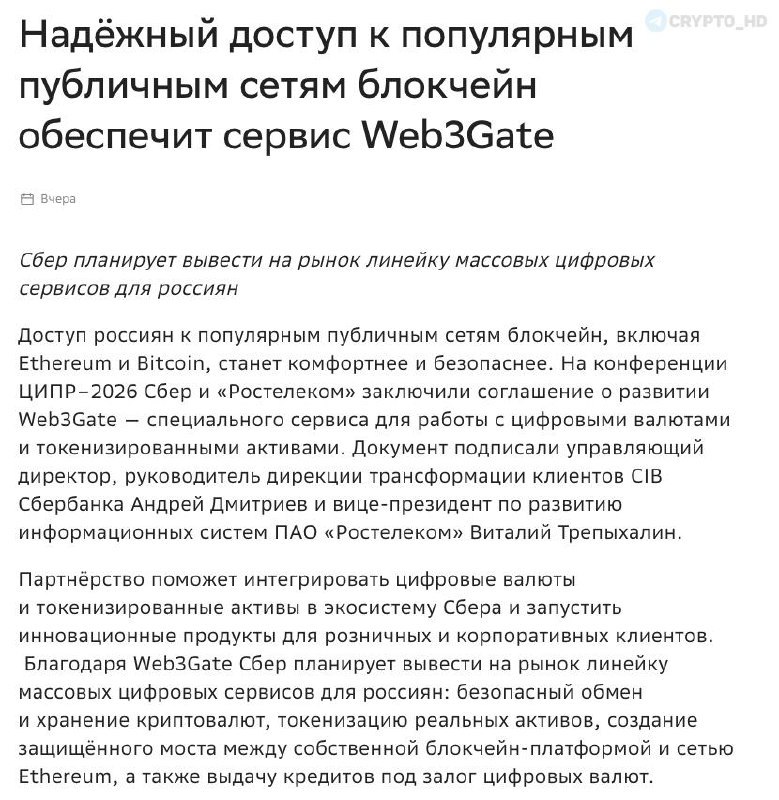
The plan is broad. Maybe too broad, at least until Web3Gate is live. Sber and Rostelecom say they will test it inside the Sber ecosystem under real load. They also mention easier and safer access to public blockchains, including Bitcoin and Ethereum. Then comes secure storage, exchange, tokenization of real assets, a protected bridge between Sber’s blockchain platform and Ethereum, and loans backed by digital currencies. Earlier items in the same news stream mentioned crypto exchanger regulation and committee amendments, but this post did not add details. That matters.
Bank adoption hits differently. A crypto native app can announce a wallet and get a shrug. When a bank announces custody and access, traders ask a sharper question: where could the money actually enter? The U.S. spot Bitcoin ETFs are the obvious comparison. They started trading on January 11, 2024. BTC moved from about $46,000 around launch day to roughly $73,800 on March 14, 2024, a gain of more than 60% in a little over two months. Web3Gate is not a U.S. ETF, and the source only says it is coming “soon.” Still, the lesson is hard to miss: once custody meets distribution, traders often price the infrastructure before most users ever touch the product.
ETH gets the cleaner setup here. A protected bridge between Sber’s blockchain platform and Ethereum puts ETH on the product map, instead of using “blockchain” as a loose label. Why does this matter? Because Ethereum has traded more on tokenization and institutional settlement stories since 2024. When U.S. spot Ether ETFs began trading on July 23, 2024, ETH started looking less like a pure smart contract bet and more like a liquid bet on on-chain financial rails. Web3Gate points in the same direction: bank ecosystem, tokenized real assets, Ethereum connection. I’ll be honest: that is cleaner for ETH than for BTC.
The BTC read is different. Sber and Rostelecom mention access to public blockchains, including Bitcoin and Ethereum, plus secure storage and crypto exchange. For BTC, that moves the story away from peer-to-peer ideology and toward custody, collateral, and regulated access. Most Bitcoin guides still frame adoption as a cultural win. That’s only half right. Traders saw the harder version in 2024: ETF custody, not a Bitcoin code change, opened a new demand channel. If a Russian banking ecosystem makes BTC easier to hold, trade, or pledge, the market will count it as another institutional adoption point, even if the first liquidity stays local.
Regulation sits right behind the announcement. A bank-linked crypto service in Russia is not going to grow outside the rulebook, especially when the same post points back to crypto exchanger regulation and committee amendments. For investors, Web3Gate bundles adoption with compliance. The Coinbase lesson from June 6, 2023 still matters for exchange equities and venue tokens: when regulators go after access points, market structure can reprice fast. By January 10, 2024, when U.S. spot Bitcoin ETFs were approved, that same access issue had turned into a bullish channel for BTC. Yes, this sounds contradictory. It is not.
The lending piece may be the line traders should watch most closely. Loans backed by digital currencies turn BTC and ETH into collateral, not just assets people hope will rise. That can add liquidity when markets are calm. It can also make selloffs uglier when collateral values fall. Crypto already saw that in 2022, when forced deleveraging hit Bitcoin, Ethereum, and lending platforms in sequence. The source does not give loan-to-value ratios, eligible assets, client types, or liquidation rules. Without those numbers, curiosity makes sense. Celebration does not. I would not underwrite the lending story yet.
Tokenized real assets create a separate bank-facing track. Sber and Rostelecom are not only talking about wallet access. They are talking about tokenizing real assets, the same category global asset managers pushed through 2023 and 2024. For ETH, that keeps attention on settlement rails, bridges, and links between permissioned systems and public networks. For BTC, the bigger question is whether banks start treating digital asset custody as a normal neighbor to deposits and securities. Credit sits there too. One detail matters: the source names Bitcoin and Ethereum. It does not name SOL, XRP, TON, or stablecoins.
Sber said the goal is to build “simple and understandable client services.” Rostelecom said the pilot should test Web3Gate in real conditions. Plain wording, but it tells traders where the 2026 bet is. Not abstract decentralization. Not a shiny crypto slogan. Usable rails. Protected access. Infrastructure that can survive load. Counter to the usual advice, the cautious language is not necessarily bearish. It sounds like a bank and a telecom operator trying to make crypto work before selling the story harder.
This does not mean instant spot buying. The source gives no trading volume, user target, launch date, pilot size, or revenue forecast. Is this overkill to say again? No, because those missing fields are exactly what traders need before pricing revenue or liquidity. Still, the list is not small: Sber ecosystem integration, Bitcoin and Ethereum access, custody, exchange, tokenization, a Sber-Ethereum bridge, and crypto-backed loans. In plain terms, this looks like the outline of a full digital asset platform, not a single feature. Traders should treat it as infrastructure news whose liquidity effect may come later.
Macro can still spoil the setup. If the next FOMC meeting on June 16-17, 2026 pushes U.S. real yields higher, BTC and ETH may trade more like rate-sensitive risk assets than adoption winners in the short run. That is the awkward part of bank adoption stories. They can expand the long term market while doing almost nothing against a dollar squeeze. In 2024, BTC’s ETF rally still had to deal with rate expectations and Treasury volatility. Web3Gate will face the same global risk filter, even if the early impact is mostly Russia-specific. My take: macro gets the first vote.
What this means
Web3Gate pushes crypto further into bank-run infrastructure in 2026, with BTC and ETH named directly. BTC and ETH are the first tickers affected because the source names Bitcoin, Ethereum, secure storage, exchange, and collateralized lending. Ethereum is the protocol to watch more closely because the proposed protected bridge between Sber’s blockchain platform and Ethereum could make ETH the connector for tokenized real assets inside the system. Not guaranteed. Just cleaner.
Watch four things next: an actual Web3Gate pilot launch date from Sber or Rostelecom, any rules tied to Russia’s crypto exchanger regulation and committee amendments, market reaction around the June 16-17, 2026 FOMC meeting, and whether Ethereum bridge language turns into real transaction data. For BTC, the trading question is whether adoption headlines can offset macro pressure near big round levels such as $100,000. For ETH, watch whether Ethereum bridge news produces strength against BTC, especially if tokenization and custody language turns into real transaction data.