















































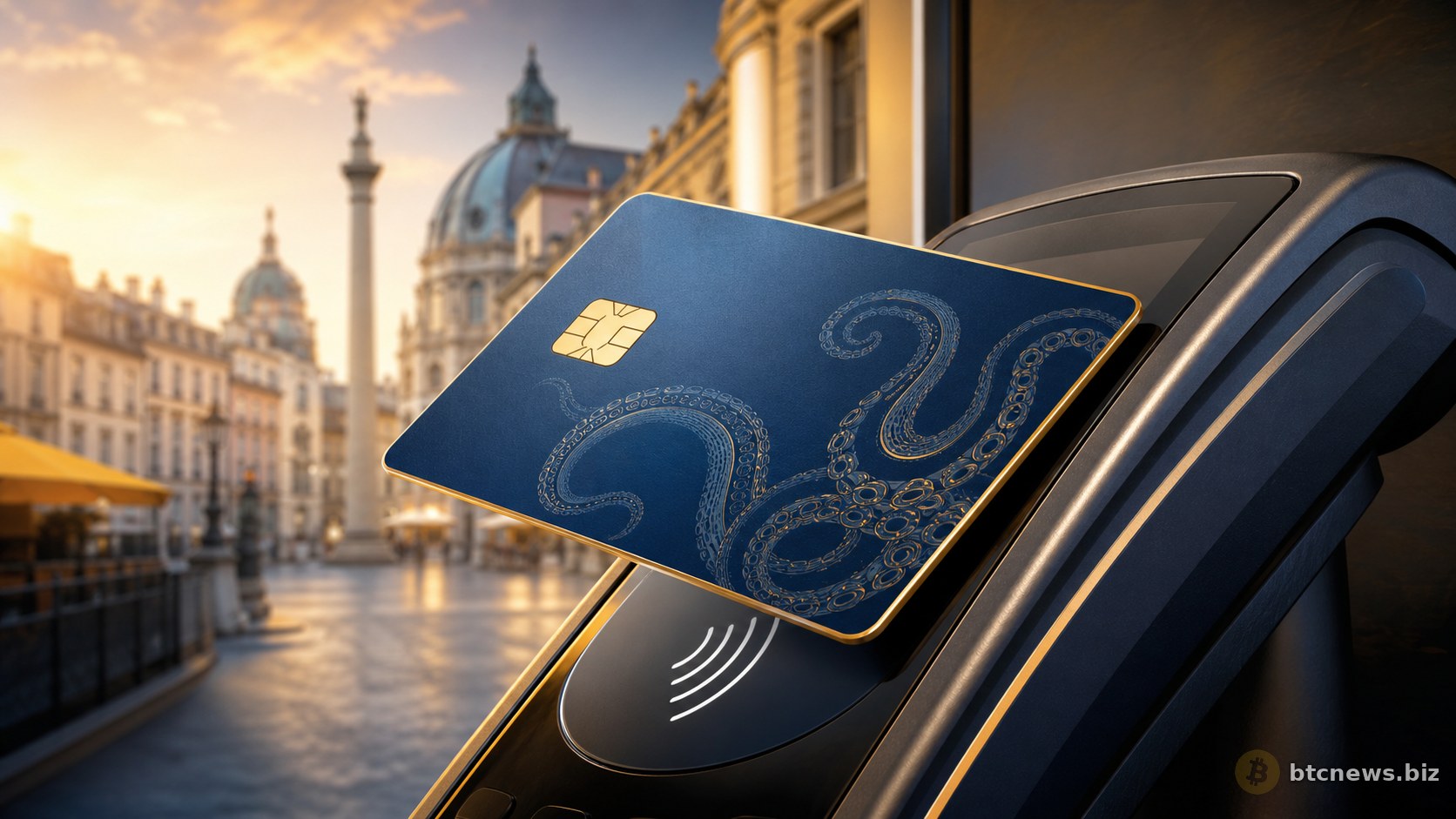
Kraken Card launch brings crypto spending to UK and Europe
Kraken launched its debit card for eligible users in the UK and the EEA on July 13, 2026. The pitch is simple enough: spend what is already sitting in your Kraken account, crypto or cash, and earn up to 2% cashback. That is useful. My take: the card does not make crypto feel magical, but it does make the old “crypto is for spending” line feel less theoretical.

The Kraken Card runs on Mastercard’s network, so it should work in most places that already accept Mastercard. Kraken says users can spend from any crypto or fiat balance they hold, with more than 600 currencies available for conversion at the point of sale. Why does this matter? Because the user does not have to manually sell Bitcoin (BTC), move euros, then pay. You could hold Bitcoin (BTC), buy a coffee in euros or pounds, and let Kraken handle the conversion at checkout. Cashback is paid weekly in BTC, euros, or pounds. Kraken also says it does not charge transaction fees or ATM fees on its side. That part matters. Fees are where crypto cards often stop being cute and start being annoying.
The 2% cashback rate has a catch. It is tiered. Kraken uses a customer’s 30-day rolling average balance across Kraken, Kraken Pro, and Krak accounts. The “Light” tier starts at €200 and pays 0.5%. “Pro” starts at €1,000 and pays 1%. “Elite” starts at €10,000 and pays 1.5%. To get the full 2%, users need the “Max” tier, which requires €50,000. New cardholders get 30 days at Max before Kraken adjusts rewards to match their actual balance. Most card writeups will lead with the 2%. That is only half right. The real product mechanic is the balance ladder, and yes, it gives people a reason to keep more money on Kraken. Subtle, it is not.
The spending controls may be the most practical part. Users can rank token balances in a spending queue, so Kraken knows what to use first. They can also switch off any token they do not want touched. I will be honest: that sounds minor until you imagine accidentally selling the wrong asset to buy lunch. One payment can pull from several balances if needed. Traditional banks rarely offer that kind of control. Counter to the usual advice, though, more control is not automatically simpler. It also means users need to think about which asset they are liquidating.
Card management happens through Krak, Kraken’s separate money app, which uses the same login as the main exchange. Krak handles transaction history and cashback settings. It also handles physical card orders. The virtual card works right away through Apple Pay and Google Pay. Kamo Asatryan, Kraken’s Global Head of Consumer, summed up the pitch: “People shouldn’t have to worry about where their money is sitting before they spend it. The Kraken Card adds ‘spend’ to that list.” That is the product in one sentence. Kraken wants crypto to feel less like something parked in an exchange account and more like money people can use.
The regulatory setup is specific, and this is where the announcement gets less glossy. In the UK, the card is issued by Monavate Limited, which is authorized by the FCA under FRN 901097. In the EEA, it is issued by UAB Monavate, authorized by the Bank of Lithuania. Kraken says these services are not covered by the UK’s Financial Services Compensation Scheme. It also warns that spending crypto can create a taxable event when assets are converted to fiat. Easy to miss. Bad idea to ignore. Kraken has also pointed to its MiCA and MiFID status in Europe as part of the rollout. The company mentioned future markets, including the United States, but gave no dates. Is that a soft launch pattern? Pretty much. Regulation is setting a lot of the pace here.
What this means
This is a real adoption signal for crypto in Europe, but it needs proportion. A debit card does not suddenly make crypto everyday money. It does remove some friction. Users can spend crypto, receive cashback in Bitcoin, and choose which balances get used first. That makes crypto easier to use for normal purchases, especially for people who already keep funds on Kraken. Skip the hype. The concrete change is that Mastercard acceptance, Krak controls, and weekly cashback now sit inside one consumer flow.
For investors, the question is whether this changes user behavior. The tiered cashback system rewards larger balances, especially at €10,000 and €50,000, so it may push some users to keep more assets on Kraken. Yes, this slightly contradicts the “just a debit card” framing above. Bear with me. The card itself is ordinary; the retention mechanic is not. Watch user growth and card uptake. Then watch trading volume after the launch. The US expansion note is also worth tracking. If Kraken gets a card live in the United States, other exchanges will notice. The next thing to watch is not vague “market sentiment.” It is a date, a license, or a filing that shows the US launch is actually moving.
FAQ
What is the Kraken Card?
The Kraken Card is a debit card for eligible users in the UK and EEA. It lets them spend crypto and fiat balances from their Kraken accounts.
When was the Kraken Card launched?
Kraken announced the card launch on July 13, 2026.
Which regions support the Kraken Card?
The Kraken Card is available to eligible users in the UK and the European Economic Area (EEA).
What network does the Kraken Card operate on?
The Kraken Card uses Mastercard’s network, so users can spend anywhere the card is accepted.
Can I earn cashback with the Kraken Card?
Yes. Users can earn up to 2% cashback, paid weekly in BTC, euros, or pounds. The rate depends on Kraken’s tier system.
Are there any transaction fees for using the Kraken Card?
Kraken says it does not charge transaction fees or ATM fees on its side.
How does the tiered cashback system work?
Kraken calculates cashback from a customer’s 30-day rolling average balance across Kraken, Kraken Pro, and Krak accounts. The tiers run from 0.5% at “Light” to 2% at “Max.”
What is the “Max” tier requirement for 2% cashback?
The “Max” tier requires a 30-day rolling average balance of €50,000 across Kraken platforms.
Can I customize which crypto assets are used for spending?
Yes. Users can rank token balances in a spending queue and switch off assets they do not want to spend.
How is the Kraken Card managed?
Users manage the card through Krak, Kraken’s separate money app. Krak handles transaction history, cashback settings, and physical card orders.
Is the Kraken Card compatible with Apple Pay and Google Pay?
Yes. The virtual Kraken Card works with Apple Pay and Google Pay right away.
Who issues the Kraken Card in the UK and EEA?
In the UK, the card is issued by Monavate Limited, authorized by the FCA under FRN 901097. In the EEA, it is issued by UAB Monavate, authorized by the Bank of Lithuania.
Are Kraken Card services covered by the UK’s Financial Services Compensation Scheme?
No. Kraken says these services are not covered by the UK’s Financial Services Compensation Scheme.
Does spending crypto with the Kraken Card have tax implications?
Yes. Kraken warns that spending crypto can trigger a taxable event when assets are converted to fiat.
Is Kraken planning to expand the card to other markets, such as the US?
Kraken says it plans to expand to more markets, including the United States. It has not given a launch date.