















































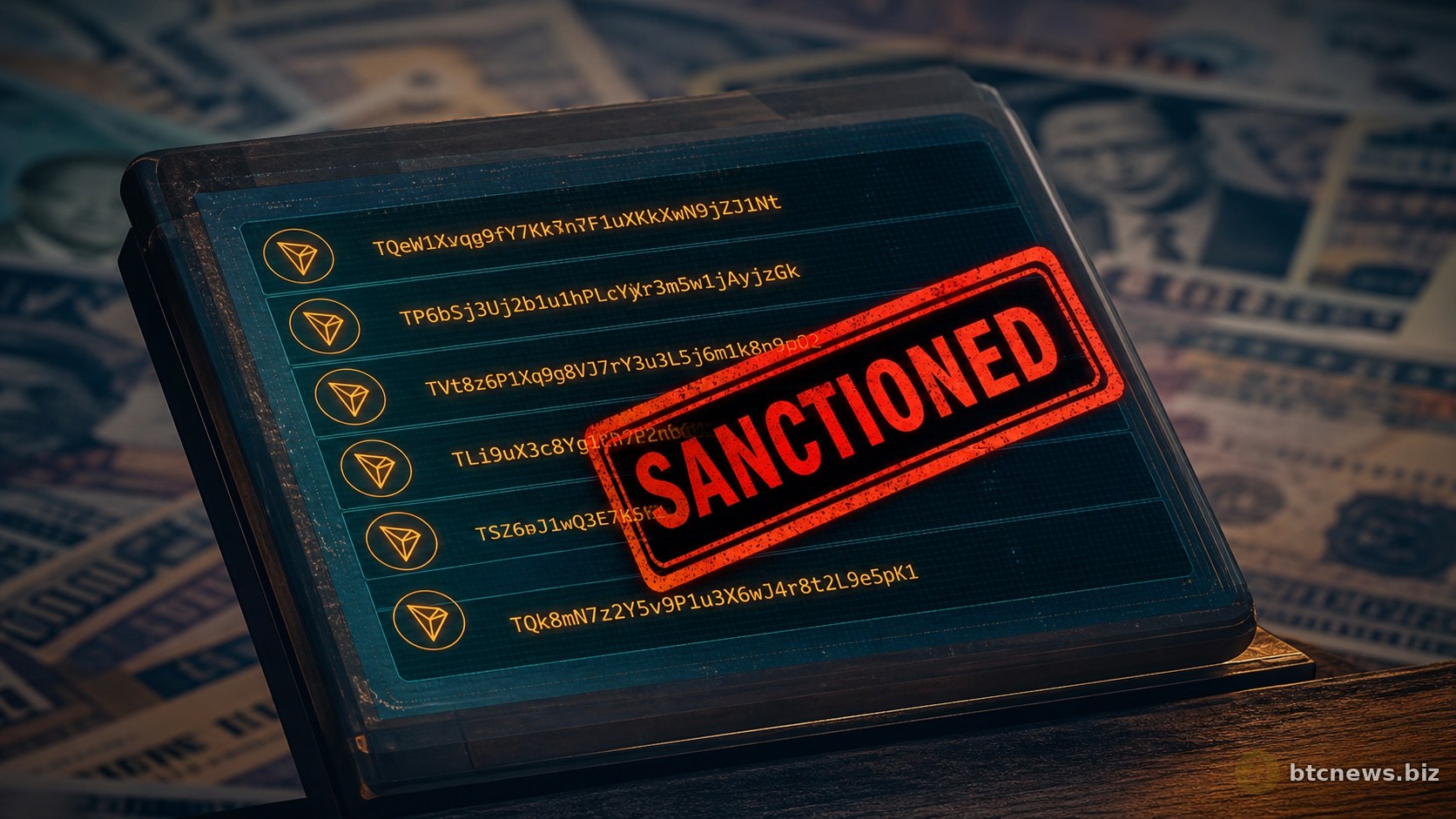
Treasury Sanctions ISIS Crypto Network, Raising Regulatory Pressure on TRON
The U.S. Treasury’s Office of Foreign Assets Control (OFAC) designated three people and six entities on June 22 for allegedly moving crypto to ISIS. The network used money service businesses and cryptocurrency to send funds through Europe, the Middle East, and West Africa. Two TRON blockchain addresses were listed by name. That is the part I would circle in red. OFAC is not only going after exchanges or companies anymore. It is naming wallet identifiers. That puts fresh pressure on chains regulators already treat with suspicion.
OFAC’s action covered a Syria-based bitcoin exchange, two Turkish money services firms, three Nigerian currency bureaus, and the people connected to them. Treasury said the network processed financial transactions for the Islamic State of Iraq and Syria (ISIS). Abdelhakim Boukich, a former Dutch national now based in Syria, was sanctioned for creating and operating Bitcoin Xchange, a Syria-based money service business. Bitcoin Xchange allegedly moved money for ISIS associates in Norway, Belgium, the Netherlands, South Africa, and the United States. OFAC also sanctioned Spider Gayrimenkul Ve Genel Ticaret Limited Sirketi and Alkaram Danismanlik Gayrimenkul Ic Ve Dis Genel Ticaret Limited Sirketi, two Turkish MSBs owned by Mohamad Alhmidan. Treasury said the firms helped provide logistical and financial support to ISIS.
Bitcoin appearing in an illicit finance case barely raises an eyebrow now. TRON does. Miloud Abderrahmane, a French national, was sanctioned for conducting transactions with ISIS affiliates and providing explosives-related instructions. OFAC added two TRON addresses to the Specially Designated Nationals (SDN) list: TBXMiRqUp1XH1zLazWu8cWitMAScv4HsYq and TDFj8tYzfLDkwEMo4MJ2DfrbpMztuCCnan. Most sanctions coverage treats that as a minor detail. I think that is only half right. This is more direct than sanctioning a custodian and moving on, because it puts the wallet itself in the compliance crosshairs. I would not turn this into a giant TRON panic story. Still, the message is clear enough: regulators are more comfortable tracing funds on-chain and naming the exact addresses they want blocked.
The sanctions also reached West Africa. OFAC named Mukhtar Adamu Muhammad, a Nigeria-based financial facilitator for ISIS in West Africa (ISIS-WA), and three bureaus de change tied to him: Nine to Nine Exchange Bureau de Change, Manhattan Bureau de Change, and Generation Currency Bureau de Change. Treasury described a network running through Syria, Turkey, France, and Nigeria. It linked that structure to its 2026 National Terrorist Financing Risk Assessment, which said ISIS has shifted toward more decentralized cells and regional facilitators. OFAC used Executive Order 13224, the counterterrorism authority used to designate ISIS in October 2004.
The move followed OFAC’s separate action against Iranian crypto rails, where it added Nobitex and three other Tehran-based exchanges to the SDN list. For traders, the issue is not just illicit finance. It is the second-order reaction. If exchanges decide TRON transactions need more screening, activity can slow, costs can rise. Liquidity can take the hit later. In a more severe case, a venue could decide the compliance burden is not worth it and restrict or delist assets tied to the chain. TRON (TRX) did not appear to sell off hard after the news. It has traded roughly between $0.08 and $0.09 over the past month. My take: the quiet price action matters, but it does not settle the risk.
What this means
Regulators are getting more precise. By naming individual TRON wallet addresses instead of only targeting exchanges, OFAC is showing that on-chain enforcement can be very specific. Why does this matter? Because authorities are watching more than centralized ramps now. They are tracking addresses, naming them, and leaving exchanges and custodians to decide how hard they want to screen related activity.
For investors, that changes the risk profile. A chain does not need to be banned to come under pressure. That sounds obvious, but it gets missed. Extra compliance checks may be enough: more monitoring, delayed withdrawals, blocked deposits, cautious exchange policies. Any one of those can chip away at usage. Counter to the usual advice, the biggest signal may not be a formal ban. It may be a boring policy update from a major exchange.
Watch the exchanges next. If major custodians or trading venues tighten screening for TRON transfers, the market will notice. Is this overkill? For a chain with active exchange flows, no. A delisting would be the loudest signal, but even “enhanced compliance” language in a policy update can shift sentiment. Also watch whether OFAC keeps naming wallet addresses on other chains. If this becomes normal, crypto compliance starts to look less like a broad exchange filter and more like address-by-address enforcement.
FAQ: Treasury Sanctions ISIS Crypto Network
What is the primary purpose of the Treasury’s recent sanctions?
OFAC said the sanctions are intended to disrupt a network accused of routing cryptocurrency to ISIS by targeting the people and entities involved in those transactions.
Which specific cryptocurrency addresses were sanctioned?
OFAC added two TRON blockchain addresses to the Specially Designated Nationals (SDN) list: TBXMiRqUp1XH1zLazWu8cWitMAScv4HsYq and TDFj8tYzfLDkwEMo4MJ2DfrbpMztuCCnan.
Who are the key individuals sanctioned in this action?
OFAC named Abdelhakim Boukich, Miloud Abderrahmane, and Mukhtar Adamu Muhammad for roles tied to financial or logistical support for ISIS.
Which entities were designated by OFAC?
The designated entities are Bitcoin Xchange, Spider Gayrimenkul Ve Genel Ticaret Limited Sirketi, Alkaram Danismanlik Gayrimenkul Ic Ve Dis Genel Ticaret Limited Sirketi, Nine to Nine Exchange Bureau de Change, Manhattan Bureau de Change, and Generation Currency Bureau de Change.
How does this action impact the TRON blockchain?
Naming TRON addresses could push exchanges and service providers to run tougher checks on TRON transactions. That could affect liquidity and adoption if the chain is treated as higher risk.
What is the significance of sanctioning specific on-chain addresses?
It shows OFAC is willing to sanction exact wallet identifiers, not only companies or exchanges. That makes crypto enforcement more targeted and harder for compliance teams to ignore.
What broader trend does this action highlight for crypto regulation?
It points to stricter crypto enforcement, with regulators using on-chain data more directly and demanding more visibility from exchanges, custodians, and blockchain service providers.
Under what authority were these sanctions imposed?
Treasury used Executive Order 13224, the counterterrorism authority used to designate ISIS in October 2004.
Where is the sanctioned network geographically distributed?
Treasury described the network as spread across Syria, Turkey, France, and Nigeria. It connected that structure to ISIS’s move toward decentralized cells and regional facilitators.
What should traders and investors watch for next?
Watch how exchanges and custodians respond to the TRON address designations. Stricter screening, restricted transfers, or delistings would matter. Also watch for new OFAC actions that name addresses on other chains.