
















































Zcash Orchard Flaw Raises Insider Trading Fears and Hits Privacy Coin Trust
Zcash’s Orchard protocol had a flaw for four years that may have let someone create fake $ZEC without limit. That alone is ugly. I’ll be honest: the trading before disclosure is the part that makes this story harder to shrug off. On paper, it is a bug report. In the market, it looked like odd volume, large shorts, and a sell-off that began before most traders had the memo. For a privacy coin, that cuts deeper than a normal exploit scare. Trust is the product.
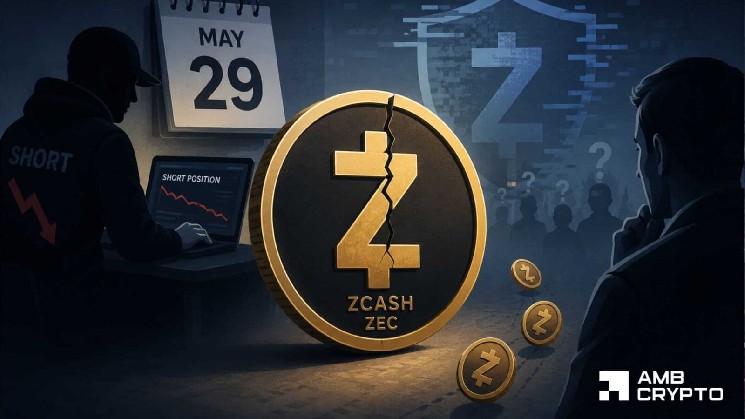
Developers said the Orchard flaw may have allowed unlimited counterfeit Zcash [$ZEC] until they pushed out an emergency fix. Then Allium Labs reviewed the trading history, and the timeline got uncomfortable. On May 26, $ZEC trading volume jumped 12 to 13 times above its average. Researchers privately found the defect three days later, on May 29. During that stretch, $ZEC fell from about $660 to $530. Developers disabled Orchard on June 2 and issued a patch on June 3. The market still did not calm down. By June 5, $ZEC had dropped 64 percent, from $685 to $247, while hourly trading hit $560 million.
Why does this matter? Because the price moved before the news did. Traditional markets have insider trading too, yes, but crypto adds pseudonymous wallets and offshore venues on top of a trust base that is already thin. Most guides treat privacy as a clean technical good. That is only half right. Privacy can protect users, but it can also make a messy post-mortem feel like staring into fog. A 64% drop from $685 to $247 by June 5, even after the patch, shows how fast confidence can leave once people start asking who knew what and when.
This is not only about Zcash. My take: privacy tech does not erase ordinary incentives. Someone can still panic. Someone can leak. Someone can front-run or quietly take the other side. Counter to the usual advice, more cryptography does not automatically mean more market confidence. Sometimes it means fewer clean answers after the damage is done. When one privacy coin starts looking fragile, capital often runs back toward Bitcoin or stablecoins. Boring wins that week.
Allium found that the most profitable positions were opened on May 25 and May 26, before researchers privately discovered the Orchard flaw. That timing is the part people will keep coming back to. The largest wallet held a $34.5 million short and made about $998,000. Another short, worth $17.7 million, made about $724,000. Those profits raise fair questions about whether some traders expected the sell-off. They do not prove it. Futures markets always match shorts with longs, so profitable shorts alone do not show prior knowledge. The other side matters too: the largest $91.5 million long lost $6.97 million.
Still, the optics are terrible. We tried to separate the code issue from the market issue here, but that split does not really hold once the timeline is this tight. The SEC and CFTC do not need much of an opening to press harder on crypto market structure, and this gives them an easy example. It could feed debates over exchange surveillance and ETF approvals. Staking rules and DeFi enforcement may get dragged into the same conversation. Zcash has another problem as well: because of its privacy model, no one can easily verify whether anyone exploited the flaw. So the market is left pricing fear, probability, and vibes. I hate that setup, but that is where traders are.
What this means
The Zcash incident exposed a code flaw, but the deeper damage is trust. A patched bug is one thing. A patched bug with suspicious trading around it is harder to dismiss. Is that unfair to developers who moved quickly? Maybe. But markets do not grade only the patch; they grade the whole sequence. The 64% fall in $ZEC shows how quickly a project can lose value when investors think the market may not have been fair. Privacy features help users, but they also make after-action checks harder. That tension is not going away.
Other privacy coins and decentralized projects may now get colder questions from traders, exchanges, and regulators. Watch for statements from the SEC, CFTC, or major exchanges about market manipulation and surveillance in decentralized markets. Watch how other privacy tokens trade if another exploit or disclosure hits. A wider sell-off could push money toward more transparent assets or regulated venues. For $ZEC, the $247 area matters because it was the post-disclosure low in this move. A clean break below it would say confidence is still leaking.
One more thing: audit tools will become part of the argument. Not generic “transparency,” but specific proposals around on-chain forensics or audit systems that try to protect privacy while giving markets some way to check what happened. Yes, this contradicts the pure privacy pitch a little. Bear with me. If a market cannot verify whether unlimited counterfeit $ZEC was created, traders will fill the gap themselves. Usually with selling.