
















































Zcash Quantum Resistance Push Targets Post-Quantum Wallets Within a Month
Zcash (ZEC) is the first major privacy-focused Layer 1 cryptocurrency moving to deploy quantum-resistant wallets, with a target shipping window of under one month and full post-quantum status within 12 to 18 months. The team says quantum-recovery wallets should ship inside a month, with full post-quantum status following in 12 to 18 months. That puts ZEC in front of every major Layer 1 on a threat most chains still file under “future problem.” My take: that label is getting lazy. For a privacy coin already attracting institutional money through Multicoin Capital, this is not trivia. It is positioning. Loud positioning.
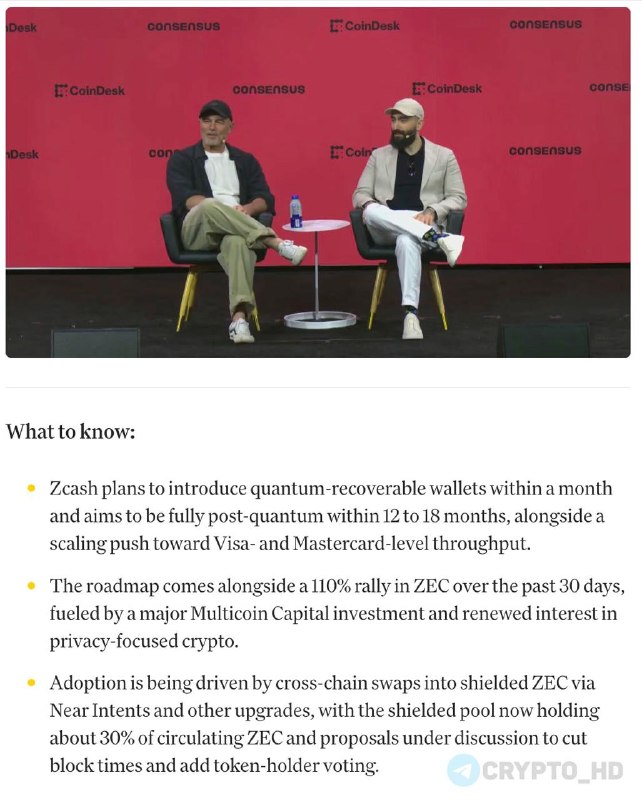
According to the Zcash core dev team, the roadmap has two tracks running at the same time. One is quantum-resistant wallets, including recovery options for users whose keys could be exposed if a cryptographically relevant quantum computer ever actually arrives. The other is throughput. The target is Visa and Mastercard territory, meaning networks that can clear tens of thousands of transactions per second even on an ordinary day. Most guides would treat those as separate cycles. That is only half right. If Zcash wants the institutional lane, security and scale have to move together, even if that makes the engineering calendar look uncomfortable.
Why quantum resistance matters for Zcash specifically
“Harvest now, decrypt later” is a documented intelligence strategy in which encrypted data is captured today and stored for retroactive decryption once quantum computers mature, a risk that disproportionately affects privacy-preserving blockchains like Zcash. Worth being blunt here. The quantum threat is not a practical 2026 problem. No public quantum machine can break elliptic curve cryptography, and according to NIST’s post-quantum cryptography assessments, conservative estimates put that capability years out, possibly a decade. So why care now? Because “harvest now, decrypt later” changes the clock. Encrypted blockchain data can be copied today, warehoused, and attacked later when the compute catches up. Bitcoin transactions are already public. Zcash shielded transactions are the product. Different risk. Bigger consequences.
I’ll be honest: I think even calling this a “privacy upgrade” undersells it. For ZEC, quantum resistance sits closer to product survival than feature polish. Yes, that sounds dramatic. It also happens to match the architecture. If shielded history can be retroactively weakened, the damage is not limited to one wallet cohort or one bad software release. It reaches backward.
Institutional adoption signal: Multicoin Capital’s ZEC position
Multicoin Capital, a thesis-driven institutional crypto fund, has publicly accumulated Zcash (ZEC), a signal that aligns the post-quantum roadmap with active institutional positioning. The first crypto angle worth flagging is adoption. Multicoin Capital, one of the more aggressive institutional crypto funds, has been buying ZEC. That is not the same thing as a retail meme rotation. Funds with that mandate usually need a thesis they can repeat in an investment memo: privacy coin, credible post-quantum roadmap, regulatory tailwinds shifting on shielded assets in select jurisdictions, supply schedule already past its halving curve. According to public price data, ZEC is up roughly threefold from its 2024 lows. A fund position telegraphed publicly tends to attract more buyers than it scares off. That part is not elegant. It works.
Regulatory pressure and the compliance edge
Zcash differs from other privacy coins because its protocol supports optional transparency. Users can disclose shielded transaction details on demand, making ZEC more compatible with regulated exchange listings than fully opaque alternatives like Monero. The second angle is regulation, and it is less obvious than the usual privacy-coin panic. Privacy coins spent the last three years getting pushed off major venues. According to public exchange announcements, Binance pulled XMR in early 2024, and several European exchanges followed. ZEC held up better than Monero because optional transparency gives exchanges and custodians something to work with. Shielded pools still exist. Disclosure is available when needed.
Counter to the usual advice, “more private” is not always the stronger institutional product. Sometimes the winning structure is privacy with an audit path. Custodians evaluating long-duration crypto exposure are increasingly asking the quantum question on diligence calls, and Zcash being able to answer “shipped” instead of “researching” matters for ETF conversations that do not really exist yet but probably will inside the next 18 months. Is that speculative? Yes. But it is the kind of speculation markets tend to price early.
Scaling to Visa-Mastercard throughput: the hard part
Visa processes approximately 65,000 transactions per second at peak load, while no privacy-preserving Layer 1 blockchain has yet demonstrated comparable throughput due to the computational cost of zero-knowledge proofs. This is where I push back hardest. According to Visa’s published network capacity figures, the network clears around 65,000 transactions per second at peak. Mastercard sits in a similar range. Ethereum’s base layer does roughly 15. Solana, on a good day, lands in the low thousands. No privacy-preserving Layer 1 has come close to credit-card-scale throughput, because zero-knowledge proofs are computationally heavy by design. The Zcash team knows this. The recursive proof work and Halo-derived techniques in the pipeline are serious research, not marketing confetti. Still, a 12 to 18 month window for both quantum resistance and Visa-tier scaling is aggressive even by crypto standards.
Track delivery against milestones, not promises. That is the whole paragraph.
The setup: three stacked narratives
The combined narrative around ZEC, institutional accumulation, post-quantum positioning, and credit-card-scale throughput, creates the conditions for a sentiment-driven rally that can decouple from delivered technology. Here is the setup. Multicoin’s position is one story. The quantum roadmap is another. The scaling pitch adds a third layer, though I trust that one the least right now. Together, they create the kind of ZEC narrative that can move price before the technology actually lands. Good for short-term momentum. Messy for anyone pretending the trade is already underwritten by shipped infrastructure.
Yes, this contradicts the cautious tone above. Bear with me. Crypto markets do not wait for completed engineering when the story is clean enough. The gap between a roadmap announcement and a deployed mainnet upgrade is usually measured in slipped quarters, not weeks. I have watched too many of these get promised in October and arrive the following spring. That does not kill the trade. It changes what the trade is.
Macro context: why ZEC fits the current rotation
Altcoin capital rotation in 2026 has concentrated in three narratives, AI tokens, real-world assets (RWA), and post-quantum cryptography, with Zcash now positioned at the intersection of the third theme and existing privacy-coin demand. The macro backdrop matters. Risk assets are sitting in a tight range while the market waits for the next Fed signal, and altcoin rotation has been thin outside a few recognizable themes. AI tokens have had their turn. RWA keeps pulling institutional attention. Now post-quantum cryptography has a cleaner ticker through ZEC. The fit is obvious: thin float, supply-side discipline, and a story that does not need Bitcoin printing new highs to function. If BTC chops sideways through Q3, capital looking for asymmetric setups tends to find coins exactly like this one.
What this means
The near-term catalyst for ZEC is a single binary event: the quantum-recovery wallet release within the next month, which the market can price as either a delivered milestone or a slipped roadmap promise. The signal is simple: Zcash is trying to become the first major crypto asset with a credible answer to the quantum question while a known institutional accumulator is already on the bid. For ZEC holders, the near-term catalyst is the quantum-recovery wallet release inside the next month. Why does this matter? Because the market can price a binary milestone much faster than it can price a 12 to 18 month cryptography roadmap. Watch ZEC reaction on the day of the wallet announcement. A clean break above recent range highs on volume would confirm the narrative is being absorbed beyond crypto-Twitter.
For everyone else, the cleaner tell is whether the quantum framing starts pulling capital out of other privacy assets and into ZEC specifically. Watch Monero’s market share. Watch the XMR/ZEC pair. Watch shielded-pool inflows. The 12 to 18 month full post-quantum target is too far out to trade directly, but the steps between now and then are not. Testnet drops matter. Audit publications matter. Exchange integrations of quantum-recovery wallets matter. If the Zcash team hits the first wallet milestone on schedule, the credibility premium gets repriced. If they slip, ZEC becomes another roadmap-driven altcoin, and the trade compresses fast.
FAQ
What is Zcash’s quantum resistance roadmap?
Zcash plans to ship quantum-recovery wallets within one month and reach full post-quantum cryptographic status within 12 to 18 months. The roadmap has two parallel tracks: quantum-resistant key management, plus Visa-Mastercard-scale throughput.
Why does Zcash need quantum resistance before other cryptocurrencies?
Zcash’s shielded transactions are the core product, and “harvest now, decrypt later” attacks could retroactively de-anonymize stored blockchain data once quantum computers mature. The risk is asymmetric for privacy coins compared with transparent chains like Bitcoin.
Is quantum computing an immediate threat to crypto in 2026?
No. According to current cryptographic research, no public quantum machine can break elliptic curve cryptography today, and credible estimates place that capability years to a decade away. The threat is the data captured now, not the compute available now.
Why is Multicoin Capital accumulating ZEC?
Multicoin Capital is positioning around three combined factors: a credible post-quantum roadmap, regulatory tailwinds for shielded assets, and a post-halving supply schedule. ZEC is up roughly threefold from its 2024 lows.
Can Zcash realistically reach Visa-Mastercard throughput?
Visa processes around 65,000 transactions per second. No privacy-preserving Layer 1 has demonstrated comparable throughput. Zcash’s recursive proof and Halo-derived techniques are some of the most advanced work in the field, but a 12 to 18 month window for both quantum resistance and credit-card-scale scaling is aggressive even by crypto standards.
How does Zcash differ from Monero on regulatory risk?
Zcash supports optional transparency. Users can disclose shielded transaction details on demand, while Monero is fully opaque. That’s why ZEC survived the 2024 privacy-coin delisting wave better than XMR.
What is the near-term catalyst to watch for ZEC?
The quantum-recovery wallet release inside the next month is a binary milestone the market can price. A clean break above recent range highs on volume on announcement day would confirm broader narrative absorption.
What signals would confirm capital rotation into ZEC from other privacy coins?
Watch Monero’s market share, the XMR/ZEC trading pair, and shielded-pool inflows on Zcash. Movement in those three metrics is the cleanest tell that the post-quantum narrative is pulling capital toward ZEC specifically.