
















































Trump’s Hormuz Strait stance: another test for Bitcoin’s safe haven story
Donald Trump’s latest statement on the Strait of Hormuz drops a nasty question into markets. He wants what is basically a “full blockade” on Iranian vessels, while saying other ships can move through. Oil desks will notice. FX traders will notice. Crypto bulls definitely will, especially the ones still arguing that Bitcoin behaves like a safe haven when geopolitics turns ugly. My take: this is exactly the kind of headline that exposes how shaky that story can be. Then there is his shift away from a 20% compensation fee and toward “HUGE” investment deals with Gulf states, which makes the whole setup harder to read, not cleaner. In past Middle East flare-ups, BTC has sometimes gained 4-7% within 72 hours. Traders will stare at that number, even if they pretend they are above it.
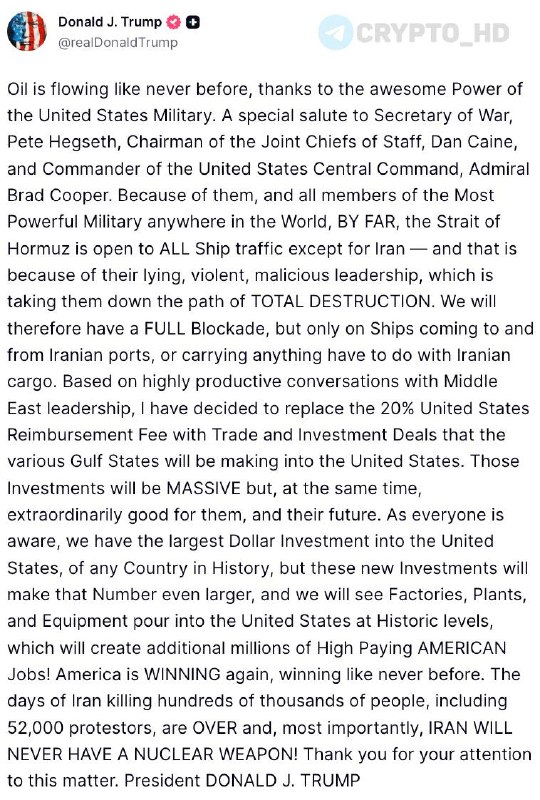
In the statement attributed to him, Trump praised the “incredible power of the United States Armed Forces” and thanked “Secretary of War Pete Hegseth, Chairman of the Joint Chiefs of Staff Dan Cain, and Commander of U.S. Central Command Admiral Brad Cooper.” He said oil now “flows” like never before because of their work and because of “the most powerful armed forces in the world, BY A HUGE MARGIN.” The Strait of Hormuz, he said, is open to “ALL vessels, except Iranian ones.” He blamed “Iran’s lying, cruel, and malicious leadership” for pushing the country toward “TOTAL DESTRUCTION.” Nobody was going to mistake this for quiet diplomacy. That part matters.
The blockade would cover “vessels traveling to or from Iranian ports, as well as those carrying any goods related to Iran.” Trump also said the United States would get paid differently. Instead of a “20-percent fee,” he said the U.S. would benefit from “trade and investment agreements” with Gulf states. He called those investments “HUGE” and said they would still be “extremely beneficial for these countries themselves and their future.” He linked the plan to what he called the “largest amount of dollar investments in history” already coming into the United States, with “millions of high-paying AMERICAN jobs” and “factories, plants, and equipment” arriving at “historic scales.” The statement closed with “America is WINNING again, like never before,” plus the claim that “the days when Iran killed hundreds of thousands of people, including 52,000 protestors, are OVER.” Then came the line markets were bound to notice: “IRAN WILL NEVER HAVE NUCLEAR WEAPONS!”
Hormuz matters because a large share of the world’s oil moves through it. That is not theater. Why does this matter? Because oil can reprice before diplomats even finish their sentences, and once that happens, traders go hunting for assets they think sit outside normal market plumbing. Bitcoin wants that job. It has had a few moments that help the case, including the January 2020 Soleimani strike, when BTC rose about 8% within days. Most guides say that proves the safe haven thesis. That’s only half right. One good episode is not a market law. Brent crude could move above $90 a barrel if traders price in a serious supply shock, but crypto may react more to fear than to the oil number itself. With BTC near $61.4K, the question is plain enough: does it hold its ground, or does the blockade story knock risk appetite sideways?
The macro picture is messier. I’ll be honest: I would not trade this as a clean oil-to-Bitcoin setup. If oil supply gets disrupted, inflation fears return fast, and the Fed has to decide whether that is a passing shock or something more stubborn. Higher rates usually hurt crypto because investors can earn yield in safer assets. Yes, that slightly contradicts the safe haven framing above. Bear with me. If the market treats the blockade as a short blast of geopolitical stress, Bitcoin could still catch a bid. I would not assume it. The move from a direct “20-percent fee” to Gulf investment deals also changes the money trail. If those deals are real and large, they could affect capital flows and liquidity. They could also change the mood around U.S. assets. That may matter for crypto, though probably not in the neat, instant way social media will want. Markets need details before “millions of high-paying AMERICAN jobs” and “historic scales” mean much beyond campaign language.
What this means
Trump’s posture points to a harder U.S. line on Iran, which could make the trading week more nervous. For crypto investors, this is another real-time test of the “Bitcoin as digital gold” claim. Is this overkill for one statement? For BTC near $61.4K, no. If traders see the blockade as a threat to oil supply and global stability, BTC could push toward the $65,000 area. If they read it as loud rhetoric, or if the Gulf investment deals settle oil markets quickly, the safe haven premium could disappear just as fast. Counter to the usual advice, Bitcoin does not have to choose one identity here. It can look like protection one day and a risk asset the next. That is the uncomfortable bit.
Watch oil and gold first. Watch the dollar too. Those three markets will show whether traditional investors are treating this as a real shock or just another headline. The next 72 hours matter for BTC because that is where past Middle East moves have tended to show up. In my view, Iran’s response is the hinge, not the social media reaction to Trump’s wording. Statements from other major powers matter as well. The useful follow-up would be something concrete from the U.S. Treasury on what “full blockade” means in practice and what the Gulf investment agreements actually contain. Until then, traders are mostly pricing tone, threats, and guesswork.