
















































Trump Iran Ormuz Strait Crypto Reaction Hinges on Whether Truce Holds
Trump’s Iran-Ormuz ultimatum is a binary geopolitical catalyst that forces crypto traders to price two opposite scenarios, renewed bombing or a holding truce, inside one 72-hour news cycle. Trump’s ultimatum on the Ormuz Strait is not subtle. Accept the deal, or face bombing “much larger and more intense” than before. That’s the whole setup. The U.S. Energy Information Administration puts roughly a fifth of global oil flow through Hormuz, so a reopening, or another strike cycle, can flip the inflation trade in one headline. Why does this matter? Because Bitcoin sits right between those narratives: relief bid if oil cools, safe-haven rotation if the Strait turns into a live military risk again. My take: traders treating this like ordinary headline noise are being too casual.
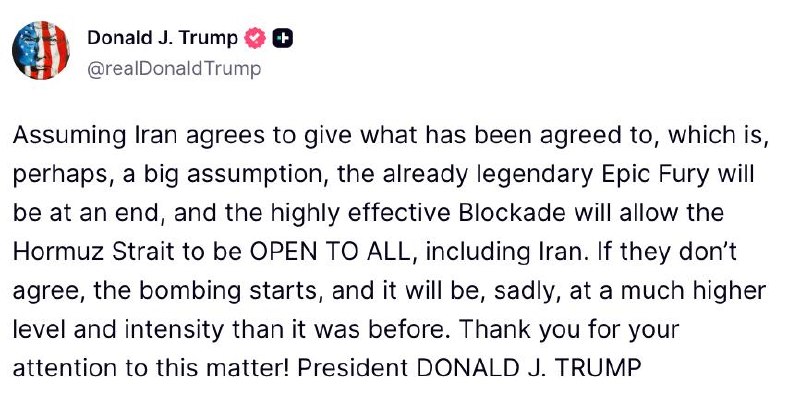
The president framed it as a fork in the road. If Tehran honors the agreements, Operation “Epic Fury” ends, the blockade lifts, and the Strait reopens for everyone, Iran included. If not, the airstrikes resume on a heavier scale. No third lane was offered. That matters. Markets can digest uncertainty over time; they digest ultimatums immediately, usually by repricing first and asking about details later.
The safe-haven case for Bitcoin rests on a clear historical pattern. Every major U.S.-Iran shock since 2020 has produced a measurable BTC bid inside 72 hours. Start with the safe-haven angle, because this is where Bitcoin has the cleanest comp. CoinMarketCap price history shows that when the U.S. killed General Soleimani in January 2020, BTC ran from roughly $6,900 to $8,400 in three weeks. The initial shock was about an 8% move, then a second leg came as Iran retaliated. The June 2025 strikes on Iranian nuclear sites produced a smaller but still visible BTC bid around the $61K zone before macro flows swallowed the story. Most guides reduce this to “war = Bitcoin up.” That’s only half right. The better read is narrower: Middle East shock plus dollar uncertainty can make BTC outperform gold for 72 hours, then the trade usually mean-reverts. If Trump’s threat becomes renewed bombing, that is the page worth reopening.
A holding truce is the more bullish scenario for higher-beta crypto, because an open Strait of Hormuz lowers oil prices, cools CPI, and gives the Fed cover to keep cutting. Now flip it. A truce that actually holds may be the better crypto trade, and I don’t think desks are giving it enough weight. Open Strait, normalized oil supply, cooler headline CPI, more cover for the Fed to keep cutting into 2026. Simple chain. Lower real yields and a softer dollar push capital back out the risk curve, where ETH and the higher-beta L1s usually move before BTC. The COIN equity tape is the tell I would watch first, since it tends to front-run spot volume by a session or two. I’ll be honest: a clean Iran de-escalation could matter more to risk assets than another 25 bps cut.
Sanctions enforcement on Iranian oil flows directly affects stablecoin issuers and U.S.-listed exchanges, which makes the regulatory channel a second-order crypto exposure. The regulation angle is less flashy, but it is not background noise. U.S. Treasury OFAC enforcement actions over the past two years have repeatedly pulled USDT and OTC desks into Treasury crosshairs over Iranian oil revenue. A lifted blockade reduces the political appetite for stablecoin enforcement tied to sanctions evasion. It does not erase it. Counter to the usual advice, this is not only an oil trade dressed up as crypto analysis; it also runs through Tether’s banking relationships and any U.S.-listed exchange, COIN, KRKN if it ever lists, carrying compliance overhang. Re-escalation does the reverse: more subpoenas, more enforcement headlines, more sentiment drag just as macro turns hostile.
The most important detail in Trump’s statement is what it omits: no deadline, no verification mechanism, no secondary sanctions language. The omission is the point. There is no timeline. There is no verification mechanism. There is no mention of secondary sanctions on buyers of Iranian crude, the lever that actually moved oil markets in 2018-2019. Is that a small detail? No, it is the trader’s tell. An ultimatum without a deadline is more negotiating posture than operational order, at least until a date appears. We have seen this rhythm before: leaked timeline, Truth Social post at 2 a.m., CENTCOM movement headline, then the repricing starts for real.
The muted crypto vol response is itself a signal. Implied vol on BTC weeklies has not spiked, which suggests positioning is already light or traders are fading the ultimatum. The crypto desk reaction has been oddly quiet. Deribit options data shows implied vol on BTC weeklies has not spiked the way it did around the June 2025 strikes. Maybe traders are conditioned to fade Trump ultimatums after the tariff cycle of the past year. Maybe positioning is already light enough that there is no forced unwind to chase. Yes, that slightly contradicts the “binary catalyst” framing above; bear with me. A catalyst can be real while the market still refuses to pay for optionality until the clock becomes explicit. For now, funding is neutral, basis is compressed, and spot has to do the talking.
What this means
This is a binary catalyst with asymmetric crypto outcomes. Re-escalation favors BTC as safe haven, de-escalation favors ETH and L1 beta, and a vague non-resolution is the worst outcome for active traders. The asymmetry favors movement, not drift. Re-escalation gives BTC the safe-haven story back on a 72-hour clock, with the historical pattern pointing to a 4-8% upside leg before macro reasserts itself. A real de-escalation, meaning Strait open, blockade lifted, oil flowing, is the under-discussed case that pulls real yields lower, weakens the dollar, and lets ETH plus the L1 complex lead. The bad trade is the mushy middle. No deadline, no strike, no clean truce. Just two weeks of vol bleeding while spot chops sideways.
The cleanest trade triggers are oil-tape based. Brent under $72 signals de-escalation and ETH/SOL rotation. Brent over $85 signals re-escalation and BTC plus miner outperformance. Watch oil first. Crypto second. Brent breaking back below $72 with no Iranian retaliation headline is the de-escalation tell, and that is where I would look for ETH/SOL beta against BTC. Brent above $85 with a Pentagon briefing on the wires is the re-escalation tell. BTC outperforms gold, miners (RIOT, MARA, CLSK) catch a bid on the energy-narrative tailwind, and stablecoin flows into Asian exchanges spike as Middle East capital hunts dollar exposure. The Federal Reserve’s published meeting calendar puts the next FOMC on June 17-18, which is the macro pin. Anything Iran-related between now and then gets amplified by rate-cut positioning. There is no timeline on Trump’s ultimatum yet. When one leaks, that is the trade trigger, not the post itself.