















































TON to GRAM renaming scam warning tests token trust
The “ton to gram renaming scam” is straightforward: scammers are using talk of a possible TON ticker change to GRAM to push fake swaps and migrations. On June 1, 2026, an odd TON Vote proposal turned a ticker rumor into a trust problem for traders. The danger is not a confirmed rebrand. It is the ton to gram renaming scam routine: convince holders they need to swap, migrate, or convert their TON. They do not. If a ticker change were real, holders would not need to move their tokens.
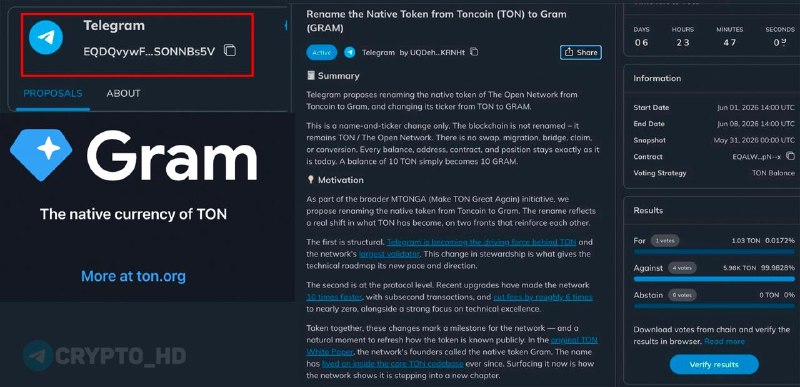
A proposal reportedly appeared in TON Vote asking to change the ticker from TON to GRAM. The post says it came from a verified Telegram account, though the link that once led to TON Vote is no longer available. That detail matters, but it does not prove a migration. According to the same post, the proposal was about the ticker only. Balances, addresses, smart contracts, staking, NFT holdings, and DeFi positions would stay as they are. The blockchain name, The Open Network, would stay too.
The GRAM name carries baggage. That is the awkward part. TON and GRAM are not just 3 letter tags on a chart. They affect exchange routing, wallet screens, search results, and what traders think they are buying. In 2019 and 2020, Telegram’s original Gram project ran into pressure from the U.S. SEC, and the name still has enough pull to attract speculators. And scammers. This is context, not a sourced claim from the post: the old regulatory memory around GRAM makes TON to GRAM chatter much more combustible than a normal ticker edit.
Here is the part I would not overthink: any request to “exchange,” “migrate,” or “convert” TON into GRAM should be treated as a scam signal. Ticker events can move markets even when the token itself does not change. Traders have seen versions of this around exchange listings, token migrations, ETF tickers, and wrapped assets tied to BTC, ETH, and other liquid markets. In this case, the source says balances, addresses, smart contracts, staking, NFTs, and DeFi positions would not change. So the swap link is not an opportunity. It is the warning sign.
The regulatory angle is hard to miss. GRAM still points back to Telegram’s blocked crypto project from 2019 and 2020, while TON now trades under The Open Network name in a different ecosystem. If traders mistake a ticker proposal for a token migration, exchanges and wallet providers could get hit with support tickets, phishing reports, and confused listing page questions. Crypto markets already parse SEC and CFTC wording around staking, token issuance, and custody. In that setting, the TON/GRAM label problem is not just branding.
The Telegram connection cuts both ways. A proposal allegedly tied to a verified Telegram account, even with the link now unavailable, shows why Telegram adjacent crypto infrastructure still gives TON a strong distribution story. It also shows why scammers would jump on it. When a ticker sits close to a mass market app brand, a governance post can become bait. So can a wallet prompt. So can an exchange notice. More attention means more targets. That is usually how this goes in crypto.
The clean read is practical, not sentimental. TON holders should not make this about nostalgia for GRAM or excitement over a cleaner ticker. They should look at custody. If the blockchain remains The Open Network, and if balances, addresses, smart contracts, staking, NFTs, and DeFi positions stay unchanged, then no legitimate process requires users to send TON anywhere on June 1, 2026. Keep the tokens where they are unless an official, verifiable channel says otherwise.
For traders, this also touches liquidity. A ticker rumor can split attention between TON and GRAM searches, especially on venues where bots scrape headlines before people read the details. BTC and ETH traders know the pattern from ETF rumor cycles. The headline moves first. The correction shows up later. Somewhere in the middle, retail finds a scam link. With TON, the source’s warning gives the filter: ticker only means no migration.
There is no source quote to add here, and inventing one would make the situation worse. The known facts are narrow enough: a TON Vote proposal reportedly appeared, it involved TON to GRAM ticker wording, the earlier link is unavailable, and the post warns that any swap, migration, or conversion offer is a scam. That is enough to act on. The risk is not that TON technology suddenly changed overnight. The risk is that users misunderstand what stayed the same.
What this means
This is a 2026 crypto problem in miniature: brand, governance, and wallet trust are tangled together. For TON, the ticker in question is TON, the disputed label is GRAM, and the weak point is every screen a user can be tricked into trusting. Traders should watch official TON and Telegram linked channels for dated clarification after June 1, 2026. Until then, treat any TON to GRAM conversion link as hostile unless a verified exchange or wallet notice says something different.
The next thing to watch is not a macro calendar date. It is an official TON Vote, exchange, or wallet update confirming whether the proposal was real, removed, or unauthorized. For market structure, watch TON spot liquidity, TON/USDT order books, and any exchange ticker notice that uses TON or GRAM wording. The practical test is blunt: if users keep TON in the same address and contract environment, nothing migrated. If a site asks for conversion, reject it.