
















































Radiant project shuts down after hack, and DeFi risk gets harder to ignore
Radiant’s shutdown after its hack shows how fast a security failure can turn into a market problem. Crypto still has not solved this part. Not really. A hack is not just a bad day in governance forums or a messy post-mortem. It can change how traders price an entire corner of the market. Radiant said that after 18 months of work following the October 2024 hack, the DAO no longer has a viable development path. My take: that is the line traders should sit with. DeFi risk premiums can widen quickly when a recovery plan finally runs out of oxygen.
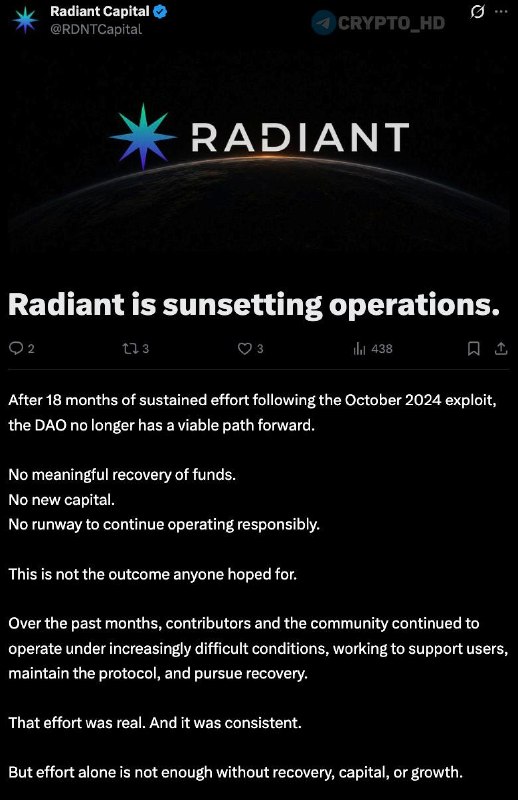
Radiant tied the shutdown to the October 2024 hack and the failed recovery effort that followed. The source post is thin. Thin enough that it leaves gaps. But it says the important thing: Radiant is ceasing operations, and the announcement links that decision to the October 2024 hack and the 18 months spent trying to recover from it. The key line is not technical. It is institutional. The DAO says there is “no longer” a viable path forward. That phrase lands hard in a market built on second chances.
Radiant’s failure gives traders another reason to rethink smart contract risk, bridge exposure, DAO governance, and treasury depth. For ETH, this belongs in the DeFi bucket. Ethereum still carries the biggest DeFi story, so protocol failures can bleed into how people price Ethereum linked risk. Most guides say smart contract exploits are isolated protocol events. That’s only half right. ETH traded near $1,600 after the March 2023 banking shock, then moved above $2,000 by April 2023 as risk appetite returned. Radiant points the other way at the sector level. It tells allocators, again, that yield is not free.
DeFi security failures can affect broader crypto flows when Bitcoin and Ethereum trade like risk assets. Why does this matter? Because security headlines do not arrive in a vacuum; they collide with rates, liquidity, ETF flows, and whatever traders already wanted to sell. BTC moved above $46,000 around the January 10, 2024 spot bitcoin ETF approval and later became a cleaner proxy for institutional crypto demand. DeFi tokens did not get that shelter. I’ll be honest: that split is getting harder to ignore. If traders are cutting exposure in a tighter liquidity market, a hacked protocol that still cannot recover after 18 months gives them an obvious place to start selling. The long tail goes first.
Hacks followed by shutdowns also give regulators an easy target. No mystery there. A DAO shutting down after a hack is exactly the kind of story regulators can understand, repeat, and use in hearings. The SEC approved spot bitcoin ETFs on January 10, 2024, but that did not end scrutiny of staking or exchanges. DeFi governance remains in the frame too. COIN is still the listed stock many traders use for U.S. crypto regulatory risk. Counter to the usual crypto reflex, decentralization does not make this story harder for regulators to explain. It makes the accountability question cleaner: who answers when a decentralized system fails its users?
Radiant is an application layer failure, not a Bitcoin base layer failure. That distinction matters. Bitcoin did not break here. BTC can still trade on scarcity, ETF demand, and macro hedging, while DeFi tokens trade much more directly on trust in protocols. During the March 2020 liquidity crash, BTC fell with risk assets before recovering. By late 2020, it had become a major macro trade again. Radiant belongs in a different pile. This is application layer fragility. It is the sort of risk DeFi investors say they price in until the bill actually shows up.
The 18 month recovery period matters because markets judge repair efforts by results, not promises. Eighteen months is a long time in crypto. Long enough for traders to assume a team, DAO, or backers have either found a workable route or run out of options. Radiant’s answer is the second one. Is that too harsh? No, because survival is the market’s cleanest post-hack metric. That gives traders a rough template for older exploit cases from 2024 and 2025. The question will not be who posted the most confident recovery thread after the hack. It will be whether the treasury survived, whether governance held together, and whether users had any reason to stay.
Radiant’s closure should push investors to separate BTC, ETH, and DeFi token risk more clearly. BTC can sit in a different risk sleeve from DeFi tokens. ETH is harder. Yes, this contradicts the neat “application layer only” framing above; bear with me. ETH benefits from DeFi activity, but it also takes some reputational damage when visible apps fail. If Radiant’s closure makes traders more cautious around lending and cross chain protocols, they may ask for higher yields, stronger audits, clearer treasury buffers, or lower token prices before they take the other side. Honestly, that seems fair. Trust is expensive after a hack.
What this means
Radiant’s shutdown shows that the cleanup from the October 2024 hack is still affecting DeFi risk. This is not only a Radiant story. It touches ETH beta, DeFi governance tokens, and appetite for lending protocol risk. Watch ETH against BTC first. If ETH underperforms while BTC holds major levels, the market is probably isolating DeFi risk instead of dumping crypto across the board. I would not overcomplicate that signal.
The near term signals are CME positioning, the June 17, 2026 FOMC decision, BTC levels, and DeFi TVL movement. The useful things to watch are specific: CME BTC and ETH positioning in the next weekly report, the next FOMC decision on June 17, 2026, whether BTC holds the major psychological level traders are using, and where TVL moves while Radiant’s announcement circulates. For DeFi, TVL migration is the cleaner tell. If money leaves smaller protocols and piles into larger venues after the October 2024 hack fallout, Radiant will look less like a one-off shutdown and more like another step in DeFi’s risk reset.
FAQ
- What caused the Radiant project shutdown?
- Radiant said it could not find a viable development path after 18 months of work following the October 2024 hack.
- How does Radiant’s shutdown affect DeFi risk premiums?
- It can push DeFi risk premiums higher because traders are being reminded, in a fairly ugly way, that security failures can become market events. DeFi yield comes with real risk.
- Is this similar to a Bitcoin security event?
- No. Radiant’s shutdown is an application layer failure. Bitcoin’s base layer did not fail.
- Why does the 18 month recovery timeline matter?
- The 18 month timeline matters because the project had a long window to recover and still could not find a path forward. Markets tend to judge post-hack recovery by survival, not by the first promises made after the exploit.
- How might this affect investor portfolio construction?
- Investors may draw a sharper line between BTC, ETH, and DeFi tokens. For DeFi protocols, they may demand higher yields, better audits, or lower prices before taking risk.
- What are the immediate market indicators to watch?
- Watch CME BTC and ETH positioning, the next FOMC decision, BTC’s ability to hold major psychological levels, and TVL migration across DeFi protocols.
- Does this increase regulatory pressure on DeFi?
- Yes. Shutdowns after hacks give regulators a simple argument and make accountability in decentralized systems harder to wave away.
- What does “ETH beta” mean in this context?
- Here, “ETH beta” means how strongly Ethereum and Ethereum linked assets react to broader crypto sentiment, especially when DeFi failures hurt confidence.
- Will this lead to capital concentration in larger DeFi protocols?
- It might. If capital leaves smaller protocols and moves into larger venues after the October 2024 hack fallout, that would point to a wider risk reset in DeFi.
- What was the date of the hack that led to the shutdown?
- The hack that led to Radiant’s shutdown happened in October 2024, according to the project’s announcement.