
















































MEXC Russia US Stocks ETFs: A Geopolitical Trade for Crypto Traders
MEXC, a large crypto exchange, has reportedly given Russian citizens a way to buy real US stocks and ETFs. If the reports are accurate, this is not just a product update. It is a sanctions story wearing a brokerage interface. Russian users would get direct ownership and dividend payments through a licensed broker partner, with crypto handling the funding route. Stablecoins in. US equities out. I’ll be honest: that is the whole trade. I would not call it clean or simple. It sits in the awkward middle of sanctions, brokerage access, offshore exchanges, and digital dollars.
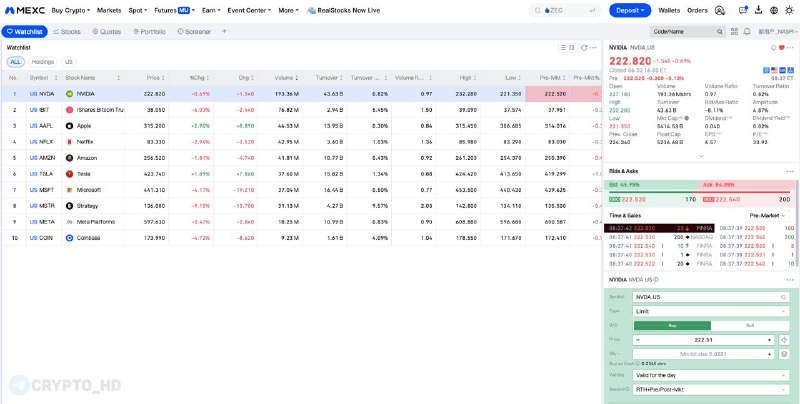
The reports came through Russian channels and describe a specific process. Users register, pass basic KYC1 checks, then open the “Stocks” or “RealStocks” section. After that, they submit more documents. Russian driver’s licenses and utility bills are reportedly accepted as ID and address proof. There is also a short questionnaire. Once approved, users can move USDT from their normal MEXC balance into a separate “Stocks” balance and buy US stocks or ETFs, including in pre-market trading. The main point: these are described as “real rights to assets,” not tokenized stock wrappers. Most guides would treat that as a minor product detail. That’s only half right. It changes the legal, custody, and dividend question in a real way. For Russian citizens whose access to US markets has been squeezed by sanctions and broker restrictions, this creates a path that did not really exist at this scale before.
The macro flow is the first thing I would watch. Russian capital has fewer regular routes into global markets now, so a USDT-to-US-equities path could pull liquidity out of crypto and into stocks. Nobody knows the size yet, which is the annoying part. My take: the size matters less at first than the proof that the route works. Russia-linked wallets and investors are widely believed to hold billions in crypto, and even a small slice moving through one exchange could show up in stablecoin flows. A larger rotation could lower USDT balances on exchanges or increase turnover. It could also put short-term pressure on liquidity in pairs where USDT is the main quote asset. Why does this matter? Because crypto markets often react before anyone has a clean dataset. Small stablecoin shocks have rattled the market before. In March 2023, USDC slipped from its peg after the Silicon Valley Bank collapse, and BTC briefly traded below $20,000 before bouncing. This is not the same setup. Still, it gives traders one more thing to track when reading stablecoin health.
The other obvious issue is regulation. US and EU regulators have spent the last few years pressing crypto exchanges on sanctions, KYC, and AML controls. If MEXC is helping Russian citizens reach US equities through a broker partner, officials in Washington and Brussels will notice. Maybe nothing happens at first. Maybe it turns into letters or subpoenas. Maybe pressure lands on partners before it lands on MEXC. That is often how these stories begin. Counter to the usual advice, I would not focus only on the headline exchange. The broker partner and payment channels may matter more. The risk is not only for MEXC. It could lead to tougher KYC checks across other offshore exchanges. Markets usually dislike that kind of uncertainty. When the SEC sued Binance and Coinbase in June 2023, ETH dropped about 10% in 48 hours, from roughly $1,870 to $1,680. This MEXC story has a similar feel: not an instant crisis, but a reason for traders to rethink exposure to exchanges operating in the gray zone.
What this means
MEXC’s reported stock access shows how crypto rails can get around traditional financial barriers. That is the uncomfortable part. Capital controls work best when money has to move through banks. Stablecoins make that harder. USDT is no longer just a trading chip inside crypto. In cases like this, it becomes a bridge into legacy markets. Yes, this slightly contradicts the idea that the flow could drain liquidity from crypto; bear with me. The same route can increase USDT demand while also moving risk appetite away from spot crypto pairs. Both can be true. That could increase demand for USDT, but it also gives regulators another reason to look closely at who is using it and where the money ends up. I would watch USDT market cap and exchange balances first. Spot volume comes next. A sudden move in any of those could be the first sign that capital is shifting between crypto and equities.
The next thing to watch is the official response. Statements from the US Treasury’s OFAC or EU financial regulators would matter more than social media chatter. Is this overkill? For a one-off product rumor, maybe. For a live route from USDT into US stocks or ETFs, no. Any action against MEXC, its broker partner, or related payment channels could hit exchange tokens and higher risk crypto assets first. Stablecoin volume also deserves attention. A sharp rise or drop in USDT activity may point to large reallocations, not ordinary trading noise. We tried to treat stories like this as isolated exchange drama before. It broke. BTC and ETH have often sold off on regulatory news, then recovered once traders understood the actual damage. For Bitcoin, $60,000 is the level I would keep on the screen. If that breaks after new sanctions or enforcement headlines, the market may be pricing in a broader regulatory hit.