
















































Binance NFT closure points to tougher rules for exchanges
Binance, the world’s largest crypto exchange by trading volume, said it will close its NFT service on July 3. Users have about a month to move their digital assets out. Short window. My take: that deadline says more about Binance’s priorities than about NFTs as collectibles.
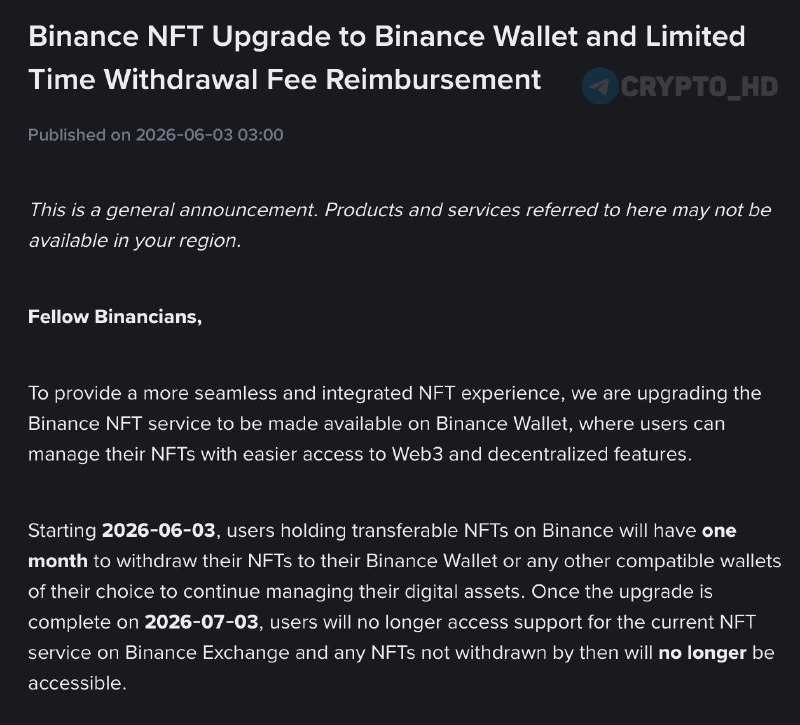
The message was blunt: transfer your NFTs to a compatible crypto wallet before July 3 or lose access to them. After the deadline, anything left on the platform becomes inaccessible. This is not just a dusty product tab disappearing from the menu. Binance’s NFT marketplace had real reach, even if spot trading and derivatives trading were always the main business. For users, the short deadline turns a boring account chore into a hard cutoff. Move the collectibles now. Or leave them behind.
The regulation pressure around Binance is hard to ignore here. Regulators in several markets, especially in the US, have been trying to bring crypto exchanges under tighter legal rules. The SEC has sued Coinbase and Binance itself, accusing them of offering unregistered securities and operating unregistered exchanges. Most guides frame this as an NFT demand story. That’s only half right. In that climate, an NFT marketplace can look like extra baggage: intellectual property disputes, resale rules, and, in some cases, fractional ownership questions. I’ll be honest: if I were sitting with a legal team during an SEC fight, I would not volunteer to keep that surface area open.
So yes, this looks defensive. Binance is giving regulators fewer targets. Is that smart? Probably. Is it good for market confidence? Not really. When a major exchange drops a side business, smaller platforms notice, and crypto niches that already feel legally messy start to look even less worth the trouble.
The move also says something about the adoption signal for crypto. NFTs had their big moment in 2021. That moment feels far away now. A major exchange shutting down its NFT platform does not help the argument that NFTs will bring in the next wave of mainstream crypto users. I know that sounds harsh, but the signal is hard to dress up.
Money has moved elsewhere. Market attention has shifted back toward Bitcoin (BTC) and Ethereum (ETH), especially after the approval of spot Bitcoin ETFs. BTC pushed past $70,000 in March 2024 after ETF inflows picked up, and ETH stayed above $3,500 for stretches of that period. NFTs, meanwhile, have mostly gone quiet. Why does this matter? Because the split is now visible at the product level: BTC and ETH attract serious capital, while speculative NFT corners have to prove they still deserve exchange real estate.
Binance seems to be choosing the cleaner path: put resources behind products with stronger demand, then cut the ones with legal drag. Yes, this contradicts the old exchange playbook of offering everything users might click. Bear with me. In 2024, that sprawl looks less like ambition and more like liability. It works. It also makes the crypto world feel a little smaller.
What this means
Binance’s NFT closure suggests that large centralized exchanges are becoming more selective. The old model was to offer everything: trading, staking, NFTs, launchpads, cards, custody, margin products, and whatever else might pull in users. That version of the exchange business looks less comfortable now.
Exchanges are moving closer to their core products. BTC and ETH will probably keep getting the most attention because they have the deepest liquidity and the clearest institutional demand. Counter to the usual advice, this is not always about innovation slowing down. Sometimes it is just product triage under legal pressure. Traders may not love a narrower product menu, but they will understand the logic: in a tougher regulatory climate, the safest revenue lines get protected first.
For NFTs, this is another bad sign. The market still has communities that care deeply, and some collections will survive because people like the culture. Not because the hype machine magically comes back. Broad relevance has been hard to hold since the 2021 boom, and Binance stepping away makes that harder to ignore. It does not kill the NFT market. It does make the comeback story less convincing.
Watch the other exchanges now. Coinbase, Kraken, and other large platforms may not copy Binance exactly, but their next product changes will matter. Services in regulatory gray areas are the ones to watch: NFT marketplaces, staking-style products, launchpads, custody features tied to unusual assets. Is July 3 just an admin deadline? No. If Binance users hit withdrawal problems before the deadline, regulators and critics will have fresh material.
After that, enforcement is the bigger issue. New SEC actions, court rulings, or guidance from regulators outside the US could push exchanges to cut more products. BTC and ETH price action around those events will give a decent read on market nerves, though not a perfect one. My read: crypto traders love a clean narrative. Regulation rarely gives them one.