
















































Ostium exchange hack on Arbitrum: $18 million loss puts DeFi security back under pressure
Ostium, a decentralized exchange on Arbitrum, was hit by a security breach that drained $18,000,000, according to Blockaid. That is not pocket change. My take: this is exactly the kind of headline that makes traders recheck every “safe-looking” DeFi app they have connected to a wallet. Clean interface, big TVL, familiar chain. None of that proves the plumbing is sound.
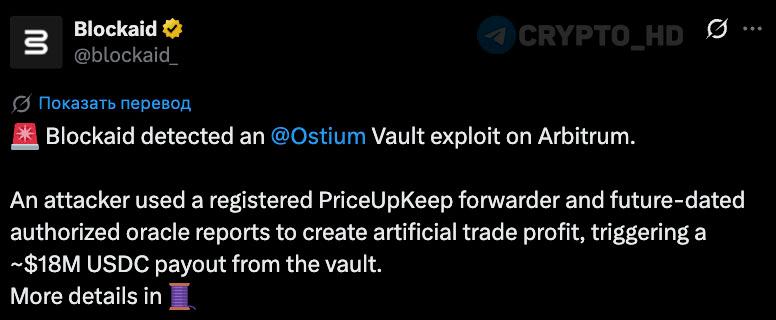
Early reports described a major exploit against Ostium, which runs on Arbitrum. The attack method is still under investigation, so the technical story is not settled yet. The number is clear, though: $18,000,000 gone. That lands differently from a small frontend bug or a temporary pricing glitch. For a DEX, that hurts. For Arbitrum, it is an awkward confidence problem at a time when Layer 2 networks are trying to show they can handle serious capital.
This hack will probably get pulled into the debate over regulation pressure in crypto. The SEC and CFTC have already spent years trying to work out how DeFi should be supervised. Most crypto-native arguments say DeFi risk should be handled by code, audits, and market discipline. That is only half right. A loss this size gives stricter oversight advocates an easy example, the kind that fits neatly into a hearing memo. We saw that after FTX in November 2022, when lawmakers suddenly had a cleaner story to tell about centralized exchange risk. DeFi is messier. If there is no obvious company in charge, who is responsible when users lose money? That question sounds simple until someone tries to answer it in a courtroom or committee hearing. Ostium may now become one more name in that argument, especially for protocols running on Arbitrum and other Layer 2 networks.
Security failures like this can also slow macro flow into crypto, especially into riskier tokens. Why does this matter? Because capital does not always sort risk with precision when fear shows up. Bitcoin often gets treated as the cleaner bet when markets get nervous, while smaller assets usually take the hit first. When $18,000,000 disappears from a DEX, some investors will not bother separating protocol risk from chain risk. They just cut exposure. I get it. One hack does not prove the whole stack is broken, but repeated losses wear people down. The likely reaction is less dramatic than a market wide panic: some money may move out of smaller altcoins and into BTC or ETH. Some may sit in stables for a while. The real damage is trust, and trust takes longer to rebuild than a chart candle.
What this means
The $18,000,000 Ostium hack shows that DeFi protocols, especially newer ones, can still carry serious security risk. Simple as that.
Decentralization does not magically make an exchange safe. That is the uncomfortable part. Counter to the usual advice, “use DeFi instead of centralized venues” is not automatically the safer move. Traders should be more careful with smaller DEXs, unaudited contracts, newer Layer 2 deployments, and any protocol where the security record is still thin. ARB, Arbitrum’s native token, could also come under short term pressure if traders start treating the hack as a wider ecosystem problem instead of an isolated Ostium issue.
Next, watch the regulators. If the SEC or CFTC uses this case in speeches, proposals, or enforcement actions, the market will notice. Arbitrum TVL is worth watching too. Is this overkill for one protocol exploit? No, not when the reported loss is $18,000,000 and the affected app sits inside a major Layer 2 ecosystem. A brief dip would not say much, but a sustained decline would suggest users are pulling back. ARB’s price matters as well, especially around the $1.00 area. If it loses that level on heavy volume, traders may read the hack as another reason to stay defensive.
FAQ: Ostium exchange hack on Arbitrum
What happened to Ostium Exchange?
Ostium Exchange, a decentralized exchange on Arbitrum, suffered a security breach that led to a $18,000,000 loss.
Which network was affected by the Ostium hack?
The hack affected Ostium’s deployment on the Arbitrum network.
How much money was lost in the Ostium hack?
Blockaid reported a loss of $18,000,000.
Who confirmed the Ostium hack?
Blockaid confirmed the hack and the reported loss.
What could this mean for Arbitrum’s ARB token?
ARB could face selling pressure if traders treat the hack as a sign of weaker confidence in Arbitrum’s DeFi ecosystem.
How might this hack affect DeFi regulation?
Regulators such as the SEC and CFTC may point to the Ostium hack when arguing for tighter DeFi oversight.
Does this hack hurt investor confidence in Layer 2 solutions?
It could. The concern is not just Arbitrum, but whether newer protocols on Layer 2 networks have been tested enough before handling large sums.
What should traders do after this hack?
Traders should be more cautious with smaller DEXs, especially ones with limited audits, short track records, or unclear risk controls.
Could this hack affect the broader crypto market?
Yes, though probably through confidence rather than an immediate market shock. Repeated DeFi hacks can push capital toward BTC, ETH, or stablecoins.
Is the attack vector known?
No. Initial reports said the attack vector was still under investigation.