















































Polygon Royalties Hack: $261k USDC Loss Shows DeFi Risk Is Still Very Real
A Royalties smart contract on Polygon was exploited, and the attacker took 261k USDC. Not a record-breaker. Not even close. But losses do not need nine zeros to make people open a wallet app, refresh twice, and wonder what else is sitting on shaky code while the crypto market already feels tense.
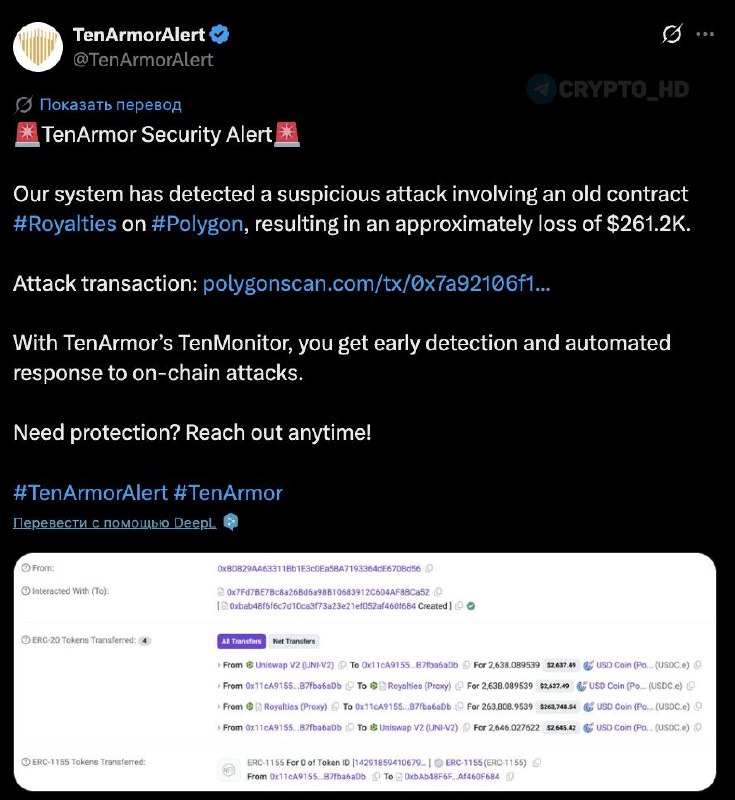
The attacker drained 261k USDC from the Royalties smart contract on Polygon. So, yes, crypto is back to “0 days without hacks,” and that joke has basically expired. My take: 261k USDC only looks small when it is compared with the nine figure exploits DeFi has already survived. If it was your money, it was not small. The sharper point is this: attackers are not only hunting famous protocols with huge TVL. A smaller contract, a lightly watched contract, or a niche project can still be a clean target if the economics work.
The hack gives regulators one more case to cite when they say DeFi needs tighter rules. Most crypto-native commentary frames that as pure overreach. That is only half right. The SEC, CFTC, and other regulators have already been looking closely at DeFi because many projects lack a clear operator or clear disclosures; sometimes there is not even an obvious person to hold responsible when funds vanish. Every hack goes into that file. Earlier this year, Bitcoin struggled near the $61.4K resistance level while SEC lawsuits against major exchanges kept pressure on the market. This Royalties exploit is not an exchange failure. It is not a spot ETF shock either. Still, it adds weight. Regulators can point to incidents like this when they call for stronger audits, compliance checks, security standards, and clearer accountability across DeFi. That might help users. It might also slow down useful projects. Annoying, but true.
There is a money flow problem too. Hacks can send people toward whatever feels safer. Why does this matter? Because user behavior after a hack is rarely neat or rational. When something breaks on a known network like Polygon, newer DeFi users may pull funds from smaller protocols first and ask questions later. Some will move into ETH or BTC. Some will park stablecoins on centralized exchanges. We have seen that pattern before. In late 2022, after several large exploits and insolvencies, money moved out of riskier altcoins and into Bitcoin and Ethereum, with BTC gaining an average of 8% in the weeks after major fear driven events, according to historical market data. A 261k USDC loss will not move the whole market on its own. Repeated hits are different. They wear people down, especially when interest rates and Federal Reserve messaging are already shaping risk appetite in crypto and traditional markets.
What this means
The Polygon Royalties hack shows, again, that smart contracts are still one of DeFi’s soft spots. Polygon itself did not need to fail for users to lose money. The weak point was the contract built on top of it. That distinction matters, even if markets do not always treat it carefully. Counter to the usual lazy read, this is not automatically a “Polygon is broken” story. It is more specific than that, and honestly more useful: application-layer code can create application-layer losses. A local exploit can still make traders nervous about smaller Polygon projects, especially newer ones with limited audits or thin liquidity. I would be careful with small cap tokens in the Polygon ecosystem until the team explains what happened.
Next, watch for a statement or post-mortem from the Royalties project, and possibly from Polygon if the incident draws more attention. The useful details are basic but non-negotiable: what the bug was, how the attacker used it, what funds remain at risk, what gets patched, and whether any recovery path exists. Is this overkill for a 261k USDC exploit? No, not if the same pattern can show up in related contracts. Traders should also watch Polygon TVL over the next few days. If USDC or other stablecoins start leaving DeFi protocols on the network, that will say more than a polished statement. I’ll be honest: TVL leakage is often the cleaner signal. Regulatory headlines matter too, especially from the SEC, because hacks like this are easy material for officials pushing stricter DeFi oversight.
FAQ
- What was the Polygon Royalties hack?
- The Polygon Royalties hack was an exploit of a Royalties smart contract on the Polygon network. The attacker stole 261,000 USDC.
- How much USDC was stolen in the hack?
- The attacker stole 261,000 USDC from the Royalties smart contract on Polygon.
- What does this hack mean for DeFi?
- It shows that smart contract risk is still a serious problem in DeFi. Even smaller contracts can be targeted, and that can hurt user confidence.
- How might this hack affect regulatory pressure on crypto?
- Analysts expect regulators to keep using hacks like this as evidence for tougher DeFi rules, especially around audits, disclosures, and compliance.
- Could this hack lead to a “flight to safety” in crypto?
- Yes. After security incidents, some investors move money out of smaller protocols and into BTC, ETH, stablecoins, or centralized exchanges.
- What should investors do after hacks like this?
- Investors should read official updates, check whether related protocols have exposure, and watch liquidity, TVL, and market sentiment.
- Is Polygon’s underlying blockchain technology at fault?
- No. The exploit appears to have happened in the Royalties smart contract, not in Polygon’s core blockchain.
- Will this hack impact the price of MATIC?
- It may not affect MATIC directly, but incidents like this can hurt sentiment around the Polygon ecosystem, especially if traders start avoiding smaller projects on the network.
- What is a “smart contract exploit”?
- A smart contract exploit happens when an attacker uses a bug or design flaw in contract code to move funds or trigger behavior the project did not intend.
- How can DeFi projects prevent similar hacks?
- Projects can reduce the risk with serious audits, bug bounties, formal verification where it fits, and live monitoring after launch. None of that is magic, but skipping it is asking for trouble.