
















































Base Outage Resolved: A Stress Test for L2 Stability
Base stopped producing new blocks for more than 2 hours. That is hard to wave away. I’ll be honest: this is exactly the kind of failure people mentally file under “unlikely” until it actually happens. The network is running again, yes. Still, the pause made one thing plain: Layer 2 chains can go offline even when users have started treating them like invisible plumbing.
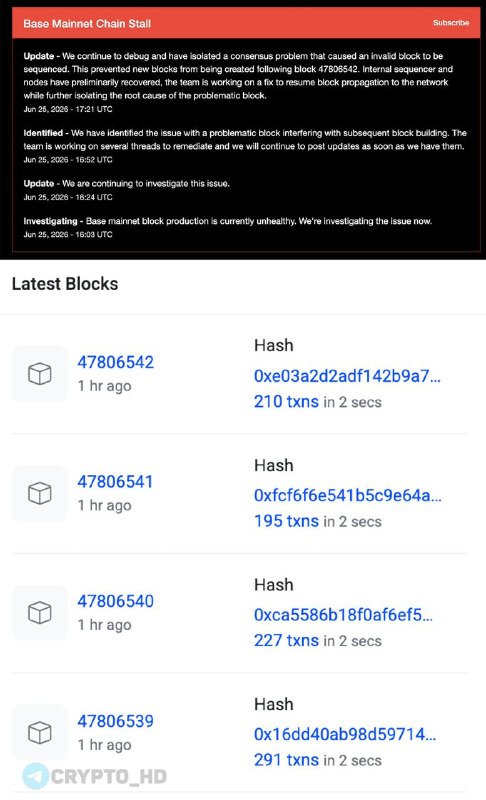
For more than 2 hours, activity on Base was basically stuck. Blocks were not being added, so transactions could not move through the network as usual. Then the issue was fixed and block production resumed. Fine. But 2 hours is a long time if you are trading, managing liquidity, or operating an app that depends on live settlement. Why does this matter? Because crypto loves talking about uptime in abstract terms, then suddenly everybody remembers uptime is a product feature.
When a chain goes down, traders often retreat to names they trust more. Usually that means ETH or BTC, although neither is some magic bunker. In February 2023, Solana had a multi-hour outage, and ETH gained about 3% over the next 48 hours as some traders looked for safer ground. Most outage takes stop there: users panic, capital rotates, bigger assets win. That is only half right. Sometimes the move is less dramatic: exit the smaller ecosystem, sit in ETH around $3,800 or BTC around $70,000, and wait until the failure has a name.
The harder question is whether institutions can live with this kind of interruption. For a casual user, a 2-hour outage is annoying. For a company building payments, stablecoin flows, or tokenized asset infrastructure on Base, it becomes something colder: an operational risk that has to be priced, documented, and explained to someone outside the crypto team. My take: one outage does not kill the L2 thesis. It does make the sales pitch messier. BlackRock’s IBIT ETF holding more than $20 billion in BTC shows that institutional interest in crypto is real. The infrastructure still has to earn that level of trust.
What this means
Base recovered, but traders should treat L2 risk a bit less casually now. Backing helps. Branding helps. Developer activity helps too, but none of it guarantees uptime. Counter to the usual advice, this is not just a “wait for the post-mortem” situation. Anyone holding Base-native assets now has a fresh reason to ask how much of that position depends on one network staying healthy. Other L2s may get dragged into the same conversation, especially newer ones that have not been stress-tested as harshly as Ethereum mainnet.
The next thing to watch is the Base team’s explanation. A clear post-mortem matters. Is that overkill after a single outage? For a 2-hour interruption on a major L2, no. Traders should watch whether liquidity leaves Base-native protocols or rotates toward Arbitrum, Optimism, or Ethereum itself. If ETH holds near the $3,750 support area, the market may be treating this as a Base-specific problem rather than a wider L2 scare. We have seen this pattern before in crypto: technical failure first, narrative sorting second. Institutional comments matter too, especially before the June 12 FOMC meeting, since rates and risk appetite affect how much patience investors have for technical failures.
FAQ: Base Network Outage
- What happened to the Base network?
- Base stopped producing new blocks for more than 2 hours, which effectively paused transactions on the network.
- How long did the Base network outage last?
- The outage lasted more than 2 hours before the network returned to normal operation.
- What caused the Base network outage?
- This report does not give the exact technical cause. It says block production stopped because of an operational failure.
- How does this outage affect investor confidence in Layer 2 solutions?
- It gives investors another reason to account for uptime risk. Even established Layer 2 networks can fail for hours.
- Did the outage affect other cryptocurrencies?
- Not directly. But outages can push some capital toward larger assets such as ETH or BTC while traders wait for the affected network to stabilize.
- What does this outage mean for institutional adoption?
- Institutions need predictable infrastructure. A 2-hour disruption can be a serious problem for firms considering stablecoins, tokenized assets, or other blockchain products.
- What should traders monitor after this event?
- Traders should watch the Base team’s post-mortem, capital flows from Base-native protocols, and ETH’s reaction around the $3,750 support level.
- Is Base the only network to experience outages?
- No. Other chains, including Solana, have had multi-hour outages before.
- What ETH and BTC prices does the article mention?
- The article mentions ETH at around $3,800 and BTC at around $70,000.
- When is the next FOMC meeting?
- The next FOMC meeting is scheduled for June 12.