
















































Moscow Exchange Crypto Index Launch May 13 Signals Russia’s Pivot Toward Regulated Digital Assets
Moscow Exchange (MOEX) flips the switch on May 13. Four altcoin indices go live — Solana, Ripple, TRON, and BNB Chain — and Russia gets its first regulated crypto reference points. The announcement on MOEX’s site is short. The implications aren’t. The exchange will start calculating and publishing indices for these four assets, and it specifically said the indices may serve as a base for future products. Translation: this isn’t decoration. Traders who’ve been watching the MOEX cryptocurrency listing story now have a date on the calendar. For SOL, XRP, TRX, and BNB holders, this is the loudest institutional whisper Russia has made about altcoins since 2022, when sanctions blew up the old shape of its capital markets.
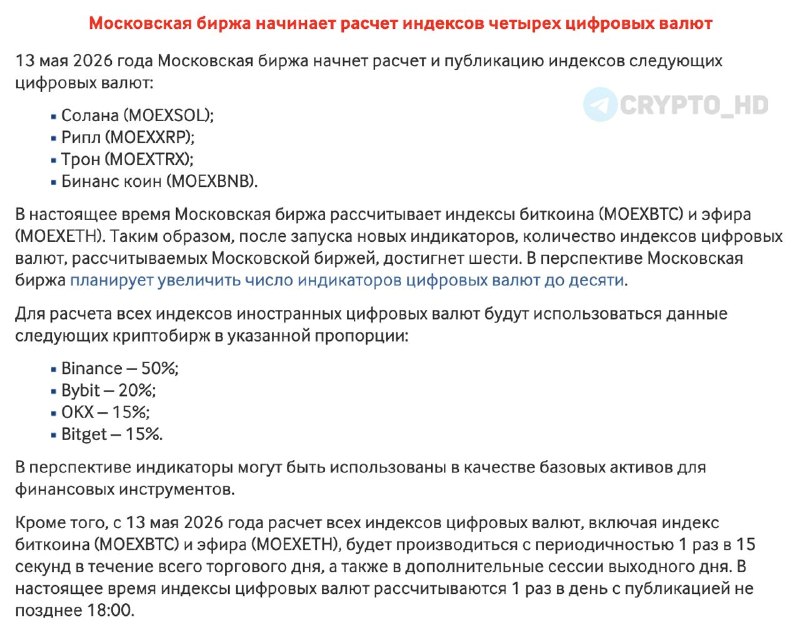
Here’s the detail that actually matters: the index refreshes every 15 seconds. That’s 5,760 times faster than the daily benchmarks Russia uses for existing digital currency reference rates. Think of it like the difference between a weather report and a radar feed — one tells you what happened yesterday, the other lets you fly through it. MOEX will pull pricing from the largest crypto exchanges and stream those numbers in near-real time. You don’t build infrastructure that fast for retail curiosity. You build it for derivatives, structured notes, and ETF-style wrappers. Exchanges don’t run a 15-second clock unless somebody plans to trade against it.
Look at the tickers Moscow picked. Solana and BNB Chain run two of the busiest smart-contract ecosystems outside Ethereum. XRP carries cross-border settlement weight, which is hardly trivial for a country shut out of SWIFT corridors. TRON moves enormous USDT volume — fitting for a state that has openly floated crypto rails for international trade. Bitcoin and Ethereum aren’t on the list, which probably means MOEX either has separate plans for the majors or already references them somewhere else. The four they did pick skew toward utility and settlement, not store-of-value. It’s the closest thing to a public statement Russian institutions have made about which corners of crypto they actually want exposure to.
This matters beyond Russia. Most non-US jurisdictions watching how to fold altcoins into regulated index products tend to imitate what major exchanges do first — it’s the same way airlines copy each other on baggage policy. Hong Kong listed spot ETH ETFs in April 2024 (per the SFC). Brazil’s B3 has run Bitcoin and Ethereum ETFs since 2021. Now MOEX adds SOL, XRP, TRX, and BNB to the conversation, even if the first product is just an index. Each ticker that earns a slot on a recognized national benchmark gains a tiny piece of legitimacy elsewhere. XRP especially — still cleaning up after its US legal mess — picks up a small but real validation point.
Worth noticing what isn’t in the announcement: a tradable product. No derivative, no ETF, no note. MOEX called future instruments a possibility, not a commitment. Russian regulators have crawled on crypto for years, and the gap between “index published” and “you can buy something tied to it” has historically been measured in seasons, not weeks. Hong Kong took roughly two years between policy signals and live spot ETFs. That said — and here’s the thing — you don’t spend on 15-second update infrastructure if the launch is theoretical. That’s like wiring a house with fiber and then claiming you might never go online.
The macro context is hard to ignore. Russia has been one of the louder jurisdictions pushing crypto for cross-border trade and reserve diversification, partly because sanctions left it short of options. A regulated index covering SOL, XRP, TRX, and BNB gives domestic institutions a sanctioned reference point — the kind of thing pension funds, insurers, and treasury desks need before they can touch any asset class. This is how regulated adoption actually moves: index first, custody second, tradable product third. May 13 is step one. Step two is the harder one.
For traders, the immediate question is whether Russian flow alone shifts the price. Honestly? Probably not in the short term. Russian crypto volume is sizeable but fragmented across OTC desks and offshore venues, and a published index doesn’t mechanically create new bids. The signal value runs deeper than the order book. What it tells global allocators is that another G20 exchange now treats these four altcoins as benchmark-worthy — a tier that, until pretty recently, only BTC and ETH had access to.
What this means
I’d file May 13 under “soft validation event,” not “price catalyst.” Expect modest narrative tailwinds. XRP probably benefits most, since it gains the most from any institutional nod after its US legal saga. BNB picks up a quieter win as it works through its own regulatory rehabilitation following the 2023 settlements. SOL and TRX gain less directly but ride the broader read — altcoin institutionalization is no longer a US-and-Hong-Kong story. Watch how the four trade against ETH in the days right after May 13. Outperformance there would suggest the market is actually pricing in an MOEX adoption premium and not just shrugging.
The bigger watch item is whatever MOEX announces next. That 15-second update cadence is hard to read as anything other than a derivative product in the pipeline. Track Russian regulatory filings and MOEX investor communications through Q3 2026 for any mention of futures, options, or structured notes tied to these indices. If a tradable instrument lands — especially an ETF-style wrapper that Russian retail or institutional clients can actually access — the May 13 indices flip from signal to actual demand. Until then, this is confirmation of a trend, not a buy trigger. Chart levels to watch haven’t changed: SOL holding above its prior consolidation range, XRP’s reaction to any fresh regulatory news in parallel jurisdictions, BNB’s behavior around exchange-token sentiment, and TRX’s USDT throughput as the fundamental floor underneath the price.