
















































Glassnode Altcoin Season Signal Hits 86: Is Bitcoin Weakness Fueling the Next Rally?
Glassnode analysts say their “Altcoin Cycle Signal” has reached 86, a level that has often come before altcoins outperform Bitcoin. The setup is odd, though. I’ll be honest: this does not look like the opening scene of some wild altcoin mania. It looks more like a market where sellers spent almost two years unloading coins, Bitcoin has started to drag, and altcoins finally have just enough room to breathe.
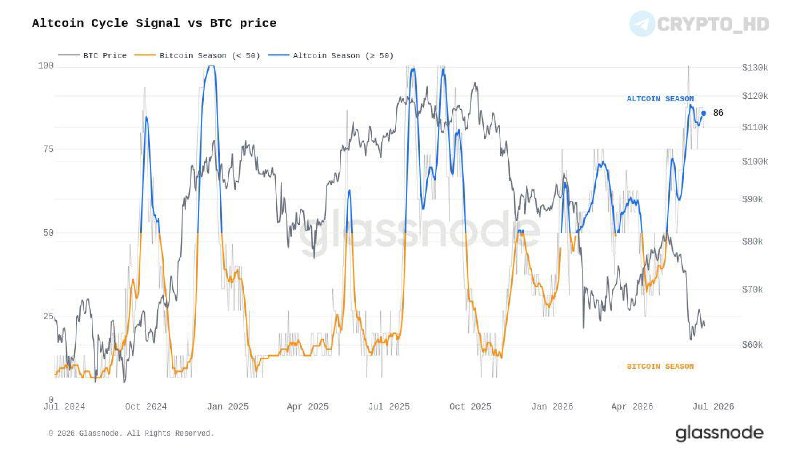
A reading of 86 has often lined up with stretches where altcoins gain against Bitcoin. Glassnode is not saying buyers are suddenly storming back in. That would be a cleaner story. Maybe too clean. The signal is more about seller exhaustion after nearly two years of pressure. There may simply be fewer holders left who still want to dump. Why does that matter? Because when supply gets thin, even modest buying can move prices faster than people expect. Add Bitcoin’s recent dips, and the trade starts to look less random. Altcoins may not be rising because fresh money is pouring in. They may be moving because selling has cooled off and BTC is giving traders an excuse to look elsewhere.
Bitcoin weakness can push traders into higher-beta altcoins, as long as the wider market stays intact. BTC is still the main reference point in crypto. When it weakens, money does not always leave the market. Sometimes it rotates. My take: traders do not need a perfect bull case here; they only need Bitcoin to look tired while a few altcoin charts stop breaking down. If they think Bitcoin’s pullback is temporary, altcoins that can rebound harder become more attractive. That trade gets easier after long drawdowns, when prices are beaten up and positioning is light. Fed policy and rates still matter, of course. Risk assets usually have a harder time when liquidity tightens. Counter to the usual macro-first read, though, this signal feels more tied to crypto’s own market structure than to one big rates headline. Bitcoin looks tired. Altcoins look less crowded. That can be enough.
The safe-haven case for Bitcoin also looks weaker in the short term. Bitcoin is often pitched as digital gold, a hedge during market stress or geopolitical shocks. Maybe that works in some windows. Right now, BTC’s underperformance makes the label harder to defend. Most Bitcoin guides say weakness is just noise if the long-term thesis is intact. That’s only half right. If Bitcoin is “prosedaya,” or sinking, as the Glassnode reading implies, investors may stop treating it as the obvious defensive crypto trade for a while. They may look instead at altcoins that held support or stopped bleeding. Some may chase the ones already showing relative strength. One comparison is January 2020, after the Soleimani strike, when BTC gained about 8% within 72 hours. If a similar shock happened now and Bitcoin barely reacted, traders might go hunting for upside somewhere else in crypto. I would not call that confidence. It feels more like impatience with BTC.
What this means
Glassnode’s altcoin signal at 86 suggests altcoins could beat Bitcoin in the near term. The reason matters. This is not a clean call for a broad, vertical altcoin bull market. It is a setup where some altcoins may outperform BTC because sellers are running out, not because demand has suddenly exploded. Small difference. Big consequence. The best moves may come from coins that already survived long downturns and now have less supply hitting the market. Traders should watch names that held up during the selloff. Also watch coins that reclaimed old support or stopped making fresh lows. Those are usually the first places money tests when rotation begins.
Bitcoin’s next move still matters. If BTC keeps slipping, especially near levels like $60,000, the altcoin rotation could get more fuel. I would watch altcoin pairs against BTC, not just dollar charts. A coin can look fine in USD terms while still losing badly to Bitcoin, and that is not real outperformance. Is this overkill? No, not when the whole signal is about relative strength versus BTC. Technical levels matter, but on-chain behavior matters too. Yes, this slightly contradicts the rotation idea above; bear with me. Rotation can start on weak supply, but it usually needs accumulation to last. Without that, this may be a relief bounce after a rough two-year bleed. The next few weeks should make the answer clearer, especially around macro data, rate expectations, and global liquidity.
FAQ
Q: What is the Glassnode Altcoin Cycle Signal?
A: It is a Glassnode metric that tracks when altcoins are more likely to outperform Bitcoin. The current reading is 86, a level that has often appeared before strong altcoin performance versus BTC.
Q: What does an Altcoin Cycle Signal of 86 mean?
A: It means the signal is leaning toward a possible altcoin season, with altcoins more likely to gain against Bitcoin in the near term.
Q: Is this altcoin season driven by strong demand?
A: Not according to Glassnode. This setup appears to come mostly from exhausted selling pressure after nearly two years of altcoin weakness, not from a rush of fresh organic demand.
Q: How does Bitcoin’s weakness feed into this?
A: When Bitcoin underperforms, traders may rotate into higher-beta altcoins, especially if they think BTC is correcting rather than breaking down completely. We see this logic show up most clearly in altcoin/BTC pairs, not in the cleaner-looking USD charts.
Q: What should traders watch now?
A: Watch Bitcoin’s price action and altcoin/BTC pairs first. Then check key support levels, upcoming catalysts, and on-chain signs of accumulation. If buyers start showing up there, the move has a better chance of lasting.