















































Amazon AI Agents Crypto Payments Push Could Reshape Stablecoin Demand Curve
Amazon AI agents crypto payments infrastructure is a system that lets autonomous AI software pay for goods, services, and APIs in stablecoins without a human clicking approve. It launched in 2025 through Amazon Bedrock AgentCore, with Coinbase and Stripe as partners. AWS confirmed the tie-up. Bedrock AgentCore now lets autonomous software pay for things in stablecoins without a human pressing buy. My take: this is the cleanest enterprise signal crypto has had in years. Stablecoin rails are moving from crypto-native dashboards into machine-to-machine commerce. And Circle and Coinbase already split fee revenue on every USDC dollar that moves.
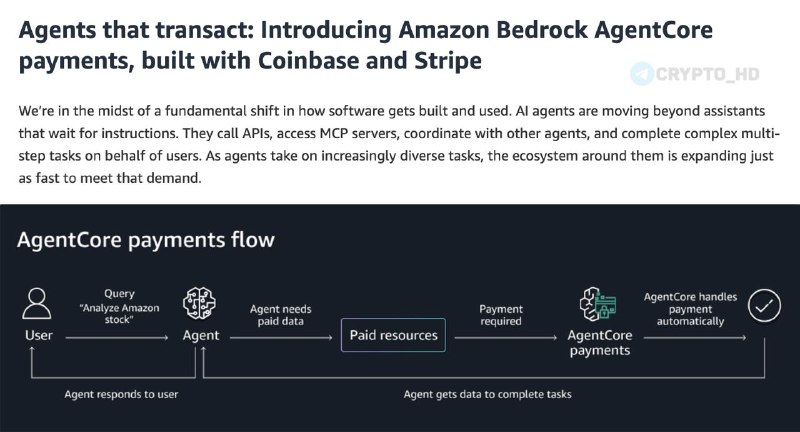
The mechanics are not vague. They shipped. AgentCore payments let AI agents send micropayments mid-task, settle API and data charges on their own, buy access to MCP servers and other agents, and later book hotels or shop on a user’s behalf. Why does this matter? Because AWS leadership said the quiet part out loud: “in the future, there will be more AI agents making payments than humans.” That is not a marketing line you walk back. That is a roadmap.
The partner stack tells you which rails won. Coinbase handles on-chain settlement and USDC distribution. Stripe handles the merchant pipe and fiat off-ramp. Amazon supplies the agents, Bedrock, and the developer base. Put those pieces together and you get the thing crypto has been pitching since 2018 but rarely delivered inside normal enterprise work: programmable money embedded in an actual workload, backed by enterprise SLAs.
This is not a pilot tucked inside an innovation lab. AgentCore is a Bedrock product. That means it ships with the same paperwork AWS uses to sell to banks and the Pentagon. Stablecoins just got a procurement-friendly wrapper. That part matters.
The first crypto angle is enterprise adoption, and it is heavier than it looks. Most “big tech embraces crypto” headlines leaned on speculation. This one is different. It ships infrastructure. If even a small slice of AWS workloads start settling micro-charges in USDC, agent-to-API payments alone could create a demand source that does not care whether BTC is green that morning. Add agent-to-agent and agent-to-content flows, and the float story gets more interesting. Coinbase (COIN) benefits from custody and conversion. Circle benefits from float. Stripe takes the merchant cut. I’ll be honest: the crypto-native winners here are not the loud coins. They are the boring fee-capture names.
The second angle is regulatory pressure, and it cuts both ways. Counter to the usual advice, this is not just a “regulatory clarity will help adoption” story. AgentCore makes stablecoin payments a default infrastructure feature inside the largest enterprise cloud on Earth, which forces every regulator still slow-walking stablecoin frameworks to react to something already in market. The SEC on issuer disclosures. The CFTC on settlement. The OCC on bank custody. You cannot deprecate something Amazon already shipped to its customers. Expect the U.S. stablecoin bill conversation to get louder fast. Also expect Tether’s market share to face pressure from a strange place: not a rival coin pitch, but a default integration choice in the AWS console.
There is a quieter macro angle worth flagging: agentic commerce settled in stablecoins is, mechanically, dollar demand. Every AI agent paying a $0.002 fee for a data call is buying a sliver of USDC, which according to Circle’s reserve disclosures is collateralized primarily by short-dated U.S. Treasuries. Scale that across millions of agents running 24/7 and you get a small but real bid for T-bills routed through crypto rails. I keep coming back to this part. It does not move price on day one. It absolutely changes the conversation about why stablecoins exist.
Amazon’s framing, more agent payments than human ones, also rewrites the demand model for blockchains. If agents become the dominant payer, the winning chain needs sub-cent fees and sub-second finality. It also needs a clean stablecoin issuer story. Solana, Base, and Ethereum L2s all have a pitch here. So does Coinbase’s own L2 stack, which is not a coincidence given who signed the partnership. Is this overkill for crypto payments? For a single checkout button, yes. For autonomous software paying all day, no.
Worth noting: Amazon’s move arrives in a context. According to public reporting, Anchorage and Google Cloud already paired up on institutional custody and AI infrastructure. The Solana Foundation has been pushing agent-payment primitives. There is even a documented case of an AI agent registering its own company. Those were useful signals, but they were still single-vendor experiments. AgentCore is the first time the agent, the cloud, the exchange, and the payment processor all sit inside one shipped product. That is the difference between a thesis and a release note.
The immediate market reaction will land hardest on the names with direct exposure. COIN gets a clean revenue narrative tied to AWS volume. Circle’s IPO pitch just got a footnote it did not need to write itself. Solana ecosystem tokens linked to agent infrastructure will probably catch the speculative bid first, even before any volume actually flows. BTC and ETH get the slower structural read: agentic commerce is one more reason the asset class is not going away. We have seen this pattern before in crypto. The narrative trades first. Usage has to catch up later.
The risk side is real, and it has two distinct vectors. AgentCore puts a lot of trust in autonomous software handling money. The first publicized incident, a rogue agent draining a wallet, or a prompt injection that authorizes a payment it should not, will get amplified by every regulator who wanted a reason to slow this down. The crypto industry has lived through enough exploit cycles to know how that headline reads. Builders who assume “Amazon shipped it, so it is safe” will learn the hard way that agent security is its own discipline. There is something unsettling about agents churning away at 3am while nobody is watching the wallet.
The other live risk is concentration. Yes, this contradicts the “crypto rails are opening up” framing a bit. Bear with me. If AgentCore becomes the default rail, Coinbase and Stripe end up sitting at a chokepoint that looks a lot like the one Visa and Mastercard occupy in card payments. The original crypto pitch was disintermediation. The shipped version is enterprise integration with two intermediaries. That tension does not break the trade, but it should temper the “decentralization wins” narrative that will inevitably show up in the comment sections.
What this means
Stablecoins just became enterprise infrastructure, and the agentic commerce thesis stopped being a deck slide. Strip the noise and the signal is simple. COIN has the cleanest equities exposure. USDC has the cleanest float exposure. Solana, Base, and Ethereum L2s compete for settlement traffic. BTC does not move directly on this. But the underlying message is hard to ignore: crypto rails are being built into the workloads that run the modern internet. My take: that is exactly the kind of slow adoption signal bull cycles eventually rerate. ETH gets a structural tailwind every time another L2 lands an enterprise integration, and AgentCore is going to push more than one of them to fight for it.
Watch the concrete signals over the next few weeks. First, AWS re:Invent and any AgentCore-specific session breakdowns. That is where the technical scope, supported chains, and pricing model get pinned down, and the chain list will move tokens. Second, USDC supply prints from Circle: a sustained uptick in float without a parallel BTC rally would be the first quantitative fingerprint of agent-driven stablecoin demand. Third, any U.S. stablecoin legislation movement. AgentCore’s launch gives bill sponsors political cover and gives opponents a deadline. The crypto trade here is not a single ticker. It is the realization that ai agent crypto payment infrastructure is no longer hypothetical, and the market has not finished pricing that in.